
| TL;DR: Poorly designed utility equipment inspection forms can let crews submit records with missing information. Those gaps can delay repair decisions and require repeat site visits. Fulcrum helps inspection managers use AI to build forms with required fields and questions that adapt to reported findings. Crews can complete forms offline and sync records later. Managers retain control over inspection requirements, while AI reduces the effort of building them into forms. |
An inspector finds a cracked insulator on a utility pole and logs a quick note, but no photo. At the office, the note can’t show how serious the crack is, so someone drives out again. The inspector followed the form, which had no rule requiring a photo for reported damage.
Rules like that, where one answer determines what the form asks for next, have to be built into the form. Setting them up often requires technical help.
With an AI form builder for field inspections, you describe the inspection in plain words, rules included, and AI builds the form. The real test is whether it gets those rules right.
Fulcrum, a field operations platform built for utilities and inspection firms, launched its version in September. It works with a company’s own AI assistant, and its forms run offline.
Some inspections still rely on paper because digitizing them meant waiting for a developer. An inspection manager can now use AI to build those forms. But here’s the catch: creating the form is only half the job. The record still needs to reach the office with all the necessary details.
Why the Form is Only the Starting Point
An inspection record rarely stops with the person who fills it in. Maintenance planners use the findings to schedule repairs, and the mapping team uses the location to update the asset map. When a record arrives with gaps, someone has to chase the missing details or type them in again.
ServicePower tackles the same problem later in the field workflow, checking technicians’ photos before they leave so problems can be investigated while they are still onsite.
Chasing missing information takes time across an organization, not just in the field. In a 2025 Quickbase survey of 2,187 professionals, 59% said they spent at least 11 hours a week chasing critical project information.
The problem is bigger at utilities, where data rarely lives in one place. Primera Engineers describes it as spread across several systems, from asset records to maps, with collection methods that vary. The engineering firm also points to a detail that matters when designing inspection forms: timing. Information gets harder to capture once equipment is buried or up on a pole. If a crew misses it on the first visit, someone may have to drive out again, just as in the cracked-insulator example.
That’s why getting the right question into the form matters while the crew is still standing in front of the equipment. A custom inspection form builder needs to account for how the work actually happens in the field, including the exceptions a standard form might miss.
AI Form Creation is Becoming a Competitive Feature
Fulcrum isn’t the only vendor turning plain-language descriptions into field forms. Two weeks before Fulcrum’s launch, Quickbase released FastField’s AI Form Builder. It builds forms from descriptions, voice input, PDFs, and photos of paper forms.
Both tools give buyers new ways to create mobile inspection forms, but their approaches differ. Edsby shows the same issue in school workflows, where the value of a digital form depends on how well its responses connect to the records and approval steps around it.
Quickbase focuses on the different inputs users can provide, from voice instructions to existing documents. Fulcrum, meanwhile, builds on its existing field operations platform, where the form will also collect and store inspection records. So, the practical questions matter more than the build itself.
Can the form require a photo when a crew finds damage? Can the crew still use it with no signal? Ultimately, those details are where an AI inspection form builder earns its place.
How Fulcrum Approaches Form Creation
Fulcrum designed its form builder to work with a company’s own AI assistant. Its MCP connector gives the assistant access to a Fulcrum account, while the AI Toolkit guides it through building forms with the platform’s capabilities.
From there, an inspection manager describes the inspection in plain words or shares an existing document. The assistant then builds the form, along with rules that change what it asks based on each answer.
These rules are known as conditional logic. For instance, in inspection forms with conditional logic, a pole in good shape might need only a condition rating. However, if the crew reports a crack, the form can require a photo and short description before submission.
Fulcrum geotags the photo automatically, and crews can pair high-accuracy GPS receivers for a more precise location. Maintenance planners can review the photo and location before deciding whether another site visit is necessary.
The AI can draft those rules, but only from what it’s told. Someone who knows the work has to decide which entries must be required and where fixed options should replace typed answers. RSVPify puts a similar boundary around AI-built event workflows, letting AI handle setup while organizers still review what ultimately reaches guests.
Fulcrum CEO Jim Grady made a similar point in a November 2025 interview, months before this launch. He said:
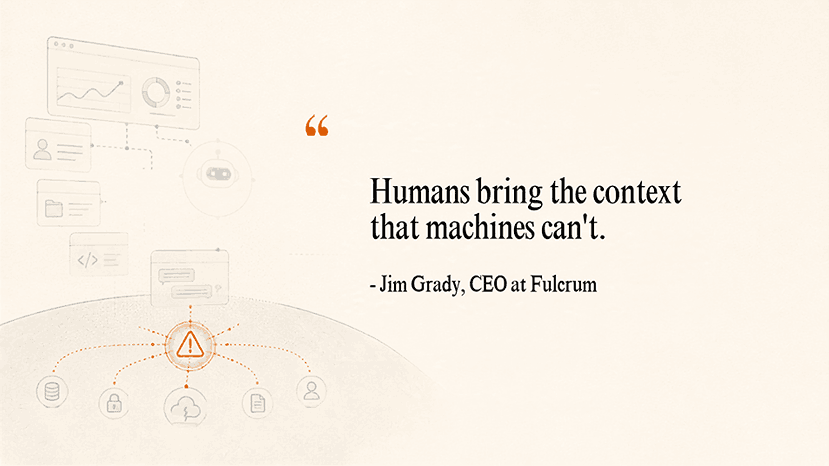
This is where human judgment still comes in. The AI can draft the form, but the inspection manager still needs to check whether it reflects the actual work.
What Offline Support Actually Means
A form that works fine at a desk is little use on a remote stretch of power line with no signal. For buyers looking for an offline inspection form builder, what the platform already handles matters as much as how the AI creates the form. In Fulcrum’s case, forms built with AI capture data offline and sync once a connection returns, just like any other form built in Fulcrum.
At launch, Fulcrum’s chief product officer, Mike Lambert, emphasized that the underlying platform handles mapping data and offline synchronization, regardless of whether a person or an AI agent builds the form. Permissions and audit trails carry over too, giving organizations the same administrative controls over AI-built forms.
One distinction worth keeping in mind, though. Crews can fill in forms offline, but building or changing a form happens through the AI assistant, which needs a connection.
From Inspection Record to Follow-up
An inspection record only pays off once the people who schedule repairs can act on it. With the connector and Toolkit in place, Fulcrum says an assistant can also generate report templates and set up webhooks. These webhooks notify another system when something changes in Fulcrum, such as a new inspection record arriving. Once configured, these tools can turn an inspection record into a formatted report or trigger the next step in the workflow.
Fulcrum’s platform is designed to work alongside asset management and work order systems, taking job details in and sending completed inspection records back. That also makes it an AI workflow builder for field operations, connecting inspection records with the systems that handle follow-up work. Once Esri’s ArcGIS is connected, records can sync both ways, so an inspected pole’s details update the asset map.
The finished reports also need to include the information required by existing maintenance and asset management processes.
Early Access to the Builder Comes with a Few Conditions
Fulcrum’s MCP connector and AI Toolkit are available by request through Fulcrum Labs, the company’s early-release program. The connector requires an Elite or Enterprise plan, and Fulcrum labels both tools as Alpha releases, meaning they’re still being tested
Before signing up, buyers should check the configuration requirements for the one they plan to use. Using the AI assistant comes with usage charges from its provider, in addition to the Fulcrum subscription.
The best trial run starts with an inspection crews already carry out, using its questions, exceptions, evidence requirements, and report as the benchmark. It should run on the tablets or phones in the field, including a stretch offline before the record syncs.
The Measure is the Record, Not the Form
AI form generation is now offered by more than one vendor. How fast a tool builds a form tells buyers only part of the story.
Fulcrum’s advantage is what happens after the form is built. Its existing platform handles offline fieldwork and connects inspection records to the systems that use them. At the end of the day, an AI-built inspection form earns its keep by capturing the evidence and exceptions a crew would otherwise miss.