| TL;DR: Broadcasters have spent years building backups around live video. But what happens when more of the work needed to keep that feed moving shifts into the network itself? We spoke with NetActuate’s Brandon Wick about what the company is building underneath the stream. |
When something goes wrong during a live broadcast, it has to be fixed while the event is still happening.
Broadcasters already use backup systems to keep a video feed running. But they do not always control the network carrying it. If the problem is on infrastructure run by another provider, they may have to report it and wait for that provider to respond.
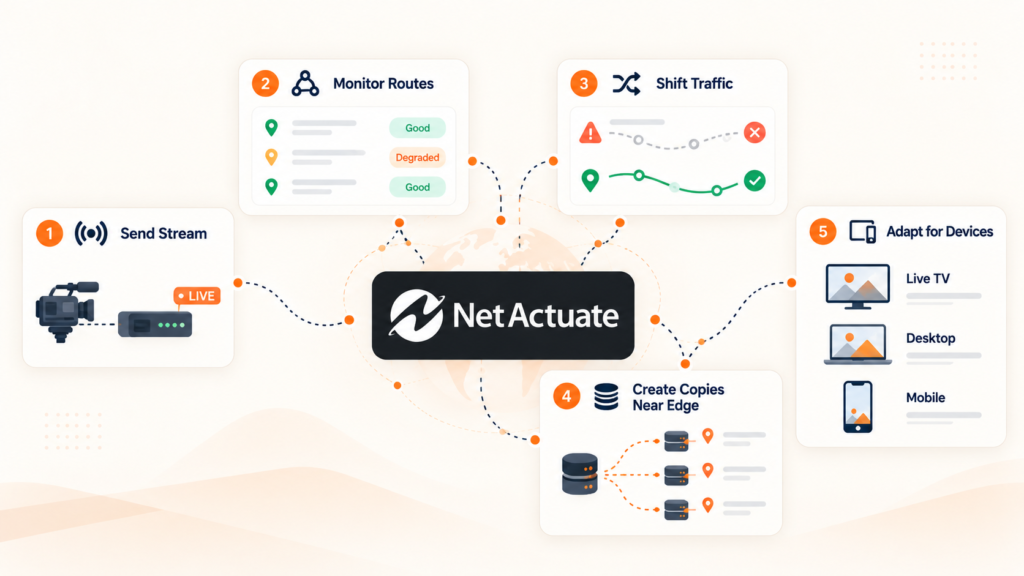
NetActuate’s Media Substrate changes who controls that part of the journey. NetActuate operates the backbone underneath Media Substrate and says it can detect problems on individual routes and move traffic elsewhere automatically.
But what else could that infrastructure take care of?
We spoke with NetActuate’s Brandon Wick about what happens when more of the work between sending a live feed and getting it to viewers moves into the network itself. His answers point to a setup where broadcasters can keep the tools and protocols they already use, while more of what happens between the two ends of the stream is handled underneath.
A Backup Route Is Only Useful If You Can Move to It
Having another route available is one part of keeping a live feed running. Knowing when to use it is another.
NetActuate says its Media Substrate measures the routes carrying a stream across its network. Because the company operates that network itself, Wick says it can move traffic when one route starts having problems rather than waiting for another network provider to act.
“If you rent capacity, a problem in the middle of a broadcast usually means a ticket with someone else’s network and a wait,” Wick told SaaStake.
But changing routes does not have to happen only when something fails.
Wick says NetActuate can choose a route based on what matters for a particular feed. A broadcaster could, for example, give a premium live event the best available route while sending a backup feed over the least expensive one.
That gives the network another job. It is no longer only carrying the feed or providing another route when something fails. Different feeds can be routed according to different priorities while they are running.
And NetActuate wants to apply that same idea to more than routing.
A New Protocol Does Not Have to Mean a New Workflow
One place that becomes clearer is Media over QUIC, or MoQ.
MoQ is still being developed by the IETF. Put simply, it allows data to be published and then passed through relays to the people or systems that need it. That makes it useful for live video that needs to reach many destinations with low delay.
NetActuate is not alone in exploring it. Cloudflare, for example, already lets customers create isolated MoQ relays and control who can publish or subscribe to them.
The more interesting part of NetActuate’s approach is where MoQ could sit.
Its Media Substrate already supports protocols broadcasters may be using today, including SRT, RIST, RTMP and WebRTC. Wick says the company does not expect those existing workflows to disappear just because MoQ becomes available.
Instead, NetActuate is working toward using MoQ to carry the stream through the middle of its network. At the other end, the stream could be handed off in whatever format the receiving device needs.
That means a broadcaster could continue using the equipment and protocol it already trusts without every part of the journey having to use the same technology.
The distinction matters because adopting a new way to transport video does not necessarily mean replacing everything around it.
It also creates another question. If the stream can travel differently through the middle, does reaching more viewers still require more copies to travel all the way through it?
The Stream Does Not Have to Multiply Everywhere
Wick was careful about this point.
Reaching more viewers still costs money. Every viewer eventually needs a copy of the video. What can change is where those copies are created.
With MoQ, a stream can be published once and passed between relays. Copies can then be served closer to their destinations rather than every copy travelling across the full backbone.
That is what NetActuate is testing with its managed MoQ Relay service.
Wick told SaaStake that in NetActuate’s own testing, one relay served 60 times the video without increasing backbone traffic. The result is NetActuate’s own test rather than an independent benchmark, but it illustrates the architectural point: audience growth still increases delivery at the edge without necessarily increasing traffic through every part of the network at the same rate.
There is also a cost implication. Wick said customers using Media Substrate are not charged for traffic between NetActuate’s own locations or for the extra data sent when a protocol has to recover lost packets.
“A bad network day shouldn’t raise your bill,” he said.
So far, that moves two jobs further into the infrastructure: deciding how the stream travels and deciding where it gets copied.
The next one is what happens to the video itself.
What If Different Versions Are Created at the End?
A video stream does not reach every viewer in exactly the same form.
Different devices and connections may need different versions of the same video. That process is called transcoding. It can change things such as the video’s resolution or bitrate so it can be delivered appropriately to different viewers.
In many live-streaming setups, those different versions are created earlier in the journey and then sent toward viewers.
NetActuate is exploring whether more of that work can happen later.
The company already has dedicated video processing hardware from NETINT running across its infrastructure. In September, NetActuate said its NETINT VPU service was live in 15 global locations. A VPU, or video processing unit, is hardware built specifically for jobs such as encoding and transcoding video.
Wick’s description connects that hardware with the MoQ work.
Instead of creating several versions of a stream in one location and then carrying all of them across the network, NetActuate wants to carry one stream farther and create the versions needed by different devices closer to where viewers are.
“The network and the VPUs work better together than either does on its own, and that’s where we’re putting our effort,” Wick said.
Seen separately, Media Substrate, MoQ Relay and NetActuate’s VPU infrastructure look like three services. But Wick described them as parts of the same direction.
Routing moves into the network first. Relays change where a stream is copied. Moving video processing closer to viewers could then change where different versions of that stream are created.
The broadcaster does not necessarily have to manage each of those changes at the start of the journey.
The Stream Could Become the Part That Changes Least
There is an important limit to all of this.
MoQ itself is still a work in progress. The IETF’s current MoQ Transport specification remains an active Internet Draft, and other infrastructure companies are building around the protocol too.
NetActuate is also describing where it wants this architecture to go, not saying every part of that end state is already how broadcasters work today.
However, that makes one part of Wick’s answers particularly notable.
For all the changes NetActuate is making underneath the stream, it is trying to leave the broadcaster’s existing workflow relatively untouched.
A broadcaster could still use the encoder and protocol it trusts. What changes is how much has to be decided and managed after the feed leaves one end and before it arrives at the other.
That brings the story back to the failure that started it. Today, when something goes wrong underneath a live feed, someone may still have to determine which provider controls the problem and what happens next. NetActuate is building toward an architecture where more of those decisions happen inside the network before anyone needs to make that call.