| TL;DR: AI has made product discovery faster and more conversational than ever. However, understanding what a shopper wants and actually completing the purchase are two very different problems. When a recommendation has to become a real transaction, someone still has to confirm inventory, route the order, and get the price right. That gap is where Shoppable has been quietly working since 2011, building the infrastructure that turns an AI conversation into a completed purchase. |
AI has made product discovery dramatically more conversational. A shopper can describe what they need, set a budget, add preferences, and get a shortlist without working through pages of filters. However, recommending a product and completing a purchase are two very different problems.
With ChatGPT shopping, a shopper can ask the platform for a skincare routine or birthday gifts. However, there is still confirmation needed that the product is in stock, the price is current, and the right retailer gets the order. After all, a recommendation only becomes commerce when all of that works.
That need is becoming more urgent with every passing day. According to Adobe’s retail analysis, traffic from AI sources to U.S. retail websites rose 393% year over year in Q1 2026. By March, those visitors were converting 42% better than non-AI traffic.
That demand is starting a wider race to figure out what happens between an AI recommendation and the final purchase. Shoppable has spent 15 years building technology for a related problem: helping shoppers buy without first finding their way back to a retailer’s website.
Shopping Is Starting Before the Retailer Website
AI shopping changes the first question a shopper asks. It no longer has to start with “moisturizer” or “running shoes.” Instead, shoppers can describe a situation, a budget, a problem, and ask an assistant to work out the rest.
That behavior is already becoming commercially meaningful. Reuters reported in August that AI-driven shopping referrals are expected to generate $8 billion in sales this year. Ulta told Reuters that shoppers finding its products through Gemini and ChatGPT were showing roughly double the conversion and intent. Numbers like that are hard for retailers to ignore.
Large commerce platforms are responding. Google’s new Universal Cart is rolling out across Search and Gemini, with YouTube and Gmail to follow, allowing shoppers to build one cart across merchants and Google services. Shopify is making merchant products available through ChatGPT, Google AI Mode, Microsoft Copilot, and Meta.
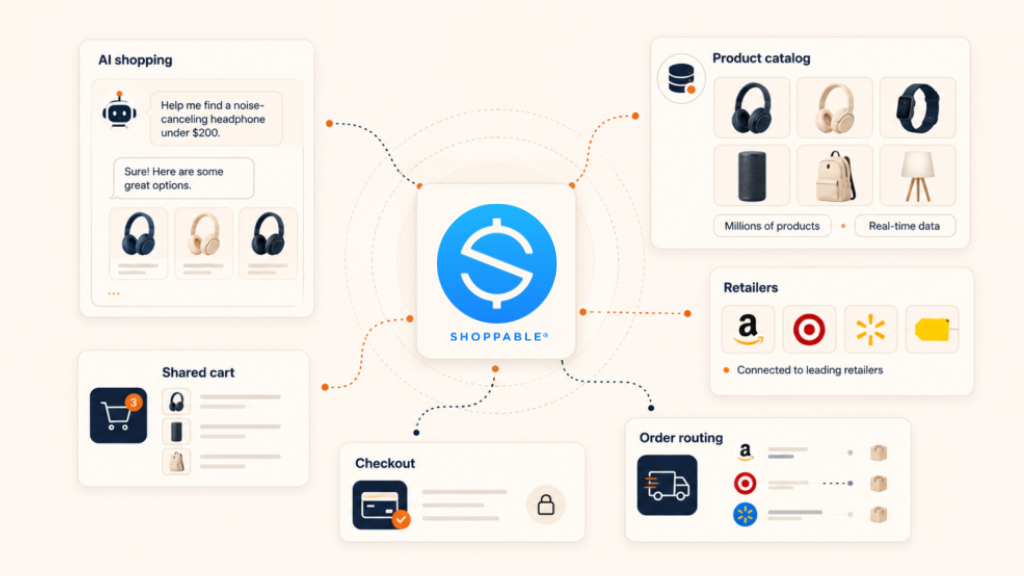
Shoppable is approaching that opportunity from a different angle. You see, instead of creating another destination shoppers have to visit, the company is connecting its catalog of 500 million products and multi-retailer cart to AI conversations where product discovery is already happening.
The retailer website is not disappearing. Not yet, anyway. However, it is no longer guaranteed to be where shopping begins.
Shoppable Was Solving This Problem Before AI
When asked about the idea behind Shoppable, Heather Udo, Founder and CEO of Shoppable, traced it back to a personal frustration as a customer.
She told SaaSTake that she would find products in magazines, reach the credits at the back, then have to track down where to buy them. When publishing moved online, she saw the same friction carry over in digital form.
Retailers were focused on building their own ecommerce destinations. Publishers could create desire but had no easy way to turn that moment into a transaction. And that was the problem.
She said Shoppable’s own consumer research found that almost everyone surveyed could recall abandoning a purchase because finding where to buy the product became too frustrating. She added:
Shoppable built its universal checkout in 2011 and applied the same idea across publisher content, ads, social, and connected TV. Udo was making that argument publicly as far back as 2021, years before AI made it a mainstream conversation.
Shopping in ChatGPT Changed the Front Door, Not the Commerce Underneath
Shoppable’s move into AI happened in two steps.
In May, it launched an MCP server, which gives compatible AI applications a standard way to connect to Shoppable’s product catalog and commerce tools. Two months later, Shoppable’s ChatGPT plugin went live. Shopping in ChatGPT could now help you discover products and build carts spanning multiple retailers inside a conversation, with checkout one click away on a Shoppable page.
Shoppable is not alone in using MCP to bring existing systems into AI workflows. CookieYes recently launched its own MCP server, allowing compatible AI assistants to work with consent-management systems without requiring users to return to a separate interface.
Udo said less had to change than people might expect. According to her:
Shoppable already had retailer connections, product data, checkout technology, and order handling in place. What it needed was a way for AI to search that system when shoppers described what they wanted in conversation, rather than through a conventional product query.
AI can understand what someone wants. However, ultimately, turning that intent into a purchase still requires something real, current, and actually available to buy. And that is, really, why the 500 million-product catalog matters here.
Recommendations Are Flexible. Transactions Are Not.
Udo described the hardest problem in one sentence: “Connecting something probabilistic to something that has to be exact.”
Consider a shopper asking for an oil-free nighttime skincare routine under $150. There could be dozens of reasonable answers to that question. However, at the end of every day, every item that reaches checkout eventually has to resolve to an exact product and variant.
The product has to be correct, the size or variant confirmed, the inventory available, the price current, and the order routed to the right retailer. Every one of those details has to be right, every time.
That is the less glamorous part of AI shopping. And yet, it is also potentially the more important one.
AI models are getting better at understanding what people mean. Still, a recommendation only becomes a purchase when another system can translate that fuzzy request into exact products, live inventory, payments, and fulfillment.
Udo says Shoppable combines its catalog with the context ChatGPT already has to narrow millions of products down to a relevant set, without asking shoppers to sort or filter. In other words, that is the part of the shopping journey Shoppable is trying to position itself around, rather than competing to build the AI assistant above it.
Large content libraries create a similar discovery problem in other software. ABCmouse’s teacher redesign, for example, organizes more than 13,000 learning activities around lessons and learning goals so teachers do not have to search through the library one activity at a time.
Related Read: Payments are another piece of the infrastructure sitting underneath that transaction. Paymath is approaching that layer from the SaaS side, helping software platforms manage and monetize payments already happening inside their products.
AI Shopping May Change What Ends Up in the Basket
The interface could also change what ends up in the basket. And this is where things get interesting.
“People aren’t browsing a catalog anymore; they’re describing a problem,” Udo told SaaSTake.
A problem can produce several products instead of one. Someone asking for a skincare routine, a wedding outfit, or birthday gifts is effectively asking AI to assemble a basket rather than find a single item.
Shoppable says its early AI orders are showing larger basket sizes than its other channels, alongside stronger sell-through for some niche products. She cautioned that the data is still early. She thinks part of the effect comes from shopping in ChatGPT itself: shoppers can keep adding needs without opening another tab or beginning another search.
Shopify reported that AI-referred visitors converted nearly 50% better than organic search visitors in Q1 2026, with 14% higher average order values.
If that holds, AI may change more than where retailers get their traffic. It could, in fact, change how shoppers think about buying in the first place.
Who Owns the Customer When AI Makes the Sale?
Retailers want the demand that AI is sending their way. At the same time, they are less sure about giving up the customer relationship that comes with the sale.
In March, OpenAI acknowledged a limitation in its first version of Instant Checkout: merchants did not have enough control. Its newer approach puts more emphasis on product discovery while giving merchants more freedom over how checkout happens.
Reuters found the same friction playing out more broadly. Retailers want visibility inside AI conversations, but many still want the purchase to happen somewhere they control; that is, where they keep the customer data, the loyalty relationship, and the ability to influence what comes next.
Udo calls Shoppable’s answer a “two-platform strategy.” The retailer’s website remains important for customers who arrive directly. Shoppable is betting retailers will also need a way to sell wherever somebody else creates the demand.
That distinction may become more important as AI shopping grows. The retailer website does not have to disappear for more of the shopping journey to happen somewhere else. After all, search once sent shoppers to websites. AI can now help choose the product, compare alternatives, and assemble the cart before the retailer ever sees the customer.
Shoppable’s 15-year bet is that checkout should be able to follow that intent wherever it forms. AI did not create that idea. However, it may finally be creating the market large enough to test it.