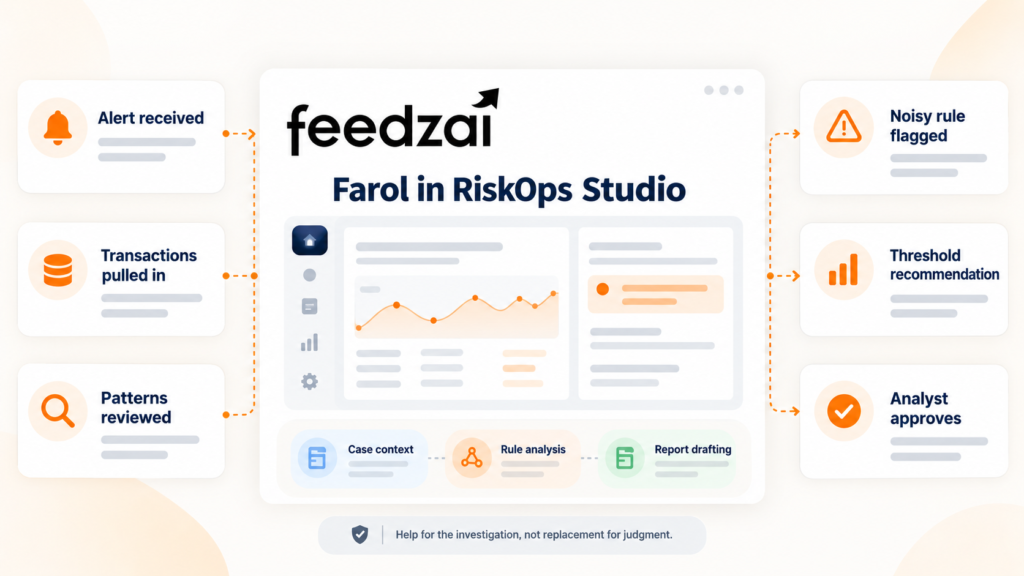
| TL;DR: Flagging a suspicious payment is only the start of a bank’s investigation. Analysts still need to understand what happened and explain their decision. Feedzai’s Farol helps prepare that work inside the software they already use. It gathers case information, reviews detection rules, and drafts suspicious activity reports. Analysts still make the decisions, while the agent helps them spend less time assembling a case and more time assessing it. |
A bank flags a payment as suspicious. Now someone has to figure out what actually happened.
That means pulling together the relevant details and deciding which ones deserve a closer look. Whatever the analyst concludes, they then have to explain it clearly enough for another investigator to follow.
And that takes time. In a busy fraud department, building the case can start eating into the time needed to judge it.
Feedzai is going after that work with Farol, a new AI agent it launched on September 24. Farol sits inside the fraud prevention software analysts already use, so it can help with their cases and the rules that generate the alerts.
That leaves banks with a question: how much preparation can an agent take on, and where does a person still need to make the call?
UK Fraud Losses Fell in 2025, but Cases Kept Climbing
At first glance, the latest UK fraud figures look encouraging.
UK Finance’s Annual Fraud Report 2026 found that unauthorised fraud losses fell 5% in 2025. The number of reported cases, however, rose 11% to 3.81 million.
Scams that trick people into authorising payments also became more costly, with losses up 19% to £576.4 million. In these cases, the genuine customer makes the payment, but a fraudster is behind it. So, investigators need to understand the story around a payment, not just the payment itself.
Reimbursement rules raise the stakes further. For instance, the Payment Systems Regulator reported 88% of money lost through reimbursable scam claims was returned over the 18 months to March 2026. It also found 82% of claims were closed within five business days.
For the bank staff handling those claims, speed is part of the customer’s experience. They have to establish what happened and make a decision while the customer waits for an answer.
Why Feedzai Wants Farol Inside the Bank’s Systems
Farol doesn’t open in a separate app. It works inside RiskOps Studio, the Feedzai platform where analysts already review alerts.
That setup addresses a problem Feedzai’s own research surfaced. It found 68% of financial institutions are testing AI agents, yet the company says many of those projects haven’t delivered efficiency gains. Feedzai puts that down to AI models running outside the bank’s systems, which can’t see its live transaction data.
Farol, by contrast, works directly with the case data inside the bank’s system. According to the launch announcement, it pulls up and summarises alert information so investigators can understand a case faster. Feedzai reports a 20% reduction in alert handling time.
Feedzai says Farol runs within each bank’s own environment, so the case information and the insights it produces stay inside the bank’s systems.
In other words, with Farol handling more of the preparation, investigators can spend less of their day gathering information and make the judgment call sooner.
Finance requests use a similar setup. Datarails Desk connects questions about invoices, payments, or reimbursements to the records behind them, then drafts a reply for an employee to review. Moreover, security teams are using AI for a similar kind of preparation. Teleskope’s Kosmo investigates exposed data and recommends next steps, while leaving the actual change for a person to approve.
The Rules Behind the Alerts Also Need Attention
Working through cases faster addresses one part of the workload. Farol also targets the rules that generate those alerts.
Banks use detection rules to flag activity for attention. When a rule keeps raising alerts that turn out to be harmless, each of those alerts still takes an analyst’s time. That same problem appears in security operations, where Legion Security’s DragonClaw can review false positives and recommend which detection rules may need tuning.
Feedzai says Farol can identify these noisy rules and suggest where thresholds could be tightened. According to the company, reviewing how rules perform becomes a job of minutes rather than days.
The two issues are linked: how quickly analysts review an alert, and whether the alert should have been raised in the first place.
Changing a threshold involves a balance. A bank wants fewer unnecessary reviews while preserving its ability to identify suspicious activity. Farol’s recommendations give the fraud team more information before changing a threshold.
After all, a better rule can reduce the number of unnecessary alerts reaching investigators in the first place.
Banks Want Agents to Prepare, Not to Decide
Feedzai’s leadership has acknowledged that banks are still deciding how much authority to give agents.
Speaking to FinTech Futures at Feedzai’s London Fusion event, chief product officer Pedro Barata said institutions remained reluctant to surrender control entirely. Agents could remove tedious work, but “the last mile is still up to them.”
UK financial firms were already drawing this line in 2024. A Bank of England and FCA survey that year found that 75% of its 118 respondents used AI. Only 2% of those applications involved fully autonomous decision-making. So, wide adoption had not meant handing over the final decision.
Farol’s product guidance follows the same approach. The agent presents recommendations and explains its reasoning. Analysts can verify the results and decide what action to take.
That division of work is appearing in other professional AI systems too. Attain IP is designing its patent AI so professionals can inspect the evidence behind its output before making the consequential decision themselves.
A Report Must Explain Why the Activity Matters
Some investigations end in a suspicious activity report, or SAR, which banks file with regulators when activity looks like possible financial crime.
Feedzai says Farol can draft these reports up to 12 times faster by reducing the effort of gathering and summarising information. Its product page describes drafts ready for investigator review.
The US Financial Crimes Enforcement Network has long published guidance on common reporting errors. It says a narrative must cover the basic facts and explain why the activity is unusual for that customer.
A transaction history shows what happened. An investigator has to explain why those events raise concern. That need to connect an answer back to its evidence also appears in identity and compliance work. For instance, Trulioo’s UBO Discovery Agent reconstructs ownership information across sources while leaving unresolved gaps for an analyst to investigate.
That is where the human review still matters. Farol’s draft leaves the investigator more time to assess whether the evidence supports the explanation.
The Agent’s Work Continues After the Alert
Farol takes Feedzai beyond identifying risk and into the work that follows. Through case preparation and reporting, the company is taking on more of the work fraud teams do after an alert.
That expansion comes as banks face another change. At the London event, Feedzai’s leadership warned that improving AI tools were also strengthening fraudsters’ capabilities. The same tools can help both sides. The technology creating new tools for banks is also changing the way fraudsters operate.
Feedzai’s answer with Farol is to put an agent beside the bank’s case information, where it can help prepare the next decision. It suggests fraud investigation software could play a bigger role after an alert, not just when one is raised.
Ultimately, an alert tells a bank where to look. Farol is designed to help investigators make decisions they can explain.