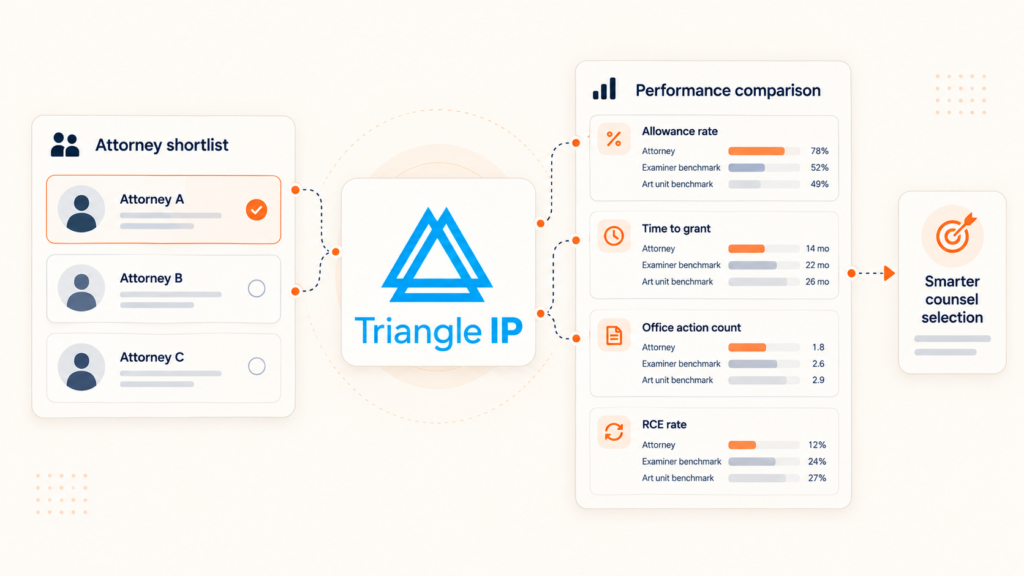
| TL;DR: Referrals and reputation can help enterprises shortlist patent counsel, but they reveal little about an attorney’s prosecution record. A poor choice can mean extra costs, longer waits, and fewer patents granted. Triangle IP’s Prosecutor Analysis Tool lets IP managers examine counsels on their past performances against examiner and art unit benchmarks. It also provides insights into timelines, prosecution rounds, and recent activity. That context helps enterprises compare candidates before hiring and ask better questions about each attorney’s experience and approach to handling patent cases. |
When an enterprise needs patent counsel, the shortlist usually comes from referrals and a firm’s reputation. Every name on it looks capable on paper.
Yet none of that shows how an attorney has performed on past applications. That often becomes clear only after filing, when the examiner pushes back, and each round of argument adds to the bill. A weaker choice can mean fewer applications turning into patents, and switching counsel midway can require time to bring the new attorney up to speed.
Tom Franklin, the founder of Triangle IP, has spent more than 25 years as a patent attorney. His company built the Triangle IP Prosecutor Analysis Tool so IP managers can check an attorney’s record on past cases before hiring.
To see why that check matters, it helps to start with what a wrong choice actually costs.
A Misfit Patent Counsel Can Cost More Than You Think
An attorney may have handled hundreds of patent applications, but how many involved technology similar to yours? If an enterprise hires counsel based on the volume of cases handled without looking at their relevance, it may end up paying that attorney to learn its technology from scratch. And with patent attorneys often charging considerably more than other lawyers, those hours add up quickly.
But the learning curve isn’t Franklin’s biggest concern. It’s what the enterprise gets after paying for it. According to him:
A poorly prepared application can create further trouble during prosecution. Each round of argument with the examiner is billed separately, at around $4,000 per round, and two to four rounds are typical, depending on the technology area.
If prosecution reaches an impasse, a request for continued examination (RCE) can keep the application under examination. That step adds costs on two fronts: the filing fee itself and the additional prosecution work that follows.
Each extra round can also push the grant date further out. In the worst case, an application is abandoned after the invention has already become public, potentially leaving the enterprise without patent protection for an invention it has already disclosed.
With those consequences in mind, your focus should remain on what to avoid to prevent making a poor counsel selection.
Look Beyond the Usual Signals When Choosing Patent Counsel
Avoiding a poor counsel selection doesn’t mean abandoning referrals, reputation, or the usual checks enterprises make before hiring an attorney. It means understanding what those signals can tell you, where they fall short, and what additional evidence can help you make a more informed choice.
A Firm’s Reputation Isn’t Enough. Check the Individual Attorney’s Record.
A trusted referral may lead you to a respected patent law firm, but its attorneys can have very different technology expertise and prosecution records. What matters is the track record of the attorney who will actually handle your applications.
Franklin recalls a company that followed the same patent attorney across three firms over roughly 20 years without ever examining their prosecution results. Familiarity had taken the place of independent evaluation.
“Nobody has statistics down to the individual prosecutor,” he observed.
Triangle IP’s Prosecutor Analysis Tool addresses that gap, letting you examine individual attorneys’ historical performance and the clients they have represented. Referrals can still help build your shortlist, but you now have evidence to look beyond them.
The next question is which performance measures deserve your attention.
Clean Drafts and Confident Claims Aren’t Enough. Examine Prosecution Outcomes.
Reviewing past patent applications or using proofreading tools can help assess an attorney’s drafting quality. Franklin uses such checks himself, but detecting errors is not the same as measuring prosecution success. Nor can an attorney’s own claims establish that success.
He says:
Triangle IP’s Prosecutor Analysis Tool offers independent evidence through historical USPTO records, including allowance rates, time to grant, and office actions, measured against relevant art-unit averages.
For instance, one prosecutor averaged 1.5 years to grant and 0.8 office actions per case, compared with art-unit averages of 2.1 years and 1.1 office actions. These figures reveal not just whether counsel secured patents, but the time and examination effort involved.
Yet even an impressive prosecution statistic can be misleading without the right context.
A High Allowance Rate Isn’t Enough. Compare It Against Some Benchmarks.
An attorney’s allowance rate tells only part of the story. What matters is how that rate compares with the examiners and art units that handled their applications.
Consider an attorney with a 68.8% allowance rate. Triangle IP’s prosecutor analysis shows that the art units handling those cases averaged 86.6%, while the USPTO average was 75%. The gap raises an important question: why were the attorneys’ results so far below the typical allowance rate in those art units?
“It’s relative to your decision maker, and nobody does that today,” Franklin says.
Triangle IP’s Prosecutor Analysis Tool makes these comparisons visible at the individual attorney and firm levels. Franklin’s own record, for instance, shows a 92% allowance rate against 77% for his examiners and 72% for the corresponding art units.
“Part of that’s getting better examiners. Part of it is just doing a better job,” he explains.
The takeaway is simple: don’t judge counsel by a high percentage alone. Check whether their results are above or below the benchmarks of the examiners and art units they have actually worked with.
With that context, the question is no longer who has the most impressive numbers on paper, but whose prosecution record gives you greater confidence in their ability to secure patents for your enterprise.
Choose Counsel Who Can Help You Win
“Really what you want, if you were picking a lawyer, you would pick the lawyer that wins,” Franklin says.
For enterprises investing substantial budgets in patent protection, that is the decision that matters. Choosing counsel should not be about who makes the strongest impression during the hiring process, but who has demonstrated the ability to turn patent applications into granted patents.