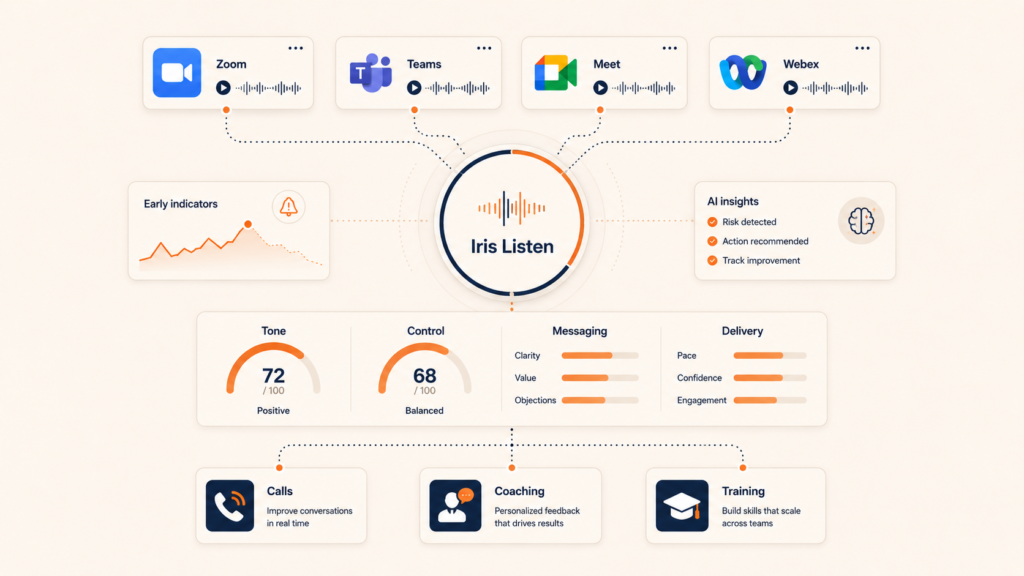
| TL;DR: A new offer sounds clear on the leadership call and vague by the time it reaches a customer, and the numbers only show it a quarter later. That’s why In2ition AI has extended Iris, its AI employee, into Iris Listen, which joins meetings across online web conferencing platforms to score tone, control, messaging, and delivery. Every meeting now feeds the same layer that already holds the company’s calls, coaching, and training. For the first time, a leadership call and the sales conversation that follows it can be compared side by side. |
A decision can make perfect sense in a leadership meeting and sound very different a few conversations later. The systems recording those conversations rarely connect the two. Take a district manager, for instance. They leave a leadership call understanding the new offer, then explain it to their stores in their own words. Three conversations later, it can sound like a totally different offer altogether.
Thankfully, AI meeting assistants make it easy to keep track of what happened in a meeting. However, they were much less useful for seeing what happened to that message after the meeting.
In2ition AI announced Iris Listen in July, with the feature being available for existing customers from August 1. The tool’s AI employee joins meetings across platforms like Zoom, Microsoft Teams, Google Meet and Webex, and scores how the message was delivered. Each meeting then feeds into the same layer that already handles the company’s calls, coaching, and training.
The company ran it across its own meetings and a group of early testers first. However, what they found was one insight that shaped how the product was designed. That pattern is not unique to AI software. Age of Learning also redesigned ABCmouse around behavior it was already seeing from teachers, including using activities with an entire class rather than one child at a time.
The Message Changes on the Way Down
We asked founder and CEO Joseph Lepordo, who ran retail operations for two decades before he built software, what the beta revealed:
Lepordo told SaaSTake:
The change he describes is not only in the wording. Across the beta and the early testers, the emphasis moved as the message traveled, and so did the energy behind it. A message can remain technically accurate while losing the emphasis that made it persuasive.
And that is hard to catch in a report. It never registers as a mistake. Instead, it shows up later as a message that technically arrived and quietly stopped working.
A Team-Wide Drop Says More About the Process Than the People
One falling score may indicate an individual coaching problem. The difficult question comes when scores drop across several people at once.
“Ten people probably didn’t independently forget how to do their jobs,” Lepordo said.
For him, a team-wide drop is a sign that something else may have changed. A process might have shifted, or a new offer may not be landing as intended. Before assuming ten people have the same performance problem, he would look at what changed around them.
The timing matters, too. Revenue, NPS, and turnover usually tell you there is a problem after something has already gone wrong. The conversations behind those numbers happened weeks earlier.
Those conversations can give you an earlier clue about what is going wrong, instead of leaving you to piece it together later. Meeting AI is beginning to move even earlier in that process. Unanimous AI’s (Co)agents participate in live discussions and surface missing information while a group is still making the decision.
Finishing the Training Was Never Proof Anyone Could Use It
Enterprise training software became very good at proving that someone completed a module. However, it remains far less capable of showing whether they could apply it at work. Measuring application required someone to observe the work, so completion became the number reported upward.
Lepordo quipped around it, “Completion isn’t competency. Application is where learning becomes real.
Iris Listen brings the conversations that follow into the same coaching intelligence. In2ition AI built its coaching loop around Lepordo’s view of how people learn: repetition, practice, feedback, and another round of observation.
That changes what a training record is worth to the person reading it. A completion rate tells a regional manager how many people sat through the session. A score on the conversations that followed can show whether they applied it in practice.
The 1:1 Now Runs Through the Same Engine as a Sales Call
If application is what you’re trying to measure, coaching has to be part of that picture too. Distributed teams already hold their one-on-ones over video, which puts those conversations in the same place as everything else Iris hears.
“The coaching conversation itself can get coaching,” Lepordo said.
That is a bigger change than it sounds. Scoring a rep on a sales call is familiar ground. Scoring a manager on how they coached is not, because coaching has usually been treated as something you either have a knack for or you do not.
This is why Lepordo says rollout matters as much as configuration. Companies decide what gets captured, what gets evaluated, who sees the output, and how it is used. In2ition AI starts with curious champions and widens the rollout once those users can demonstrate its value.
Recording Was Never the Hard Part
None of this depends on In2ition AI being first into the room. Plenty of its customers already record their calls, and Fireflies, Otter, Fathom, or Gemini may already be running before Iris arrives.
According to Lepordo:
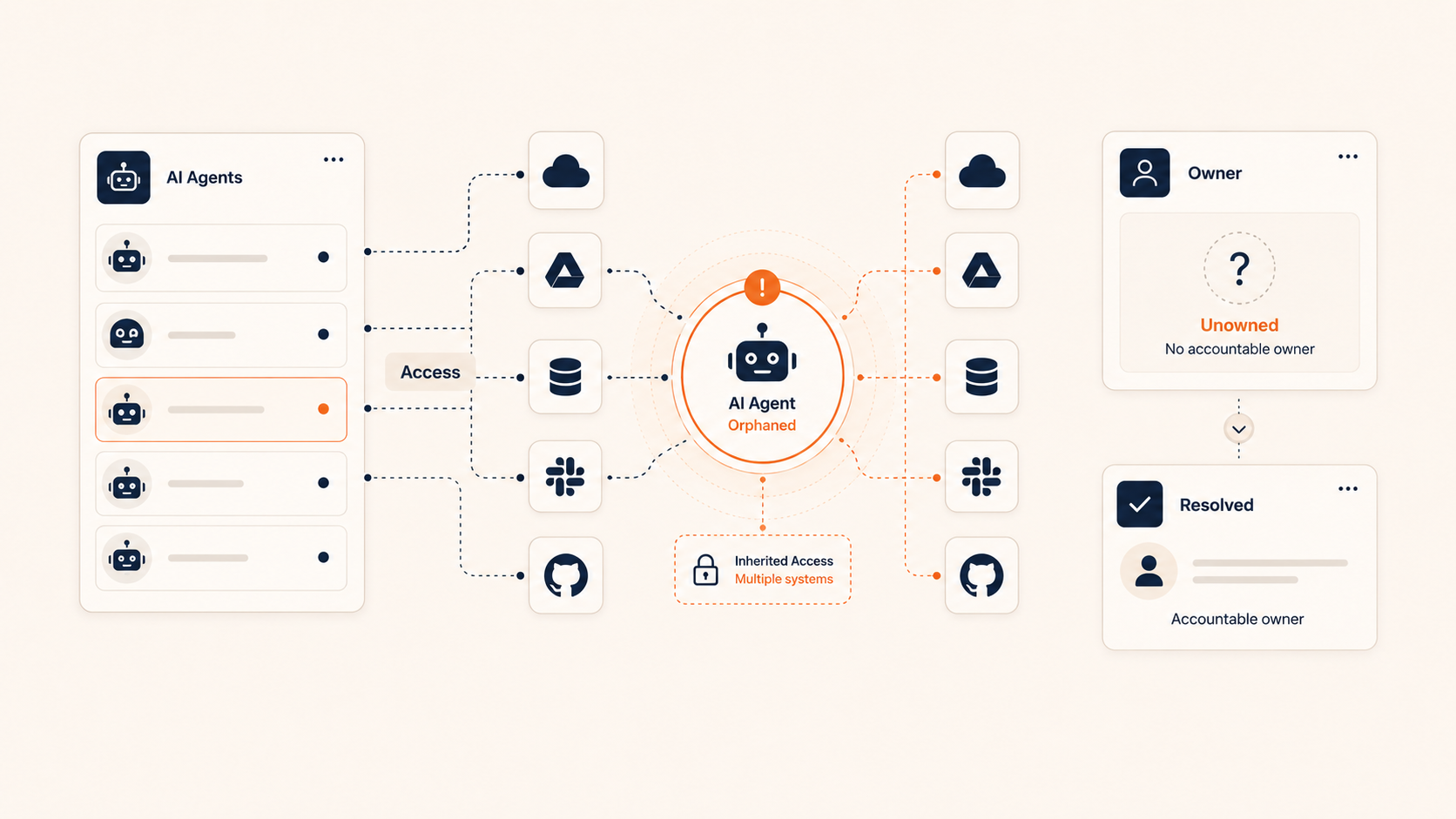
The problem, as Lepordo describes it, is fragmentation rather than a lack of data. Calls sit in one system and meetings in another, while training records, CRM notes, and survey results each sit somewhere else again. A notetaker’s output is usually the meeting record, and that is where the analysis ends.
Banks face a similar fragmentation problem in customer communications. MHC NorthStar brings messages and customer activity from different systems into one communication layer, so one interaction can help shape what the customer receives next.
The bigger shift is that conversation intelligence is moving beyond the sales call. An employee’s performance is shaped across their calendar, including internal reviews, coaching sessions, and cross-functional meetings, not just inside the dialer. Sales AI is moving earlier in the customer conversation too. Respondly can handle the opening exchange with an inbound B2B buyer before a salesperson joins the conversation.
Ask Iris is the next layer the company plans to place over that connected data. Lepordo said leaders will be able to query conversation intelligence in plain language and generate charts and tables on the spot. He calls it BI on the Fly, and sees the bigger opportunity in helping leaders find patterns, rather than simply preparing for another meeting.
What This Changes About Where Companies Look First
Conversation intelligence has spent a decade pointed at the sales call, because that was the conversation with revenue attached to it. Iris Listen takes that same scoring into meetings that were never treated as performance data in the first place.
That shifts what a business is watching. A monthly review looks at what already happened and works backward through it. With conversation scoring, the leadership call, the district manager’s follow-up, and the coaching session that came after can all sit in one place, in the order they happened.
Lepordo’s whole argument rests on that ordering. If a message weakens at a specific handoff, the drop shows up in the conversation before it shows up in revenue or turnover. That is the difference between finding a cause and explaining a result.
That is also where the category appears to be heading. Recording every conversation is now table stakes, and companies building in this space are betting that the next advantage comes from what those conversations can predict, rather than what they simply document.