| TL;DR: AI meeting assistants commonly join workplace calls to create transcripts, summaries, and action lists after people finish speaking. Unanimous AI’s new (Co)agents instead join live discussions and speak up when they detect missing information or overlooked ideas. The agents can search company data, explore the open web, or suggest alternatives. The launch moves this meeting AI tool beyond documenting conversations and into the decisions being made inside them. |
AI notetakers have been sitting in on meetings for a while. It transcribes the call and writes the summary afterward, but it stays silent while people are still deciding.
However, a summary cannot recover information that never entered the conversation. A detail that could change the discussion may go unmentioned because only one participant knows it and does not mention it.
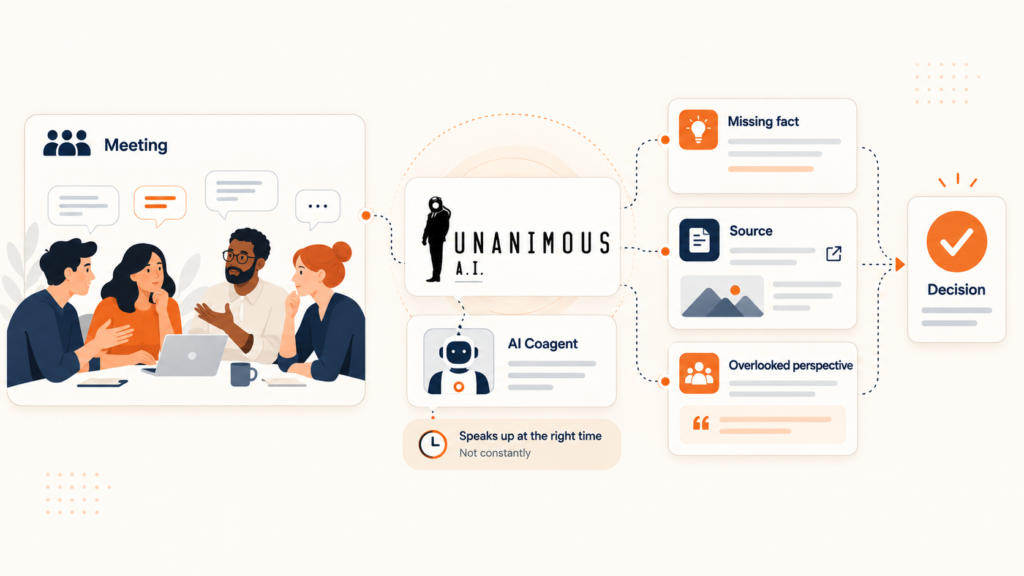
Unanimous AI is betting that the AI in the room should speak up. Its newly launched (Co)agents join live discussions as AI coworkers and step in unprompted when a workplace group appears to be missing something important.
That sounds useful in theory, but it creates a problem most meeting tools have not had to deal with yet. The agent must understand what is missing, decide whether the moment calls for an interruption, and contribute without taking over the discussion. Unanimous AI has started testing whether that can work, and the results offer a closer look at both what an AI coworker can add and where people still matter.
Workplace AI is Moving From Tool to Teammate
Enterprise software companies are now building agentic AI platforms that search business systems and complete work on their own. The idea is simple: instead of asking AI for help when you need it, AI becomes part of the work itself.
Leaders are already planning for it. A survey of 31,000 workers found that 81% of leaders expect agents to be moderately or extensively integrated into their AI strategy. Their timeline is 12 to 18 months.
Workers are less settled on what that relationship should look like. Fifty-two percent see AI mainly as a tool that follows commands, while 46% treat it as a thought partner.
(Co)agents are built around the second view. Louis Rosenberg, Unanimous AI’s CEO and chief scientist, said even diverse teams have knowledge gaps that weaken their decisions. The company designed its agents to close those gaps while the discussion is still underway.
AI is Already Helping Teams Combine What They Know
There is already some evidence that AI can help people bring different kinds of knowledge together. When 791 Procter & Gamble professionals worked on real product problems, teams using AI produced the highest-quality ideas. Ideas ranked in the top 10% were three times more likely to come from AI-supported groups than from individuals working without AI. Those teams also finished their work 13% faster.
The study found another effect that matters for large companies. Technical staff usually pitched technical fixes, while commercial staff focused on the market. With AI, ideas blended both sides more evenly, helping knowledge move between lines that normally divide departments.
However, there is a key difference between asking AI for help and having AI decide when to step in. Studies so far have largely examined AI that people choose to consult. (Co)agents take a further step, since they must recognize on their own that a team could use their help.
Knowing When to Speak is Part of the Technology
Unanimous AI offers three kinds of (Co)agents: Knowledge (Co)agents draw on a company’s own documents and data, while Scouting (Co)agents search the open web for current information. A third type, Brainstorming (Co)agents, suggests alternatives the group has not raised.
Other meeting AI tools are also moving beyond transcription. In2ition AI’s Iris Listen joins workplace meetings to analyze the conversations themselves. (Co)agents go a step further by deciding when the AI should contribute to the discussion.
Each can answer a direct question. They can also step in unprompted, flagging an unsupported claim or a line of thinking that has narrowed too early.
That independence creates a hard design problem. The most heavily messaged employees are already interrupted every two minutes during core hours. In that environment, an agent that talks too much would simply add more noise. So an AI that keeps jumping into the conversation could easily become one more source of noise.
Rosenberg put the challenge this way:
Put simply, the agent has to know when to speak and when to stay quiet. The system tracks what has been said and judges how urgently the group needs a missing fact. It also weighs how recently the agent last spoke.
When the need is strong, the agent searches for information and returns with a short, sourced message. When a fact would only add background, it waits for a better opening. The goal is less “AI search result” and more “colleague who knows when to chime in.”
That restraint held up in a forecasting study run by Unanimous AI researchers and a Carnegie Mellon University collaborator. The agent wrote 18% of the messages in the groups it joined, and people talked as much as they did without it. 82% of participants said it spoke up at the right time, and 88% found its information useful.
(Co)agents Add More When Expertise Already Exists
Speaking at the right moment does not guarantee that the information will improve a decision. The people in the room still need to know enough about the subject to make sense of what the agent gives them.
The forecasting study showed this difference. Small groups of self-described baseball fans were asked to predict the outcomes of 34 Major League Baseball games. Some groups discussed each prediction with a Scouting (Co)agent that searched the web and introduced relevant information, while others worked without one.
When predicting game winners, groups supported by a (Co)agent achieved 76.4% accuracy, compared with 60% for groups without one. Their forecasting error also fell by 18%.
The result changed when participants predicted total runs. Accuracy remained below 50% with or without an agent. The researchers concluded that the baseball fans understood how to evaluate likely winners but had less knowledge about forecasting total scores.
Here, Rosenberg made the distinction pretty clear:
That may be the more interesting takeaway from the study. An engineering group may know how to diagnose a failure but miss a similar incident logged in another system. Financial analysts may each hold part of the evidence about the same market. In both cases, the people involved have the knowledge needed to assess the information once the agent brings it into the conversation.
A (Co)agent does not need to replace subject knowledge. It can simply put relevant evidence in front of people who know what to do with it before the discussion moves on.
The Idea Behind (Co)agents Predates the Generative AI Boom
Rosenberg said Unanimous AI began in 2014 with a question: could workplace groups reach decisions in a more connected way than collecting votes or averaging separate opinions? The company drew inspiration from how bee swarms, bird flocks, and fish schools coordinate as connected systems. That work led to Swarm AI and later shaped Hyperchat AI and (Co)agents.
Hyperchat AI divides large groups into smaller discussions, then uses AI agents to carry ideas between them. The technology powers Thinkscape, where as many as 250 people can participate in the same deliberation. (Co)agents are already available within Thinkscape and are being tested for Microsoft Teams and Slack.
The approach is also attracting interest in high-stakes settings. Unanimous AI recently received a US Air Force contract to bring its agent technology to the Defense Department’s version of Microsoft Teams.
“We see strong adoption because we use AI to connect people rather than replace people,” Rosenberg said. “Our mission is to use AI to keep humans in the loop.”
That principle is reflected in how the product works. Every contribution from a (Co)agent is visible and attributed, allowing the people in the discussion to examine, question, or reject what it provides.
Meeting AI Tools Will Be Judged by the Decisions it Improves
As companies bring agents into everyday work, meeting AI tools may eventually be judged less by how well they capture a conversation and more by what they change while the conversation is happening.
That changes what buyers should ask of these tools. The central question is whether an agent can add a missing fact or overlooked perspective while a group is weighing its options.
Unanimous AI has built (Co)agents around that challenge. Its bet is that the live conversation, rather than the summary afterward, is where meeting AI tools will prove their value.