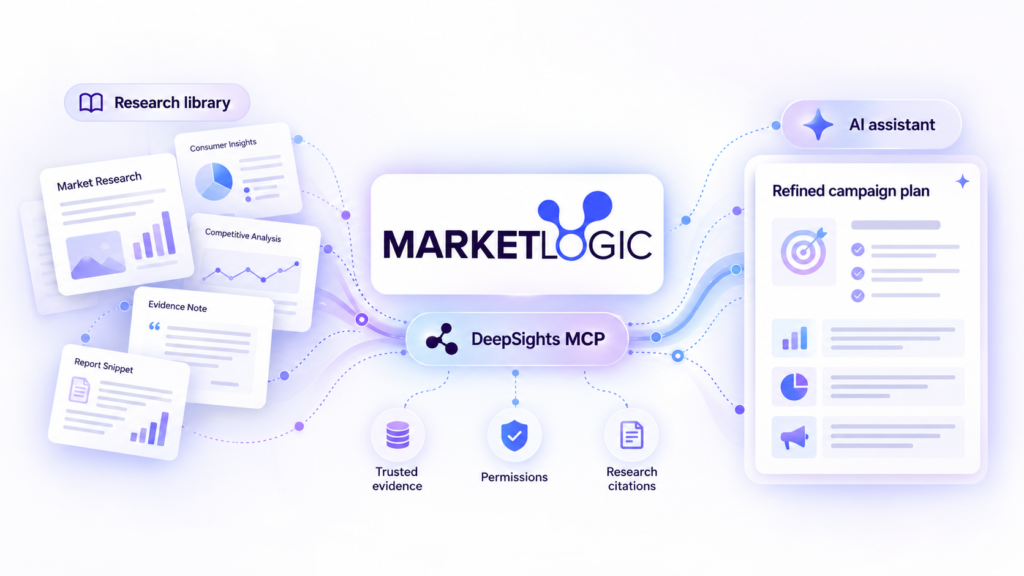
| TL;DR: Employees using AI to build business plans may miss customer research their company has already collected. Market Logic’s DeepSights MCP connects company research to compatible AI assistants, helping employees test their plans against existing findings. It returns evidence that supports or challenges the plan, flags unanswered questions, and provides source references while respecting access permissions. Marketing and product managers can use this information to revise their plans before committing a budget. |
A marketing manager asks an AI assistant to help plan a product launch. It suggests an audience and develops the messaging for the team’s brief.
However, the company may already have research showing the suggested audience is unlikely to buy. It could also show that customers choose the product for a different reason. The assistant may not have access to that research, and the manager may not know it exists. Without that evidence, the team could spend its campaign budget targeting the wrong people with the wrong message.
Market Logic is bringing that research into employees’ AI-assisted planning workflows. On October 7, it made DeepSights MCP generally available to customers, connecting its market intelligence platform to compatible AI assistants.
Employees can then ask their assistant to check a plan against research the company already holds. The question is whether that research can help teams spot weak assumptions and identify gaps before they commit their budgets.
Companies Can Lose Track of Research They Already Own
The challenge isn’t always a lack of research. Sometimes, it’s finding what the company already knows.
The trouble is, a large company may commission studies across brands and countries. Each study answers a specific question, but its insights may also help teams working on other projects. Those teams can only benefit if they know the research exists. As the number of studies grows, finding relevant work becomes harder.
At Mars, consumer research spans businesses from confectionery to pet care. Matthew Blacknell, a Mars insights leader, has described how a relevant presentation from another market could slip past him. DeepSights, he says, helps by “connecting those, we call them insight silos.”
In other words, even experienced researchers can miss useful work when colleagues conduct studies in other markets.
DeepSights customers interviewed by Forrester for Market Logic said research had been scattered across departments and shared drives. Some business units commissioned overlapping studies because they could not find what the company already knew.
And this isn’t just a market research problem. APQC found knowledge workers spent an average of two hours a week recreating work that already existed elsewhere in their organization.
This creates two problems. Companies may pay for the same research twice, while employees make decisions without information their colleagues already have.
Other knowledge-heavy businesses face the same problem with work they have already created. Epona’s approach to legal knowledge management focuses on identifying which past work is useful enough to preserve and reuse, rather than treating everything in the archive equally.
AI Creates Another Place Where Research Needs to Reach People
As employees use AI assistants to plan campaigns and products, those assistants need access to the AI market research behind their decisions.
Microsoft says active agents in its Microsoft 365 ecosystem grew fifteenfold between March 2025 and March 2026. In large enterprises, the growth was eighteenfold.
Market Logic aims to make that research accessible through AI assistants, so employees don’t have to search for it separately.
DeepSights, Market Logic’s AI research platform, analyzes a company’s proprietary research and licensed market information. The connection uses Model Context Protocol (MCP), an open standard that lets AI assistants retrieve information from other applications.
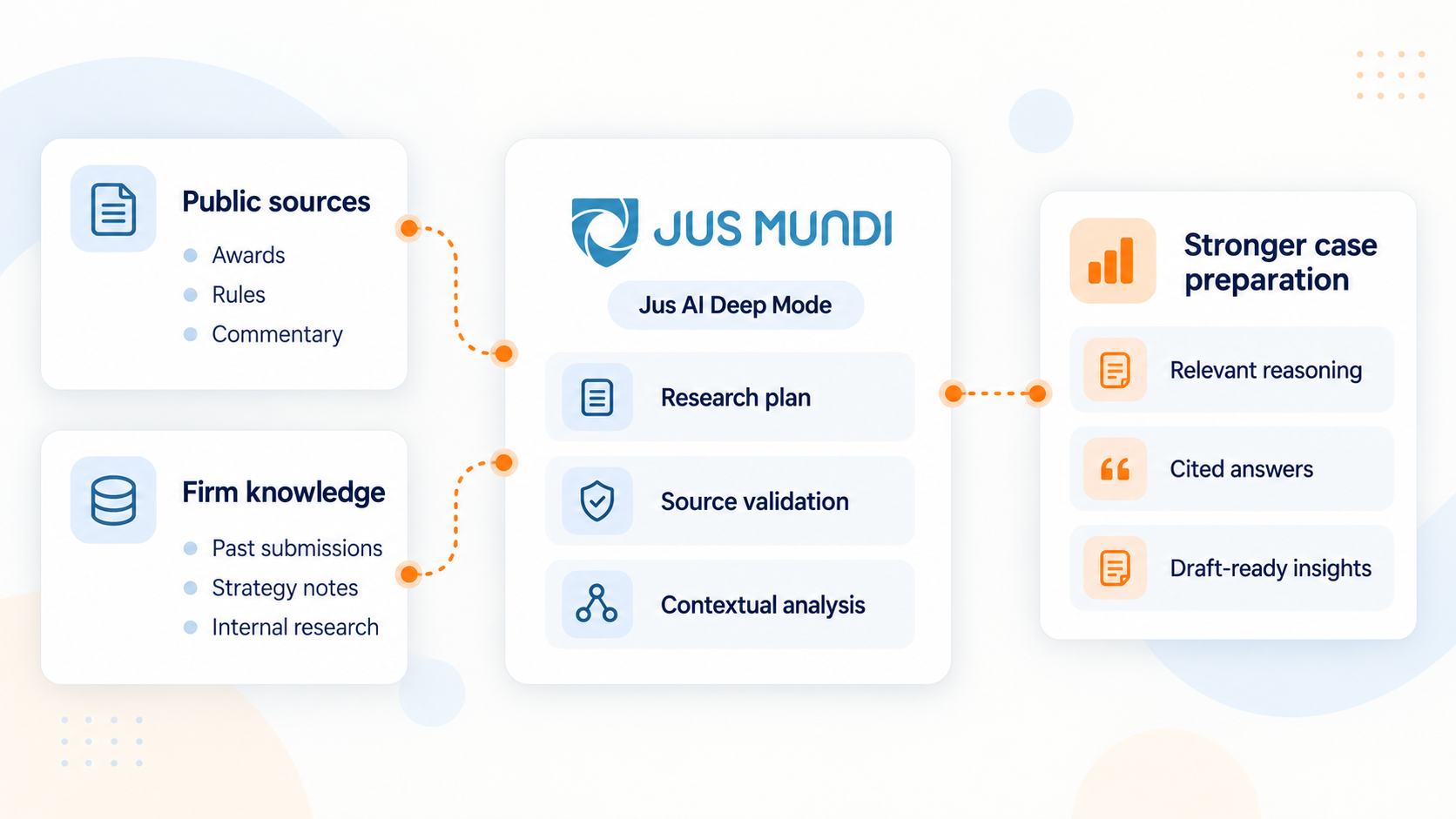
So an employee can keep working in Copilot or ChatGPT while the assistant requests market evidence from DeepSights. Legal research is similarly moving into broader AI tools. Jus Mundi lets lawyers access specialist arbitration research from tools such as Claude while still opening the underlying sources behind the answer.
“Your AI knows your company. DeepSights knows your market,” said Olaf Lenzmann, Market Logic’s chief innovation and product officer.
The point is to bring relevant research into the conversation while employees are still developing a plan, not after they’ve committed to it.
Evidence Can Challenge a Plan Before Money Is Committed
Imagine the marketing manager asking the assistant to check the launch plan against the company’s existing research. DeepSights returns findings that support or contradict the plan, each with references. It also flags questions the research cannot yet answer.
An AI assistant can produce a convincing plan without getting its assumptions right. Research suggests that checking those assumptions matters.
A randomized experiment involving 758 Boston Consulting Group consultants found GPT-4 helped participants work faster and better on tasks it handled well. However, the results changed when the task went beyond the model’s capabilities. On that complex task, AI users were 19 percentage points less likely to reach the correct solution.
Graders also rated the AI users’ recommendations as more persuasive, even when the answer was wrong. Although the experiment used GPT-4 in 2023, it shows a continuing risk: AI can present incorrect conclusions with confidence.
That’s where company research can help. It gives employees a way to verify AI recommendations, with citations linking back to the original sources.
Permissions Travel With the Research
Connecting company research to AI assistants also raises a security question: who can access that information?
DeepSights checks the signed-in user’s permissions on every request. The research itself stays in DeepSights, and the assistant only receives what that user is allowed to see. The same access model is appearing in other MCP connections. LawToolBox lets compatible AI tools reach matter information while the firm’s existing Microsoft 365 permissions and governance continue to apply.
The connector also carries over the sources an insights team has marked as trusted. Putting those controls in place can take months of review. Mars ran an eight-month approval process before its earlier DeepSights rollout, including security and responsible AI reviews.
Market Logic isn’t the only company working on these connections. Glean introduced its MCP Gateway in June to give outside AI tools controlled access to company information.
The broader shift is clear: enterprise software providers are connecting the information stored in their platforms to the AI assistants employees already use.
When Research Changes the Plan
The potential goes beyond answering individual questions. An AI agent could consult company research at one stage of a task before handing the results to another agent.
As companies automate more tasks, they will need to decide which research results require human review. For instance, if the evidence suggests the launch is targeting the wrong audience, the team may need to rethink its campaign.
Ultimately, the benefit comes from acting on what the research reveals. If company research contradicts a launch plan, teams can revise their approach before spending more on the campaign.