| TL;DR: AI promises to save lawyers time, but law firms may have to spend heavily to make that happen. We spoke with Burford Capital’s David Perla to examine what happens when firms invest more in technology while the hours behind traditional legal pricing begin to shrink. |
Law firms have spent years hearing that AI will save them time. Morgan & Morgan, America’s largest personal injury law firm, has now put a price on that promise.
On September 14, the firm committed at least $1 billion over the next decade to technology and AI. That builds on the $300 million it spent on technology and AI over the previous five years.
Saving time, it turns out, can require a lot of money first.
That is the tension we took to David Perla, Vice Chair of Burford Capital, a finance firm focused on the legal market. What happens when the technology designed to reduce lawyer hours also makes law firms more expensive to build?
Saving Lawyer Time Is Becoming a Capital Project
Perla’s answer started with the investment itself.
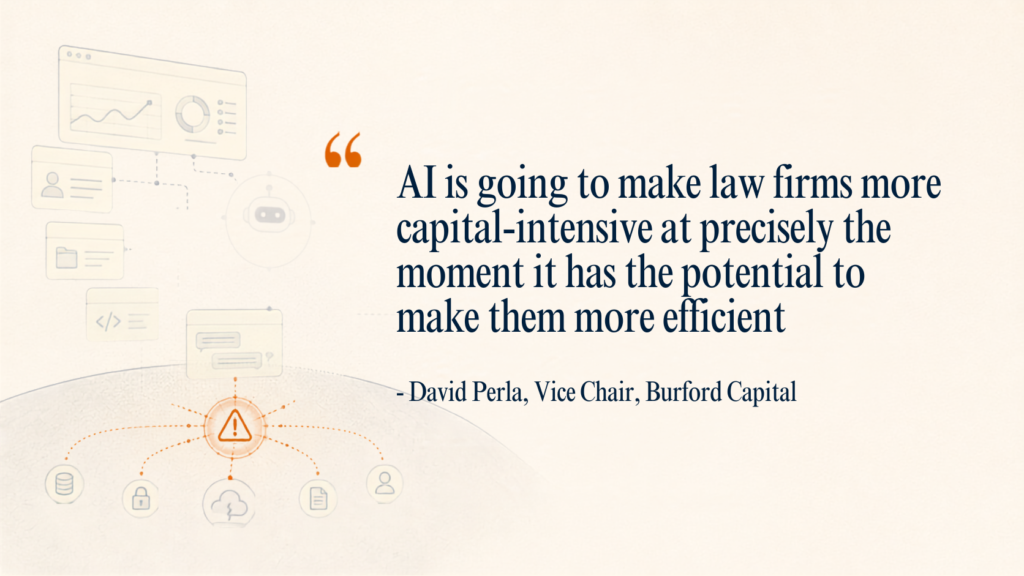
Perla is talking about more than the cost of buying AI software. Firms may also need to invest in the technology, data systems and infrastructure around it.
Latham & Watkins offers a glimpse of what that can look like. The global law firm has bought Nvidia GPU servers to run parts of its AI infrastructure in-house and employs more than 900 technology specialists.
Morgan & Morgan is an unusually large example. Latham is a different kind of firm. But together they make Perla’s point easier to see: for some firms, the AI question is moving beyond which software to buy.
It is becoming a question of what they are willing to build around it.
And that creates another problem. Law firms have not traditionally raised money the way technology companies do.
Law Firms Cannot Raise Money Quite Like Tech Companies
A technology company can sell equity to investors to finance expensive growth. US law firms generally have fewer options because most jurisdictions restrict nonlawyer ownership.
For decades, Perla said, firms have relied heavily on partner capital and cash flow. That works differently when the investment in front of them stretches across technology, infrastructure and years of development.
There are already signs that firms are exploring the edges of the traditional model.
Three months before announcing its $1 billion technology commitment, Morgan & Morgan hired JPMorgan to explore selling a minority stake, potentially raising more than $1 billion. John Morgan told Reuters that the profitable firm did not need outside capital to grow.
There is no evidence connecting that potential transaction to its AI investment. But put the two developments beside each other and a broader question emerges: if technology becomes a long-term investment for law firms, where should the money come from?
Perla expects “much more experimentation with capital.”
One option he points to is a management services organization, or MSO.
The structure sounds more complicated than the basic idea. The lawyers continue to control the law firm, while a separate business can provide services such as technology, finance, recruiting, and data systems. Outside investors may be able to back that services company without owning the law firm.
Major US firms have already explored MSO-style arrangements, although interest has not always turned into deals.
Burford has a commercial interest here. It offers law firms outside capital, including through structures designed to comply with professional ownership rules. Travis Lenkner, then Burford’s chief development officer, described its intended role in MSOs as a passive investor.
That helps explain why Perla looks at AI somewhat differently. For him, the question is not simply what technology costs. It is what kind of investment that cost represents.
Then the Investment Has to Put a Value on the Time It Saves
That way of thinking is already familiar to Burford.
Its legal-finance business helps companies finance commercial litigation and arbitration. Perla’s argument is that a significant commercial claim should not be viewed only as a legal bill that keeps consuming cash.
“The moment you stop viewing litigation exclusively as an expense, the conversation changes,” he told SaaSTake.
The claim itself has not changed. What changes is the financial question being asked about it: how much capital should remain tied up and whether waiting years for the full value still makes sense.
AI raises a different version of that question.
If a firm spends heavily on technology because it expects lawyers to do work faster, eventually it has to ask what those saved hours are worth.
That is where the investment story runs into the billable hour.
What Happens to the Three Hours AI Gives Back?
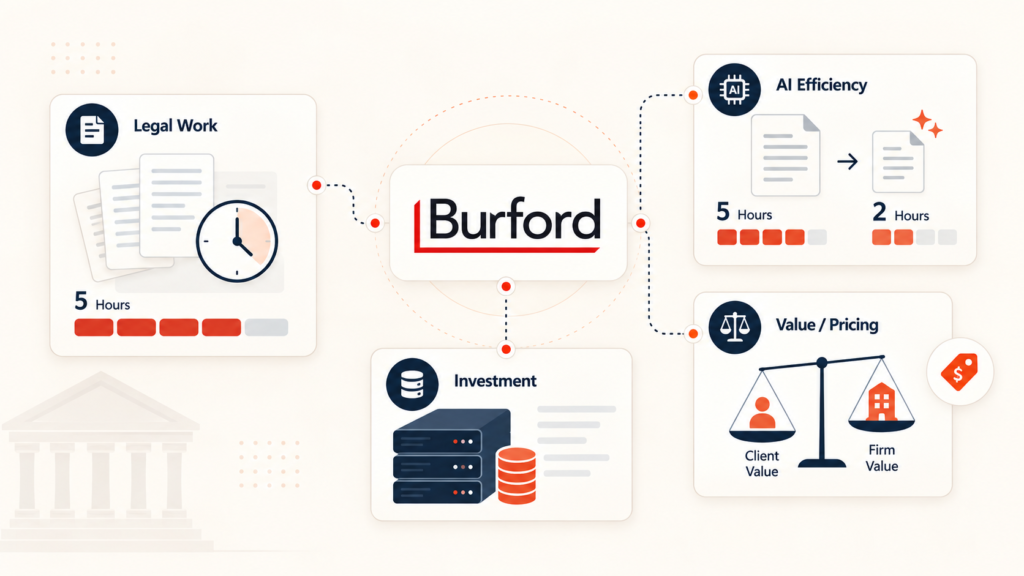
Suppose a lawyer normally spends five hours reviewing documents and preparing an analysis for a client, AI helps the lawyer finish the same work in two.
For the client, those three saved hours are an efficiency gain. For a firm billing by the hour, they are also three hours that can no longer be billed for that task.
The firm does not necessarily lose. The lawyer could handle more matters, or the firm could charge for the value of the work rather than the time it took.
Among in-house legal professionals, 71% expect outside firms to change how they charge as AI use grows. Yet 62% of law-firm professionals said their pricing had not changed in response to AI.
“We are spending an enormous amount of time discussing the impact of AI on lawyers,” Perla told SaaSTake. “I think what AI will do to the economics of law is ultimately more consequential.”
The technology can save the hours. It cannot decide who gets the value of them.
The Client and the Firm Can Both Claim the Same Efficiency
A client can reasonably ask why work that once took five hours should still cost what five hours did.
The firm can point to what it spent on the technology, infrastructure and training that made two-hour work possible.
Perla said firms will have to rethink “how the economic benefits of greater efficiency are shared between firms and clients.”
Not every saved hour has the same financial effect, a distinction we ran into while investigating Caddi’s approach to legal AI automation. An hour cut from internal administration does not affect a firm’s finances in the same way as an hour of work that would otherwise have been billed.
So “AI saved 1,000 hours” tells us something about efficiency, but not necessarily what that efficiency was worth.
Hours also shape how firms measure their own lawyers.
Perla pointed out that associate compensation has traditionally rewarded inputs, chiefly hours billed. A lawyer who gets good at using AI could finish work faster and still look less productive under a system that rewards time.
That tension sits inside an industry where about 90% of legal dollars still flow through standard hourly arrangements.
Hours are imperfect. But they are beautifully easy to count.
If Hours Matter Less, What Do Firms Count Instead?
Perla’s answer is judgment, something technology cannot easily measure. AI can help lawyers find patterns and useful information much faster, particularly when a dispute involves huge amounts of data.
But faster access to information does not automatically produce better decisions.
“More data does not produce better judgment on its own,” Perla told SaaSTake.
Experience still determines which variables matter, which apparent patterns are misleading and what is unusual about a particular dispute. Perla describes AI as a “force multiplier for judgment,” rather than a replacement for it.
That creates an awkward economic problem.
If AI does more of the searching, sorting, and first-pass work, lawyers may spend less time producing some outputs and more of their value on deciding what matters, what is wrong and what should happen next.
Those may be precisely the things that are hardest to reduce to an hourly count.
Saving Time May Be Easier Than Changing What Time Means
Morgan & Morgan’s $1 billion commitment brings the problem back to where it started. AI efficiency can require significant investment before it saves a single hour.
John Morgan has argued that AI presents a greater challenge to practices built around hourly drafting and document review than to trial work. That distinction matters because the more successful AI becomes at reducing time, the harder it may become to treat time as the obvious measure of legal work.
None of this means the billable hour disappears tomorrow. The technology may simply move faster than the economics built around it.
Saving lawyer time may turn out to be the easier problem. Deciding what that time is worth could be the harder one.