| TL;DR: Legal AI can save lawyers time, but proving what that time is worth is harder. We spoke with Caddi to investigate whether a clearer route to measuring its return may be hiding in the operational work law firms rarely count. |
Ask an experienced law firm employee to explain a routine task they have done hundreds of times, and the process may sound surprisingly simple.
Open the email. Download the document. Check it. Rename it. File it.
But ask what happens when only one party has signed, how they distinguish an executed document from a near-final draft, or what they do when something does not fit the usual pattern, and a much more complicated job begins to appear.
The employee did not necessarily leave those details out because they were unimportant. After enough repetitions, some decisions stop feeling like decisions at all.
When we asked Jason Alafgani of Caddi what people tend to leave out when explaining a job they have done for years, his answer was simple: “The exceptions.” Much of the knowledge behind routine work, he says, eventually becomes reflex.
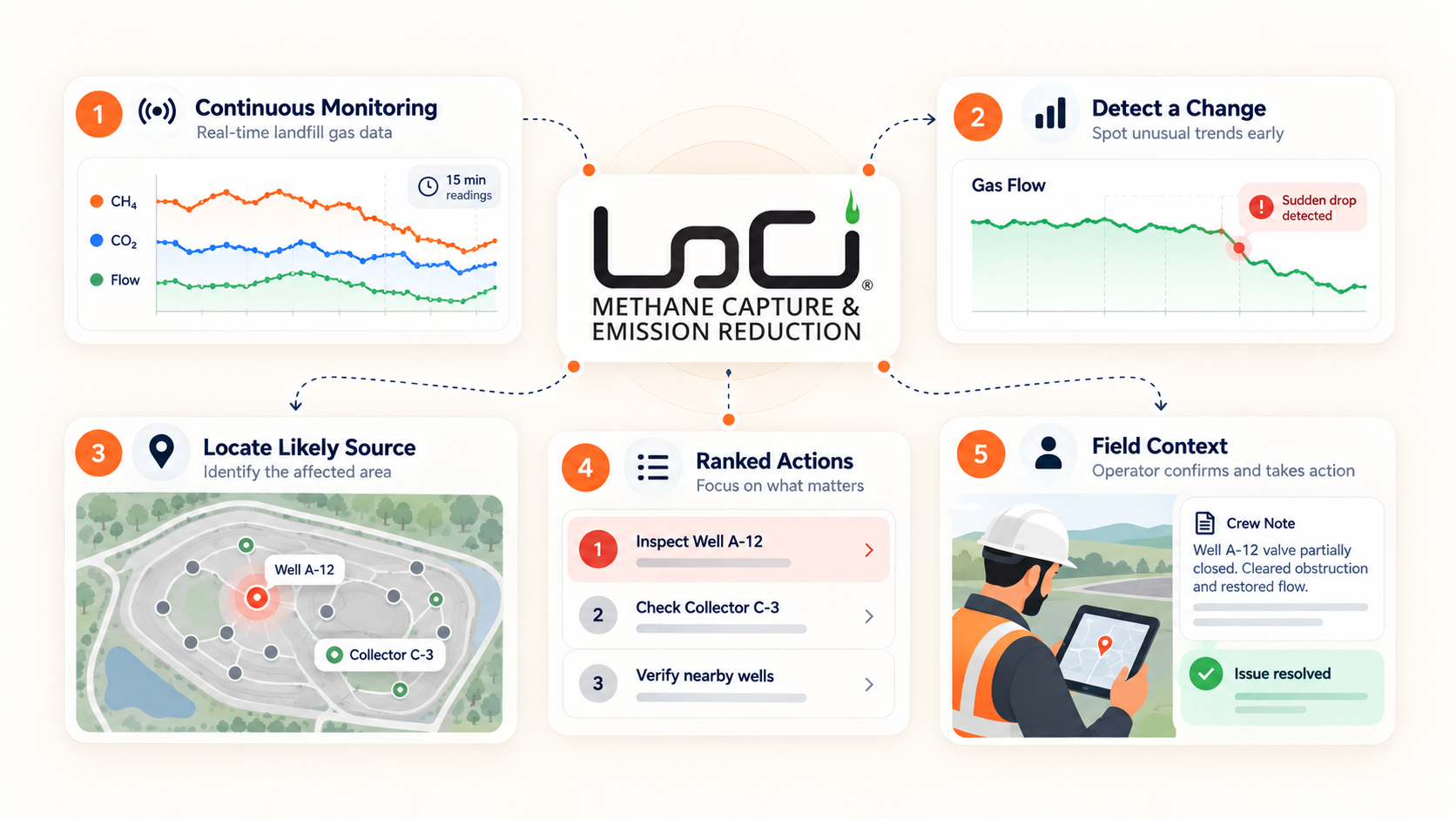
Caddi builds AI agents for repetitive operational work such as intake, document filing, billing, and other tasks that move between a firm’s existing software. Its work raises a larger question: could law firms have their own version of the employee who no longer notices part of the job?
They know what a lawyer’s time is worth because billable work is measured closely. The operational work surrounding legal practice is not billed to clients in the same way and has historically received less attention.
That matters because proving AI can save time is becoming easier than proving what the saved time is worth.
The measurement gap remains striking. A 2026 Thomson Reuters Institute study found that 85% of law firm respondents were either not collecting data on AI return on investment (ROI) or did not know whether their organization was doing so.
Alafgani thinks the problem begins one step earlier: with where firms are looking for the return.
“The ROI problem is a location problem, not a measurement problem,” he told SaaSTake.
Legal AI solved for time before firms solved for its value
Generative AI made one benefit immediately understandable: speed. But an hour saved and an hour of financial value are not automatically the same thing.
That question becomes harder in a profession still heavily dependent on hourly billing. AI can reduce the time required to produce legal work without making the financial value of that saved time equally obvious.
Clio’s research shows the tension beginning to reach pricing decisions. Among firms using AI more widely, 21% said AI was making billable targets harder to meet, while 45% had adjusted pricing.
The problem is not simply that firms cannot count AI usage. As we found in our reporting on Harbor’s legal AI adoption research, firms can deploy the technology and still struggle to connect adoption, workflow fit, and measurement to actual value.
Alafgani describes a law firm as running two economies: the practice of law, which clients pay for, and the business of law, which includes intake, conflicts, matter opening, docketing, billing, and collections. Saving an hour does not have the same financial consequence in both.
Making billable work faster can create capacity and improve client service, but it can also raise questions about pricing and who ultimately benefits from the efficiency.
Removing repetitive operational work, though, starts from a different equation.
The cleaner ROI may sit in work firms barely measure
Imagine an administrative process that consumes 500 employee hours a year. If automation removes 300 of them, the firm has created 300 hours of capacity. That does not automatically mean cash savings, but the operational gain is relatively easy to identify.
There is a catch, though. To prove that automation removed 300 hours, someone needs to know the process consumed 500 hours in the first place. Alafgani told SaaSTake that firms have historically paid less attention to measuring this non-billable work, leaving many manual handoffs, document checks, and inbox decisions without a clear baseline.
That makes Caddi’s Discovery system relevant to the ROI question. It is designed to examine activity across connected tools, identify repetitive work, and rank potential automations partly by the time involved. In doing so, it can establish a baseline before the automation gets credit for improving it.
And that creates a strange paradox: the work that may offer one of the cleaner routes to demonstrating AI value can also be the work firms were least likely to measure closely before AI arrived.
Finding the hours is easier than understanding what happens inside them
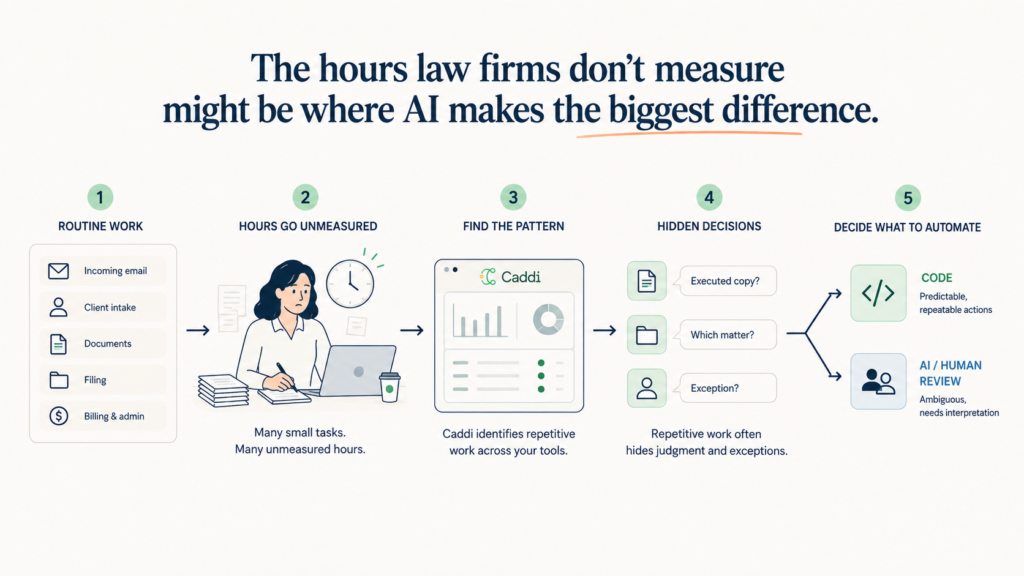
But finding the hours is not the same as knowing how to automate them. The five-step process from the beginning shows why.
From the outside, opening an email, downloading a document, renaming it, and filing it can look repetitive enough to automate immediately.
But the clicks are only the visible layer.
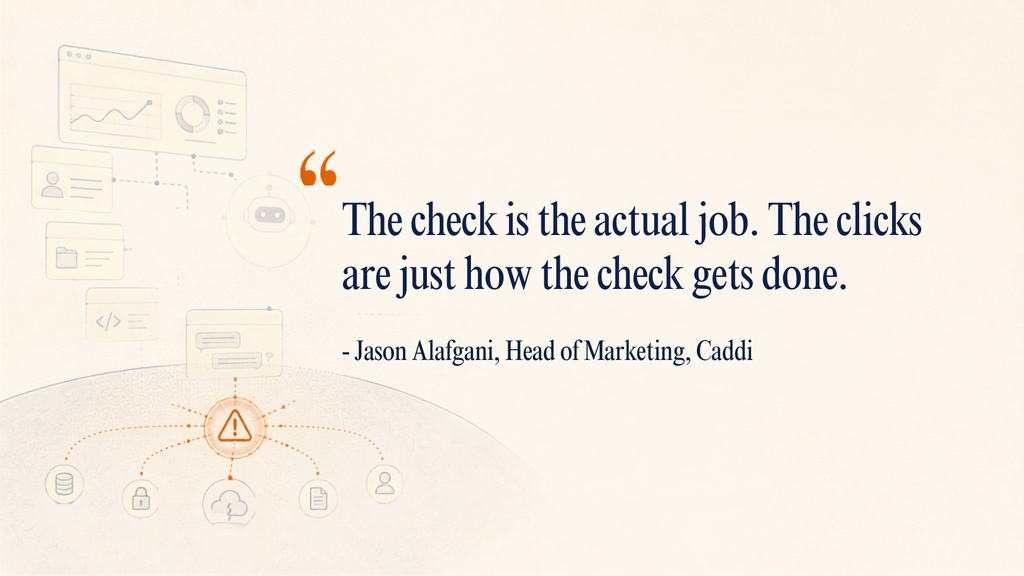
Opening DocuSign is a step. Determining whether the document inside is actually the executed version is a judgment.
Alafgani says Caddi tries to surface those uncertain cases while a person is teaching the workflow, asking about ambiguity before it reaches production. That exception-handling problem appears in insurance too. Majesco’s Immersive AI lets agents complete routine work when they are confident in the result and send cases outside those limits to an employee.
Automating routine work may therefore begin with extracting knowledge employees have become so accustomed to using that they no longer think to explain it.
Sometimes the ambiguity belongs to the firm, not the AI
Uncovering those decisions creates the next problem: deciding which ones AI should actually make.
Alafgani uses a relatively simple test. If two competent people at the firm should perform a step identically every time, use code: move the file, update the fields, send something to the specified address.
If the step requires interpreting variable information before knowing what to do, Alafgani says Caddi uses AI for that narrower decision, with the decision logged and routed to a person when confidence is insufficient. Its public materials describe the broader principle simply: AI where judgment is needed, deterministic code where the action has to remain exact.
That boundary is already appearing elsewhere in legal AI. As we found when examining AI-assisted document review with Law In Order, giving a system the ability to apply decisions at scale does not remove the need to decide where human judgment still belongs.
But Alafgani’s most revealing example is not really about technology.
Imagine three paralegals performing the same intake process three different ways. It would be tempting to treat that variation as human judgment and teach AI to accommodate all three.
Alafgani sees it differently: “That is not a judgment step. It is an undecided policy.”
Perhaps there is nothing for the AI to learn yet because the organization itself has never decided what should happen.
That problem is not unique to workflow automation. In our reporting on Epona’s approach to legal AI knowledge management, we found a similar prerequisite: AI can surface information, but the firm still has to decide what it considers approved and trustworthy.
A process that looked flexible may therefore be inconsistent. What looked like employee discretion may be a policy nobody ever had to write down. Automation can surface organizational decisions that were previously disguised as individual habit.
What kind of hour are you trying to save?
None of this means the best place for legal AI is always the back office. AI can create value in research, drafting, review, analysis, client service, and work much closer to the lawyer.
But Caddi’s argument gives the ROI conversation a more useful starting point than “How many hours did AI save?”
What kind of hour was it?
Was the firm measuring it before? Does removing it reduce cost, create capacity, or change revenue? And how much judgment was hiding inside something everyone called repetitive?
That brings the question back to the employee explaining a familiar job in five simple steps.
The work sounded easy to automate because so much of what made it difficult had disappeared from the explanation. A similar blind spot can exist at the firm level: the hours go unmeasured while the decisions inside them become too familiar to notice.
Finding those hours is only the beginning. Firms still have to understand what happens inside them, decide what actually requires judgment, and establish what removing that work would change.
That is a more demanding definition of AI ROI than counting hours saved. It is also a more useful one.
Legal AI’s first wave showed how much faster machines could make the lawyer’s work. Its next ROI test, though, may depend on understanding all the work happening around the lawyer that firms never thought to count.