| TL;DR: Landfill gas is a valuable energy source, making a steady supply important to facilities producing electricity or renewable natural gas. Continuous monitoring helps operators spot changes but leaves thousands of readings to interpret. LoCI Controls’ WellWatcher Action Plan compares conditions with each site’s history and points crews toward issues worth investigating. Operators can inspect the data and add field context before deciding what to do. By narrowing the search, LoCI aims to help teams respond sooner when gas collection changes. |
For years, finding the source of a gas problem at a landfill could mean walking the site, well by well. At many sites, routine wellhead checks took place about once a month. If the amount of gas reaching an energy plant dropped between visits, tracing the loss could take hours.
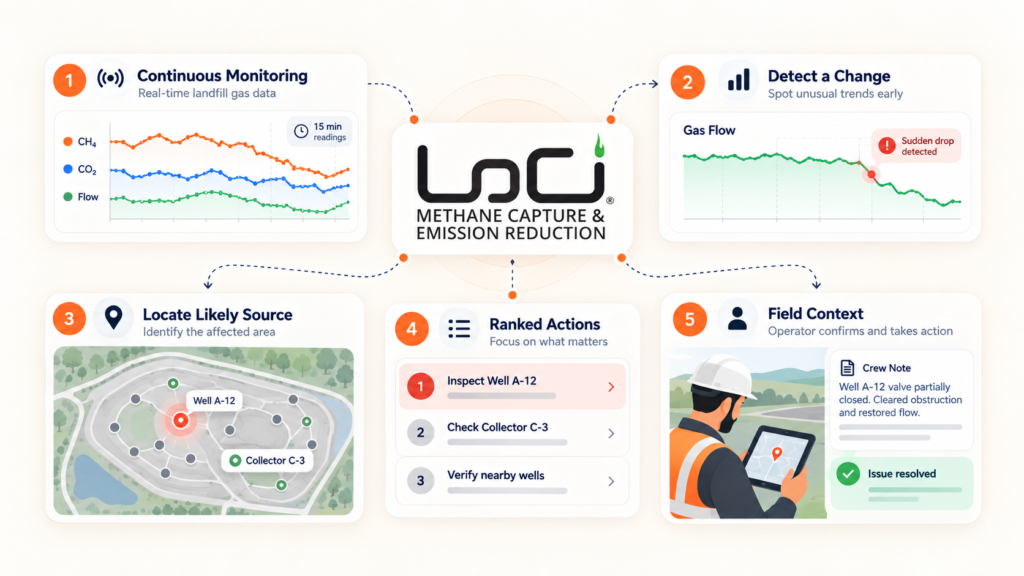
Continuous monitoring brought readings as often as every 15 minutes. It also gave operators far more numbers to review. They could see that something had changed, but they still needed to work out where the change began and what caused it.
That challenge became concrete at one landfill when gas flow to its energy plant suddenly fell. The drop came to about 400 standard cubic feet per minute, or scfm. LoCI Controls’ new WellWatcher Action Plan narrowed the loss to two horizontal collectors within minutes. The operators suspected heavy equipment had crushed them. However, why does a drop like that matter so much to a landfill in the first place?
Landfill Gas Has Become a Big Energy Business
Landfill gas matters because it is no longer just something to get rid of safely. It has become a fuel that energy plants depend on every day.
When food scraps and other organic waste break down in a landfill, they give off a gas rich in methane. Landfills capture this gas with a network of wells and pipes buried in the waste.
Some sites burn the gas to make electricity, while others clean it into renewable natural gas, or RNG. Once cleaned, RNG can flow through the same pipelines as regular natural gas.
The role of landfill gas in the U.S. RNG market has also grown. According to the American Biogas Council’s July 2026 figures, landfill gas makes up 64% of U.S. RNG production. The group also says nearly $1 billion went into landfill gas projects that started running in 2025.
For operators, that makes keeping gas flowing a daily concern. And when that flow suddenly drops, the plant can feel the impact.
There is an environmental side as well. Methane that escapes into the air traps far more heat than carbon dioxide. The U.S. Environmental Protection Agency has also found recurring problems in how landfills collect gas and maintain their systems. On top of that, a growing number of states and Canadian provinces are adding their own methane rules.
More Data Created a New Kind of Work
LoCI’s monitoring system now covers more than 5,000 measurement points across over 35 U.S. states, with the company expanding into Canada.
Under federal rules, many landfills check each well by hand about once a month. LoCI’s devices take readings as often as every 15 minutes and send them to its WellWatcher platform. There, operators can follow gas quality and flow at every point where a device is installed, on a map or in historical charts.
Operators could now see conditions between monthly visits. That sounds useful, and it was. However, they also had far more data to interpret. The gap between visibility and action shows up in other operational systems too. Gremlin’s Dynatrace integration is built around putting resilience signals beside the performance data teams already monitor.
Madison Barringer, LoCI’s Director of Communications and Marketing, told SaaSTake that the company’s analysts kept asking the same questions: What changed, and which wells were behind it? Did it need attention today, and where should someone look first?
A single reading rarely told the full story. A rise in oxygen, for example, only means something once it is read alongside the well’s suction and its recent history. You need that surrounding data to know whether something is actually wrong.
LoCI says it used that experience to build the Action Plan, which it announced in August. The feature reads each site’s data against that site’s own history rather than a general rulebook.
The Action Plan uses those historical readings to narrow down where an operator should investigate first. Barringer described the goal this way:
What the Action Plan Shows Each Morning
In a recent LoCI webinar, Dr. Melinda Sims, LoCI’s Director of Product Development, explained why the feature focuses on change. She said the data becomes most useful when something changes quickly and without warning.
The Action Plan starts by comparing the day’s gas flow and quality with the previous day and the site’s 30-day history. It then highlights the biggest changes on a map and ranks the areas operators may want to investigate first. Each recommendation links back to the charts behind it, so operators can see what prompted the flag. That kind of traceability is becoming important in other decision-support software too. Nuix links AI-generated answers back to the underlying evidence, giving users something concrete to inspect before acting on the result.
It can also flag wells where the data suggests flow could be improved. At one site, it spotted a well that looked held back by the small opening controlling how much gas passes through. The crew widened that opening twice, and the well’s flow rose sharply.
Operators Still Make the Final Call
The 400 scfm case shows why operators still need to make the final call. The Action Plan pointed to the two pipes linked to the loss, but it could not see a bulldozer crush them. The operators knew heavy equipment had been working there, which gave them the missing piece of context. They then planned new pipes for the area and marked it for vertical wells once the ground was stable.
Sims said LoCI tested the Action Plan at a few pilot sites over several months before rolling it out in August. Landfills shift with the weather and with work happening on the surface.
Sims told SaaSTake:
That context comes from the people on site. Operators can leave notes on individual wells for others at the site to read. They can also give each finding a thumbs up or down and explain what they found. An operator might know, for example, that a storm just passed or that a crew repaired a well yesterday.
According to LoCI, operators have confirmed more than 130 issues resolved through this feedback.
The Action Plan also has a clear limit. Where LoCI’s control equipment is installed, its wider system can adjust valves automatically to keep gas collection steady. The Action Plan itself does not change a valve or setting. It flags changes and shows the data behind them; the operator decides what happens next.
Continuous monitoring does not automatically mean autonomous action. Finzly is making the same distinction in banking security, where software keeps watching and investigating while people remain responsible for the final decision.
Operators Can Now Check the Site Before They Drive in
As landfill operators know, problems don’t always arrive during working hours. Before continuous data, a sudden drop in flow often meant driving in and spending hours walking the site to find the source.
An operator can now review the change remotely before deciding whether someone needs to visit the site. At sites with LoCI’s control valves, some problems can be handled remotely. Others still need someone in the field, but the operator already knows where to start looking.
In one case, the Action Plan led a crew to a loose air line on a pump. In another, it traced a sudden oxygen spike to a hole in a plastic pipe.
“It puts the operator in the driver’s seat, but with a much better set of directions,” Sims said.
For an RNG plant, time spent looking for a problem can delay the fix and affect plant operations. Getting a crew to the right spot sooner shortens the wait before the fix can begin.
From Monitoring to Knowing Where to Look
For more than a decade, LoCI has given operators a way to monitor conditions across their wellfields. The Action Plan uses those readings to show operators where an investigation should begin.
At the landfill that lost 400 scfm, it narrowed the search to two horizontal collectors. The operators knew heavy equipment had been working there and made the call on what to do next. The software gave them a place to look; their knowledge of the site gave the finding meaning.