| TL;DR: The robotics industry has spent years pouring investment into capability: better models, larger datasets, more generalizable machines. But as robots get smarter, controlling them without specialist knowledge gets harder. The interaction layer was never treated as a first-order problem. Enigma simply built on a gap the industry left open. The company raised $71M to build the intelligence and interaction layer for robots, covering the foundation model, hardware abstraction, and the interface connecting people to the machine. |
Billions have gone into making robots smarter. Yet, almost none of it went into making them easier to control.
Global industrial robot installations hit 542,000 units in 2024, more than double the annual figure from a decade earlier. The operational stock has crossed 4.66 million units worldwide. By almost every metric, robots are more capable than they have ever been.
But capability and usability are not the same thing. A 2025 study of robotics professionals found that as robots gain capability, giving non-expert users intuitive control actually becomes harder, not easier. The industry has spent years solving the model problem. What it hasn’t solved is the interaction layer.
Enigma was founded to bridge that gap. Started in 2025 by Jonathan Jacobi and Gal Niv, the company raised a $71M seed round to build the intelligence and interaction layer the robotics industry skipped.
The Capability Race Ran Ahead of the Usability Race
Much of the current robotics race is focused on better models, larger datasets, and machines capable of handling more tasks.
However, Enigma believes the interaction layer deserves as much attention as the models underneath it.
Enigma’s co-founder Jonathan Jacobi describes the gap this way: if you had to do your dishes and spent 15 minutes explaining to a robot where to put everything, you’d eventually reach the point of “forget it, I’ll just do it myself.” And, really, his argument is that even the most capable models available today don’t make that friction disappear.
According to him, every dollar went into the model. However, nobody funded the mile between the machine and the person using it. After all, that gap doesn’t close on its own just because the model gets better.
Robotics Still Lacks Its Volume Knob
Jacobi has a specific way of framing what usable robot control should feel like. Think about adjusting the volume in your car. You turn a knob and get instant, intuitive feedback. You don’t input a percentage and wait to find out if the output was too loud or too quiet.
In Jacobi’s analogy, robotics still lacks an interface that feels predictable and effortless. The interaction models that exist today require precision, patience, and expertise that most end users don’t have and shouldn’t have to develop.
Enigma’s thesis is that the interface isn’t a secondary problem to solve after capability is figured out. In fact, it could determine how easily increasingly capable robots move into broader real-world use. Without it, the most advanced robot in the room stays underutilized.
Enigma Is Building a Full Stack, Not Just a Better Screen
It’s worth being clear about what Enigma is actually building, because the interface angle can make it sound like a UX layer on top of someone else’s system.
That’s not quite it. Enigma says its stack includes a robotics foundation model, a hardware-agnostic abstraction layer, and the interface that connects people to the robot.
The system is designed to work across different hardware form factors, meaning the same model and interface can run on different physical robots.
That’s a meaningful distinction. For one thing, it means Enigma isn’t dependent on any single hardware partner, and it isn’t solving a narrow interface problem for one robot type. The ambition is to be the intelligence and interaction layer across the category.
Enigma Is Running a Global Experiment Before Locking In a Product
Enigma’s public launch looks different from a conventional product launch. It begins with an open-ended question.
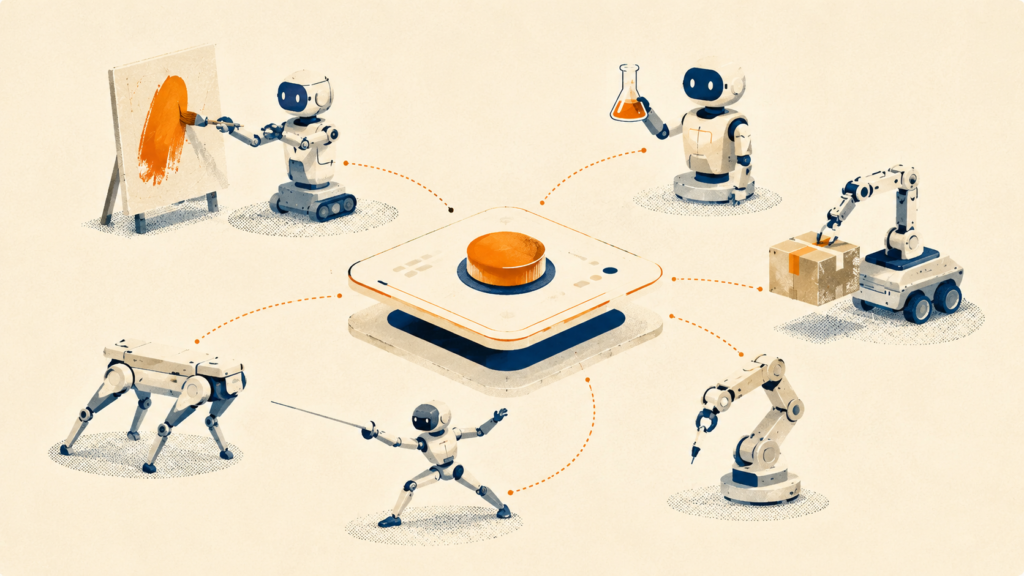
The company is running a large-scale public experiment where anyone in the world can interact online with more than 100 of its robots, housed in facilities across Israel and California. The robots can draw with a paintbrush, fence with swords, and run basic chemistry experiments.
Their research goal is to understand how people naturally want to communicate with robots. Do they want to type? Use voice? Show the robot a video? Tap and drag on a screen?
Enigma doesn’t know yet. And that’s the point. The company is betting that direct interaction with real users can reveal interaction preferences that simulation alone may not capture. It’s a research strategy before it’s a go-to-market strategy, and the $71M gives them the runway to run it properly. Age of Learning followed a similar signal from real-world use when it redesigned ABCmouse for teachers after finding that many were already projecting activities and leading them with whole classes.
Outsider Instincts Are What Drove This Bet
Jacobi and Niv are not roboticists. They are cybersecurity researchers who met when competing in hacking competitions as teenagers and later served together in Israel’s elite Unit 8200.
Index Ventures partner Shardul Shah frames that directly as a strength. Insiders start from teleoperation or dexterity. Enigma is starting from a different question entirely: what is the ultimate experience for the human on the other end?
Shah’s broader point is simple: someone without prior assumptions about how robotics is supposed to work has more room for a genuinely original answer.
The $71M seed round was co-led by Index Ventures and Ribbit Capital, with Conviction Partners also participating. The angel group includes employees from Google DeepMind, Anthropic, and OpenAI, adding another connection between frontier AI and Enigma’s robotics thesis.
The Market Enigma Is Betting On
Enigma says it is already partnering with companies in healthcare, logistics, and entertainment, though it has not disclosed names or specific use cases. For now, no revenue model has been made public yet.
The intelligent robotics market is projected to grow from $13.99 billion in 2025 to $50.33 billion by 2030. That kind of growth means the interaction standard gets set in the next few years, not later.
The companies that define how humans talk to robots early will be difficult to displace. We believe that Enigma is making a specific bet: that the company that solves usability at scale won’t just participate in that market. It could end up defining how everyone else has to compete inside it.