| TL;DR: Answering questions about payments, invoices, or reimbursements often requires finance employees to search several systems. Datarails Desk gathers those requests and the relevant financial records in one place, then drafts replies for employees to check and send. Having the records available can help explain a delay, but resolving it may still require someone to act. Tracking those requests also gives finance managers a clearer view of where work gets stuck and which processes need attention. |
A supplier emails a company to ask about an unpaid invoice. Before anyone can reply, someone in finance has to find out whether the invoice was approved and whether payment is scheduled. If this is a follow-up, there is also an earlier email thread to track down.
The question takes seconds to ask. Answering it can mean piecing together what happened from records spread across different systems.
Datarails wants to make those records easier to find. On September 10, the financial software company launched Desk. It organizes finance requests and uses connected financial data to draft replies for employees to review.
The launch addresses a familiar frustration. But here’s the practical question: how much work does it actually save, and what still needs a finance employee’s attention?
Payment Questions Persist After Automation
Businesses have spent years automating how invoices move toward payment. Yet explaining where a specific invoice stands still keeps finance employees busy.
In a 2024 MineralTree report, 65% of organizations had automated parts of accounts payable, but only 19% had gone all the way. The report also examined how much time accounts payable teams spend answering vendor payment inquiries. Half of respondents said six hours a month or more, up from 43% in 2022.
After all, automating an invoice or payment doesn’t necessarily save finance teams the time they spend answering questions about it. Software can capture an invoice and send a payment, but answering a supplier’s question about it often remains manual. A similar gap appears in insurance, where Majesco’s AI agents can speed up individual claims tasks while customers may still wait for the next employee or approval.
Some of those questions also point to real delays. In the Institute of Finance & Management’s summer 2025 survey, 80% of organizations got invoices ready to pay in under a week. By winter 2025/2026, that share had fallen to 52%.
The surveys don’t explain the slowdown. Still, they suggest that answering a payment inquiry may involve tracking down a delayed approval, not simply sharing an update.
Datarails Connects the Request to Its Records
Datarails’ finance software helps departments combine business data for tasks such as budgeting and the month-end close, without leaving Excel.
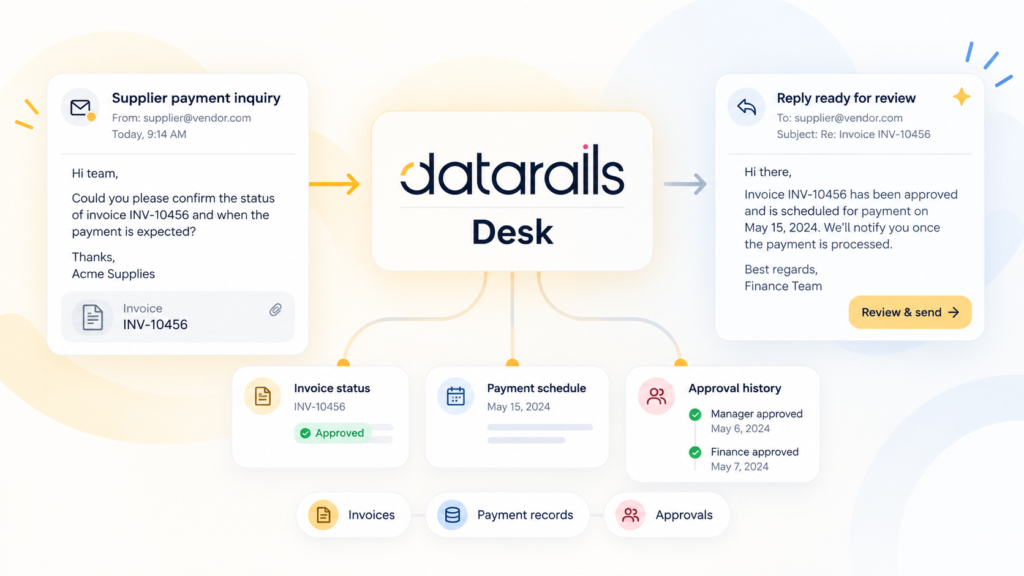
Desk applies the same approach to the questions finance teams receive every day. As an AI finance help desk, it brings incoming requests and relevant financial records together, helping employees draft replies without searching across multiple systems. Requests arriving by email or through chat apps like Slack land in a shared queue. FinanceOS, the company’s underlying data platform, then brings the relevant invoices and payment records into each request. An AI agent uses those records to draft a reply, which an employee reviews before it goes out.
For a supplier waiting on payment, the employee could see the invoice and its payment record right next to the message. For a customer disputing a bill, Desk could pull up the records that explain the charge.
Customer communications have a similar dependence on context held across different systems. MHC NorthStar brings banking interactions and customer activity together so the next message can reflect what has already happened.
Desk also takes a different approach to ownership. Datarails argues that generic help desks are built around escalation, passing a ticket up through tiers of support. The company says one person is responsible for each finance request, from the moment it arrives until it’s resolved.
For Datarails, assigning a ticket isn’t enough. As Co-founder and CEO Didi Gurfinkel put it at launch:
In practice, the person handling a request can see its deadline and the relevant records in one place. Access controls limit who can see sensitive financial data, and the system logs every action. This helps the owner respond with the right information and track the request until it’s resolved.
Reviewing the Answer is Part of the Work
Having the records in front of them doesn’t eliminate the need for human review. Employees must still confirm that the records match the supplier and invoice and support the proposed reply.
That review step also appears in fraud investigations. Feedzai’s Farol gathers case information and prepares reports, while analysts still examine the evidence and make the final judgment.
Datarails’ own survey offers a useful example of this problem. Its 2026 CFO Sentiments Survey polled 270 US CFOs and finance leaders. All worked at companies with at least 1,000 employees and $100 million or more in annual revenue.
Among respondents whose data sat across disconnected systems, 76% spent over a quarter of their time verifying AI output. For respondents with mostly centralized data, the share was 31%.
That difference raises an important question for Desk: does bringing financial records together save employees time overall, including the time they spend checking AI-generated answers?
And this isn’t just a Datarails concern. Data quality remains a broader challenge for finance teams adopting AI. In Gartner’s finance AI survey, inadequate data quality and availability ranked among the largest obstacles to adoption.
Desk needs to pull the right records together and present them clearly enough for an employee to verify the reply.
Finance Help Desks are Becoming Their Own Category
Datarails isn’t the only company building tools to answer finance questions using accounting records.
Xelix, for instance, launched its Helpdesk in June 2024 to turn supplier emails into tickets and draft replies from accounting records. This June, it added a ServiceNow integration that brings invoice data and payment history into that platform.
The main difference is the range of requests each product handles. Xelix’s Helpdesk focuses on accounts payable and supplier inquiries. Desk also handles customer and employee requests involving areas such as receivables and payroll.
Desk can cover that much ground because it runs on the same data foundation as Datarails’ planning and month-end close tools. A payroll question and an invoice dispute both draw from one connected set of records.
The Business Value Extends Beyond a Reply
Faster replies help, but finance teams could gain more by figuring out why the same questions keep coming up.
Repeated reminders might point to a stalled approval or a billing dispute that never quite gets settled. Desk’s dashboards support finance request management by showing where requests pile up and how long they stay open. That information can help finance managers decide where to focus. If several inquiries trace back to the same delay, they can work out what needs to change and who needs to act.
Ultimately, these patterns could help finance teams address the underlying problems, rather than repeatedly answering questions about them.