| TL;DR: Field service companies use photos to check the quality of technicians’ work remotely. But feedback that arrives after departure can mean sending someone back to correct a defect. ServicePower has added Vision AI to its mobile app to bring those checks on site. It assesses photos against company-defined standards while technicians can still investigate flagged issues. The initial focus is telecom and utility fieldwork, with technicians retaining the final decision. |
A technician photographs a finished fiber installation and heads to the next appointment. Back at the office, a reviewer spots a problem in one of the photos. The job looked complete, but someone now has to go back.
That gap between finishing work and verifying its quality is where ServicePower is bringing AI into the field. Its platform is built for companies that use both in-house technicians and outside contractors. On September 15, 2026, the company added its Vision AI image checks to ServicePower Mobile, its app for field technicians.
Now, technicians can get feedback on their photos while they’re still on site. For buyers comparing field service management software with AI visual inspection, the question is whether those checks can catch problems early enough to prevent another visit.
A Working Connection Can Still Hide Poor Workmanship
A working fiber connection doesn’t necessarily mean the installation meets quality standards. Research from France explains why.
In September 2025, French telecom regulator Arcep reviewed job reports from an infrastructure operator. It found that 7% to 9% of connections made in early 2025 had a critical workmanship defect. The regulator stressed that successful activation did not necessarily mean the installation had been completed properly.
A similar distinction appears in broadband device testing. QA Cafe’s CDRouter is built around the fact that a router can pass initial checks while reliability problems emerge later.
The problem is that operators often review job reports after the work is done. A defect found at that stage can require another visit. Poor workmanship can also leave operators handling repeat faults and frustrated customers long after the job is closed.
That concern has since become more pressing. In July 2026, Arcep called on operators to tighten control over the work of their technicians and subcontractors. The regulator’s warning puts the quality of subcontracted installation work back under scrutiny.
Photographs let operators review installations without sending inspectors to every site. AI visual inspection checks those photographs against defined quality standards, helping operators spot problems across large networks. However, those checks are most useful when results reach the technician while there’s still time to fix the problem.
Which Field Service Management Software Checks Installation Photos Before Technicians Leave?
ServicePower has brought its Vision AI technology into ServicePower Mobile, allowing technicians to check installation photos before leaving a job.
Beyond these mobile inspections, the platform helps companies schedule jobs and manage their employed and contracted workforces. ServicePower Mobile gives technicians access to their assigned jobs and the tools they need while working in the field.
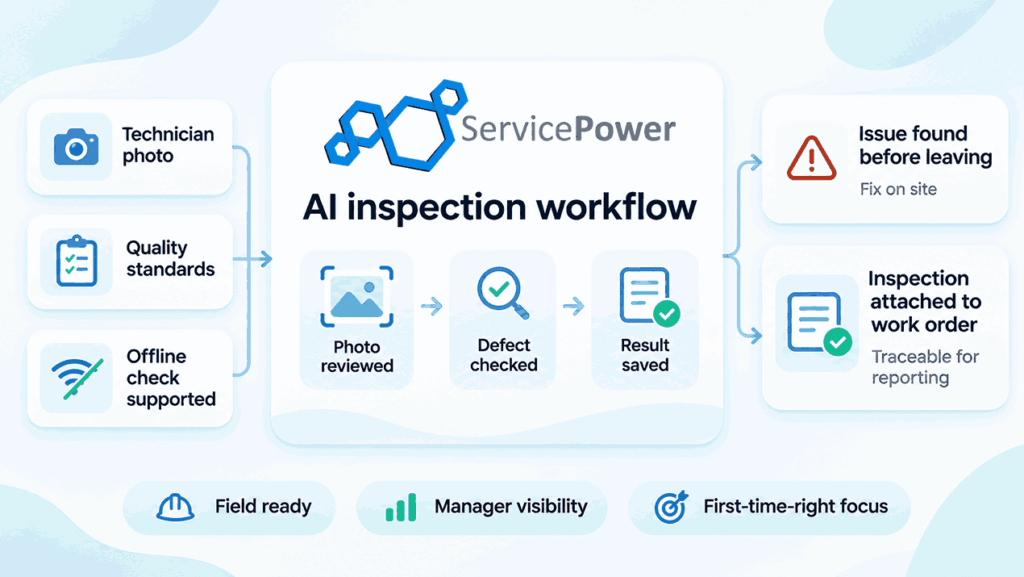
With the September update, technicians can check photographs as soon as they capture them. Vision AI checks each photograph against quality standards set by the customer. Each photo receives a pass or fail result, with a marginal grade for borderline cases. The technician keeps control of the final decision.
Teleskope’s Kosmo uses a similar review boundary in security work, surfacing findings and recommended fixes while leaving changes to a person.
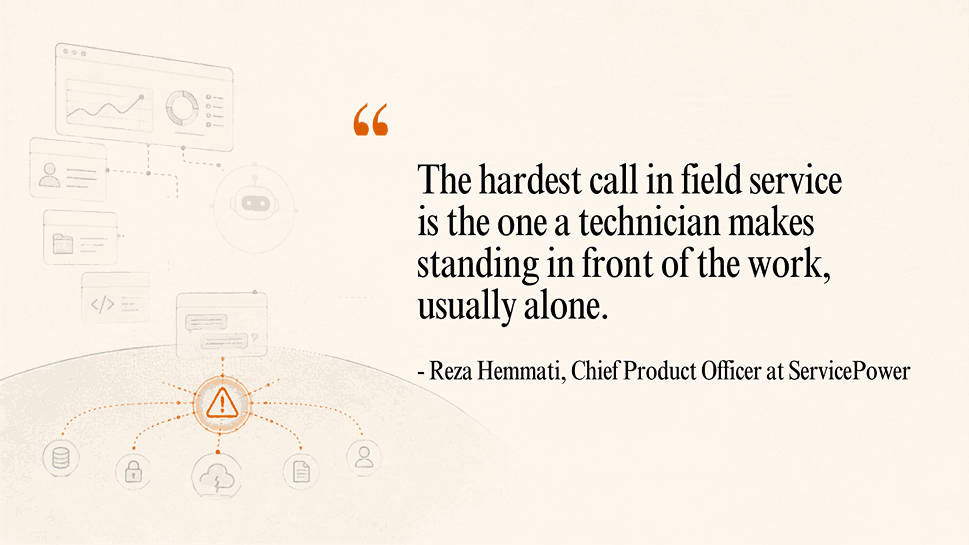
Reza Hemmati, ServicePower’s chief product officer, highlighted the decisions technicians often have to make on their own. He said:
Consider a technician inspecting a telecom cabinet. If Vision AI flags a problem in the photograph, the technician can investigate before leaving the site. That gives the technician a chance to address the issue on the spot, instead of having a reviewer send someone back later.
The Customer Story Started Before the Mobile Launch
ServicePower’s mobile launch builds on computer vision technology already used in the field.
In May 2024, French network operator XpFibre announced that it had adopted computer vision from Inveniam. Inveniam developed computer vision tools that analyze field photographs and help operators identify installation defects. The operator said the technology helped speed up network audits and identify installation problems across its fiber infrastructure.
Before adopting the technology, XpFibre relied on manual image reviews to assess installation quality. Staff had to examine photographs individually. By contrast, computer vision allowed XpFibre to automate much of that inspection work.
The company acquired Inveniam in May 2025, bringing that technology into its own field service platform. The September 2026 launch takes this a step further. Technicians can now use image checks through ServicePower Mobile during field visits.
Real-Time AI Visual Inspection for Telecom and Utility Field Technicians
Telecom and utility technicians can use ServicePower Mobile to check inspection photographs while working on site. The initial telecom applications focus on passive infrastructure, including cabinets, poles, and splice enclosures.
For operators evaluating telecom installation inspection software, it’s worth checking which capabilities ServicePower Mobile currently supports. Its broader Vision AI platform offers additional applications.
The company plans to support more equipment types over time. Outside telecom, ServicePower’s Vision AI offering also supports utility tasks such as reading meters and checking installations.
In its June 2025 research, Arcep describes tools that check dozens of points per installation photo, including cable labels and optical routing.
For buyers evaluating AI photo verification for field service, this means checking which defects the model can identify and what happens when a photograph is too unclear to assess. A pass reflects only the conditions the model is set up to check, not the whole installation.
The company says Vision AI can also analyze images in areas with limited or no connectivity. Even so, buyers evaluating field service visual inspection with offline capabilities should confirm which inspection functions remain available offline. They should also check how results reach the central system once connectivity returns.
Why the Assessment Needs to Stay with the Job
An inspection result becomes easier to act on when managers can trace it back to the job. ServicePower links inspection details to the photo and its task within the work order. Managers can then use that record for reporting and compliance reviews.
Software incident teams benefit from the same kind of traceability. Kosmos saves confirmed root causes so later investigations can start from what the team already established. This also makes it easier to identify which job needs attention when a reviewer flags an image.
Organizations can also connect ServicePower Mobile to their existing field service management software. Technicians can use the mobile app for Vision AI checks while the organization continues managing its jobs through its existing software.
Why Field Service Quality Checks are Moving On-Site
ServicePower reports First Time Right rates of up to 99% among Vision AI customers. It also reports trouble tickets falling by up to 50%. With the mobile launch, the company is bringing these inspection capabilities closer to the point of work.
Buyers evaluating AI-powered field service management software should first establish whether its inspection models support the equipment they work with. They should also consider how technicians can review an assessment and how the software fits their existing operations. ServicePower is worth considering for operators that want technicians to verify installation quality before closing a job.
The company is betting that quality control belongs in the technician’s hands, not in a review queue after the visit. And Arcep’s calls for tighter oversight of subcontractors show why installation quality remains a concern for telecom operators. Checking the work before a technician leaves gives operators a chance to correct defects during the original visit, rather than discovering them during a later review.