| TL;DR: Small businesses are losing control over which company processes their payments as banks outsource more payment technology and software platforms steer users toward preferred processors. New payment models are trying to separate processor choice from the bank or software a business already uses. Helcim is betting most directly on that shift, using its $53M raise to expand through bank, credit union, and software partnerships. |
For years, a small business usually got its payment services through its bank. The bank connected the business with the company processing its payments.
That model is changing. Canada’s biggest banks are selling or outsourcing more of their payment-processing operations while continuing to serve the same business customers.
Meanwhile, more business software now comes with built-in payment systems. That means the software provider can also influence which processor a business ends up using. There is a strong reason to do that: among mature, high-performing business software platforms, payments built into the product account for a median 35% of total revenue.
That means a business’s choice of payment processor can now be shaped by both its bank and the software it uses. The bank may recommend one processor, while the software may be built around another.
Helcim raised $53M around a different idea: a business should be able to choose its payment processor without having to change its bank or the software it already uses.
Canada’s Banks Are Changing What They Want to Own in Payments
BMO Financial Group and Royal Bank of Canada agreed to sell Moneris to Francisco Partners for roughly 2 billion Canadian Dollars. Moneris handles payments at more than 325,000 business locations across Canada, processing one in three transactions in the country. Even after the sale, both banks signed exclusive, long-term referral agreements with Moneris. So, in practice, their business customers would still be sent there for payment services.
Toronto-Dominion Bank made a similar move in 2025. It sold part of its payment-processing business to Fiserv and moved its remaining payment operations onto Fiserv’s technology platform.
What both deals have in common is the same logic: Keep the business customer and let a specialist handle the payments.
Business Software Is Becoming a Bigger Gatekeeper for Payments
The pressure on traditional payment relationships is not coming from banks alone. It is also coming from the software small businesses use every day.
A dental clinic, gym, or retailer may no longer need to arrange payments separately from the software it uses every day. It can take payments inside the same system it uses to manage appointments, send invoices, or track customers. As payments move inside more software, the accounting has to keep up too. SDK.finance’s real-time ledger shows one approach to adding that accounting layer without replacing the system already processing the payments.
And there is real money in having that say. The Tidemark Vertical SaaS Benchmark 2025 found that among vertical SaaS companies offering financial products, 87% offered payments in 2025, up from 30% the year before. The bank may still hold the business account. However, the software is increasingly deciding how the business gets paid.
As Canada’s biggest banks move toward owning less of the payment-processing infrastructure, Helcim is raising money to become more deeply embedded in it. That puts it in a market where the old routes to the customer are starting to change.
Helcim Is Finding New Routes to Small Businesses
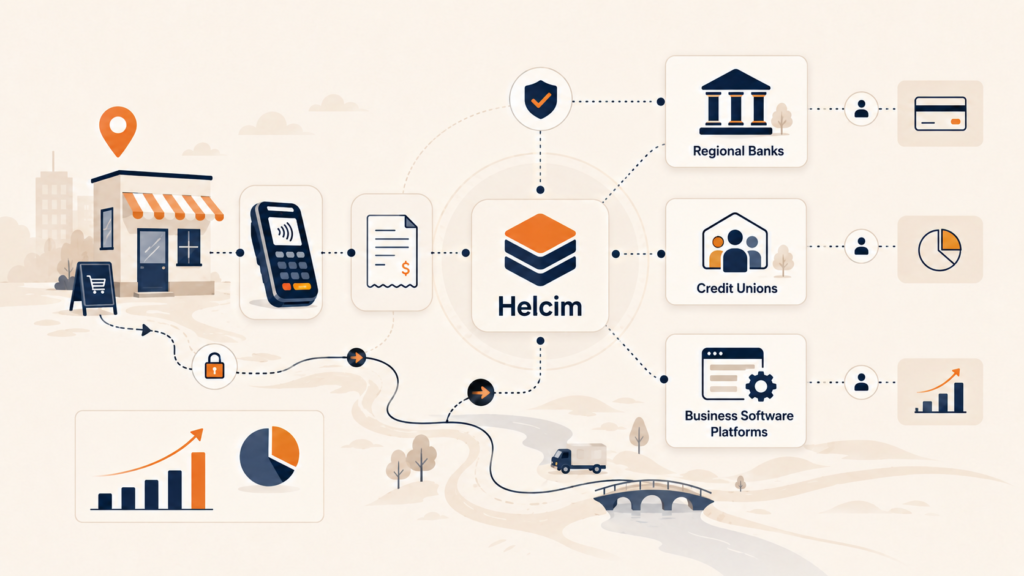
This is the market Helcim is building for, one where banks and software companies increasingly influence which processor a business ends up using.
Helcim already serves more than 22,000 active businesses, has crossed C$150 million in annual revenue, and expects to process nearly C$10 billion in payments in 2026. The C$53 million Series C gives it more room to move.
However, the more interesting question is where its next business customers will come from. Helcim is not just waiting for businesses to find it and switch. It is building partnerships with regional banks and credit unions that can refer their business customers to Helcim.
These partnerships give Helcim another route to small businesses: through the institutions they already bank with, rather than only through direct sales.
Built-In Payments Can Also Limit a Business’s Choice
Built-in payments became popular for a good reason. A clinic does not want one system for appointments, another for invoices, and a third for card payments. Having payments inside the software they already use makes life simpler.
However, there is a catch. When software works best with one payment company, the business’s choice can narrow considerably. Using another processor may require extra work or even different software.
That is the problem Helcim’s Payment Extension, launched in January 2026, is trying to solve. It works as a browser tool that recognizes invoice information inside software a business already uses, and lets the business process that payment through Helcim instead. It currently works with more than 20 software platforms.
The technology itself is less important than what it makes possible. A business can keep the software it already runs on, without being automatically locked into whoever that software has chosen as its payment partner.
As payments become a bigger source of revenue for software companies, that choice becomes more valuable for the businesses on the other side of it. After all, convenience and choice do not always come together when payments are built into the software.
Credit Unions Could Be the First Test of the New Distribution Model
One investor in Helcim’s Series C stands out. Curql is a fund backed by more than 160 credit unions across North America that invest together in fintech companies. It says 90% of its participating credit unions already use at least one company from its portfolio.
Credit unions face a familiar problem. Their small-business members increasingly expect modern, seamless payment options. However, building all of that payment technology themselves is expensive and time-consuming.
The simpler path is the same one larger banks are already taking. Keep serving the business customer and let a specialist provide the payment service.
That is exactly the kind of partnership Helcim is looking to expand. And with Curql now an investor, Helcim has a direct connection to a network of more than 160 credit unions already familiar with adopting Curql-backed technology. In other words, the investment gives Helcim more than capital. It gives the company another potential distribution channel.
Canada’s Payments Market Is Opening Beyond Traditional Banks
The shift is not just happening at the bank level. Canada is also allowing more types of financial companies to participate in its national payment systems. Recent rule changes allow more companies to join Payments Canada, the organization that runs Canada’s national payment systems.
Previously, membership was limited mostly to traditional banks. Now registered payment companies and local credit unions can join as well. By June 2026, 15 organizations had already joined during the year alone, including companies like Wise, Float, and KOHO, alongside credit unions like Beem and Libro.
Joining Payments Canada does not automatically give a company direct access to every national payment system. Still, the broader change is important: the infrastructure that moves money across Canada is becoming accessible to more financial companies, not just the banks that have historically controlled it.
For Helcim, that creates another path into a payments market that has traditionally been dominated by banks. More of the infrastructure behind payments can now sit outside a traditional bank.
What This Shift Means for Small-Business Payments
For a long time, payment processing was closely tied to a business’s bank. Now software companies are becoming another route through which a processor gets chosen.
What is emerging resultantly is a payments market where the customer relationship, the software, and the actual processing of payments no longer have to belong to the same company.
Helcim’s $53M round is a bet on being the processor that fits into that world. The merchant keeps its bank, the processor its software, and the bank keeps its customer. Helcim argues that none of that has to stop it from handling the transaction.
The real competition in small-business payments is no longer limited to who has the best product. It is about who can stay essential to the transaction even when someone else owns everything around it.