| TL;DR: AI agents need far more from web search than traditional APIs were built to provide. As Google and Microsoft pull back from older search access models, a new infrastructure market is opening up. Keenable is one of the startups betting it can become part of that search layer for agents, alongside a wider wave of investment into AI-powered web search. |
For nearly three decades, the internet’s search infrastructure had one kind of reader in mind: humans who arrive, go through the results, and maybe click a link. Search engines optimized for that behavior until it became the dominant model developers built around.
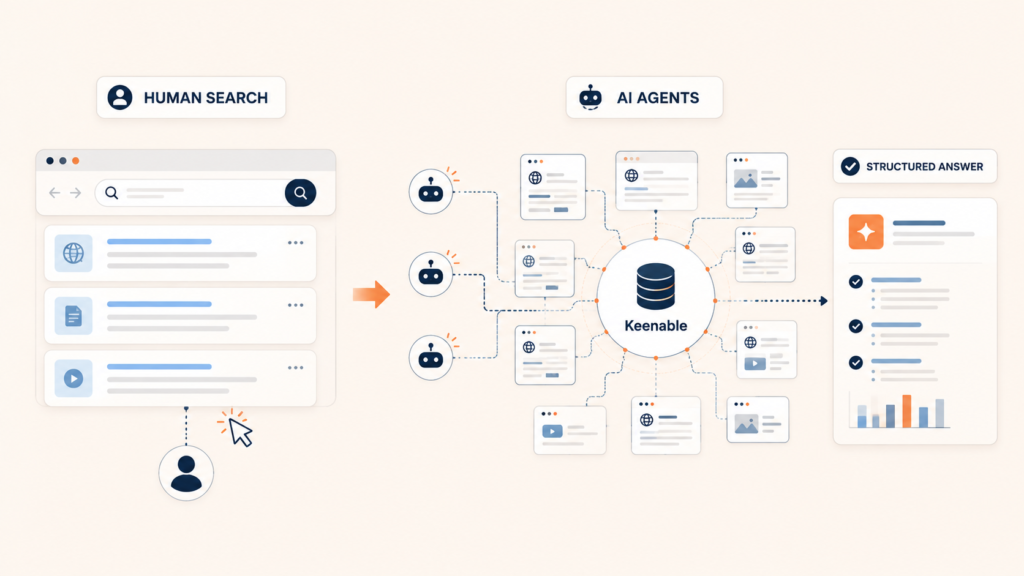
AI agents don’t work that way. They can retrieve, process, and combine information across the web at a scale no human searcher could.
That shift is creating demand for a different kind of search infrastructure. And just as that demand is growing, Microsoft has retired its Bing Search APIs, and Google is winding down its Custom Search JSON API. Developers had previously used these APIs to pull web search results into their own applications.
Accel partner Zhenya Loginov, who led Keenable’s seed round, told TechCrunch that AI companies now have very few options for large-scale web search.
Keenable is trying to bridge that gap by building its own web index and search tools specifically for AI agents. How that gap opened, though, is worth understanding first.
The Search APIs Developers Built Around Are Disappearing
Microsoft made the first major move. On August 11, 2025, it retired the Bing Search APIs completely. Existing instances were decommissioned, and Microsoft directed customers toward Grounding with Bing Search inside its Azure AI agent ecosystem instead.
Google followed the same logic. Its Custom Search JSON API is now closed to new customers. Existing customers have until January 1, 2027, to migrate. Google recommends Vertex AI Search for searches covering up to 50 domains. Developers needing full-web search are told to contact Google directly about another solution.
Neither company stopped offering web information to AI products. What has changed is how developers get access to it.
The open APIs developers could build on are disappearing. In its place are tighter systems that keep the queries, data, and value inside proprietary ecosystems. Agents are arriving at exactly the moment independent access to the web is getting harder to buy.
Investors Have Put $423 Million Into the New Search Layer This Year
Keenable’s $26 million seed can look unusually large until you look at what else investors have funded in 2026.
In May, Exa raised $250 million at a $2.2 billion valuation. It describes itself as a search engine for AI, with technology already used by Cursor, Cognition, HubSpot, OpenRouter, Monday.com, and more than 400,000 developers.
A month earlier, Parallel Web Systems raised $100 million at a $2 billion valuation. It provides web search and research APIs for AI agents, with customers including Clay, Harvey, Notion, and Opendoor. More than 100,000 developers use its products.
In February, Nimble raised $47 million. Its approach is different: agents that retrieve, validate, and structure live web information so enterprises can work with it like database data.
Add Keenable’s $26 million and those four companies alone have raised $423 million this year. They are not identical businesses, of course, but they are all solving versions of the same problem.
AI models know a lot. They increasingly need to know what is happening right now to pull from external sources, verify it, and return something another piece of software can use. That is where the new infrastructure layer comes in.
Search is becoming part of the infrastructure behind AI.
Keenable Is Betting the Search Workload Itself Has Changed
Keenable’s answer is to build an independent index designed around how machines search.
The company says its index already covers more than 100 billion documents and is in production at several AI labs and companies that run AI models. Its founders are also developing Web Query Language, designed to let AI systems combine information from multiple sources even when no single page contains the complete answer.
The difference from what traditional web search does is actually pretty straightforward.
A person enters a query, skims ten results, visits two pages, and stops. An agent completing a market-mapping task searches repeatedly, retrieves multiple pages, compares companies, extracts structured facts, discovers missing information, searches again, and returns one final answer.
In other words, the agent is not just looking for a page. It is using search as part of a much larger process.
When search becomes something used by agents rather than people, the economics shift. Keenable’s pricing reflects that. General agent builders pay $4 per 1,000 requests. Whereas AI labs and inference platforms can get higher-volume plans starting at $1 per 1,000 requests at 100 requests per second or more.
That is not search priced around someone occasionally opening a browser. It is, instead, search priced like infrastructure.
This reframes the competitive question entirely. Keenable is not competing for consumers. It is competing for developers who need the web retrieved more efficiently for the workloads their agents generate.
The Next Search Cost May Not Come From the Search Engine
There is another complication emerging alongside all of this. And it could matter more than it first appears.
Cloudflare is currently testing Pay Per Crawl, which lets website owners charge AI crawlers every time they successfully retrieve content. Publishers set their own prices, with a current minimum of $0.001 per successful crawl.
That number sounds insignificant until the customer is a machine making millions of requests for web content. At that scale, though, even a tiny per-request fee starts to look different.
If models and agents eventually have to pay publishers at scale, search infrastructure companies face a problem that has nothing to do with relevance or speed. They will also need to decide which sources are worth paying to retrieve for a particular task. That is a very different calculation from simply asking which result is most relevant. The system also has to consider what it costs to retrieve that result in the first place.
Search ranking, in other words, is taking on a new economic dimension as publishers begin charging for machine access.
The Web Search Market Is Being Reopened
Google is not disappearing, Microsoft is not leaving search, and Keenable is far from alone. That is precisely what makes the moment interesting.
For years, building another general-purpose web index looked irrational. Google had already spent decades crawling, ranking, and monetizing the web. AI agents changed the customer.
Now that Microsoft has retired its Bing Search APIs, and Google’s equivalent is headed toward discontinuation, hundreds of millions in venture dollars are flowing into independent alternatives. Keenable’s $26 million is one of the bets being made on where this transition is headed. More importantly, it comes to life as several parts of the old search model are changing at once.
The race is no longer about building a better search engine for people. It is about deciding who supplies, controls, and ultimately pays for the information layer underneath billions of searches that no human will ever type.