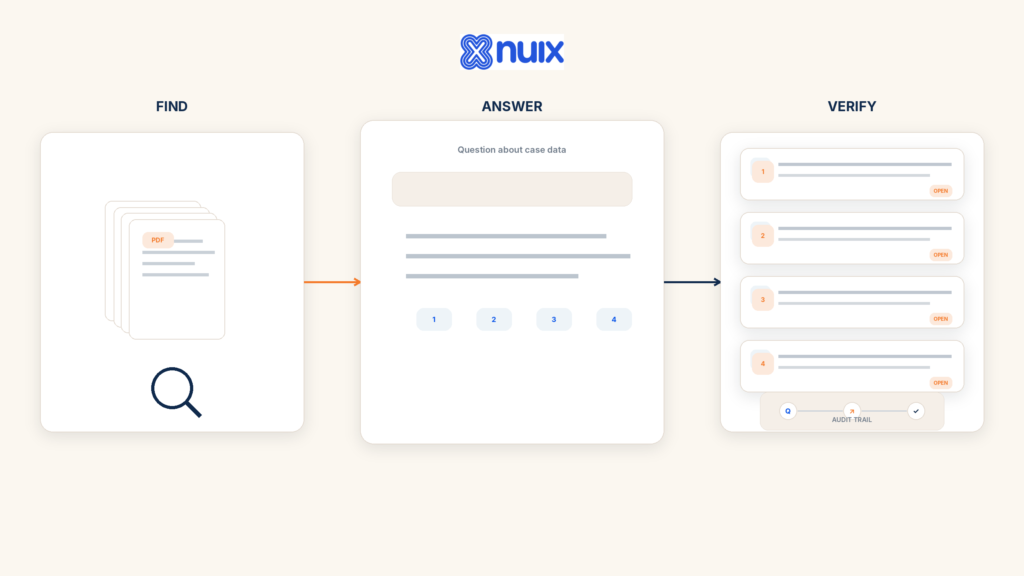
| TL;DR: Legal software used to help lawyers find the evidence they need. Generative AI can now go a step further and generate answers about what that evidence says. We looked at Nuix’s latest AI rollout to understand what changes when legal review starts producing answers, not just documents. |
Searching case evidence and asking AI to answer a question about that evidence are two different things.
The first gives a lawyer material to examine. The second can use that material to generate an answer.
That could save hours of searching and reading. But if an AI-generated answer shapes what a lawyer looks at next, there is another question to deal with: can they later trace that answer back to the evidence that produced it?
Nuix is now adding generative AI capabilities to Discover, its eDiscovery platform for helping legal teams process, search, and review large collections of electronic evidence. Among them is AI Chat, which lets reviewers ask questions about case data in natural language and receive answers linked back to the underlying documents.
Nuix’s broader bet is that review software can now do more than help lawyers find documents. It can help them interrogate what those documents collectively say.
Finding evidence and interpreting it are different problems
Before generative AI, eDiscovery software, which helps legal teams find and review electronic evidence for a case, largely helped narrow the pile.
Keyword searches found documents containing particular terms. Technology-assisted review went further. With continuous active learning, or CAL, the system learned from the documents lawyers reviewed and used those decisions to move potentially relevant material higher in the queue.
The output was still a set of documents for someone to review.
The American Bar Association has now warned lawyers using GenAI for discovery that generated output creates another verification problem. An answer can sound convincing even when it is wrong, which means reviewers need to check it against the source material.
Finding citations that support an answer does not tell you whether the system missed documents that might change it. The ABA recommends checking for relevant files that may have been omitted too.
We saw a related problem when looking at AI search inside a law firm’s existing knowledge: finding the right material does not necessarily mean it is safe to rely on. Generative eDiscovery adds another layer. The software is no longer only helping a reviewer find the evidence. It can also help tell them what that evidence says.
The chatbot sits on top of an established review system
To understand Nuix legal AI, it helps to look at what AI Chat is being added to. Discover is an established review system that Nuix has continued to develop over more than two decades. Ilona Meyer, EVP of Discover at Nuix, told SaaSTake that the company began incorporating large language models into its CAL scoring models in 2021.
Its current generative features build on that existing review architecture. AI Chat can synthesize answers from case documents, with citations that allow reviewers to return to the underlying material.
That gives legal teams something new to scrutinize: the generated answer itself. Legal research creates the same need for scrutiny. Jus Mundi’s Jus AI is designed to help arbitration lawyers analyze legal sources while keeping the underlying material available for them to check.
With predictive review, teams may need to defend the process used to identify and prioritize documents relevant to the case. Once software starts generating an interpretation, reviewers may also need to ask which evidence contributed to that answer and whether the conclusion survives when they inspect the source material themselves.
Meyer described Nuix’s approach as a question of “standards and sequencing.” In practice, that means the answer cannot be separated from the evidence behind it.
The limits of an AI audit trail
Nuix says interactions with AI Chat are logged, creating a record of what a reviewer asked and what the system returned. That matters once an AI-generated answer starts influencing what the reviewer does next.
It might change which documents a reviewer reads or point an investigation in a direction that initially seemed unimportant. In either case, the AI has shaped human attention.
Meyer put the issue more sharply:
“Who governs the model my evidence depends on? Can I audit every step? Can I defend this decision when it’s challenged?”
But there is a limit to what an audit can show. An interaction log is not the same as visibility into everything happening inside a model.
What Nuix says it can preserve is the interaction and the link back to the documents supporting the response. That gives reviewers something concrete to check, but it does not explain everything that happened inside the model before it produced the answer.
So the audit trail can help with verification, but the reviewer still has to do the verifying.
Sometimes the first AI question is where the evidence can go
An audit trail matters after AI has worked with the evidence. But legal teams may have to make another decision before the model ever sees it: where can those documents be processed?
A legal matter may contain privileged communications, personal information, or commercially sensitive records. Some data may also be subject to requirements about where or how it is handled. That can make moving case material into a new cloud environment simply to use an AI feature difficult.
This is where the deployment model behind Nuix legal AI becomes relevant. The company says Discover can operate on-premises, in the cloud, or in a sovereign environment.
That flexibility does not make an AI answer more trustworthy automatically. However, it addresses an earlier part of the problem: whether a legal team can use the technology while keeping case data within the environment and controls it requires. As we found when examining AI governance platforms, governance can extend beyond model outputs to the data, systems, and controls surrounding them.
And that brings the problem back to the answer itself. Once legal AI produces an answer, the next question is whether a reviewer can trace it back to the evidence, see what may have been missed, and defend the conclusion if it is challenged.
That is where tools like Nuix are trying to move legal AI beyond convenience. The answer is useful only if the legal team can verify how well it holds up against the underlying evidence.
So after legal AI gives you an answer, the review is not over. In many ways, that is where it begins.