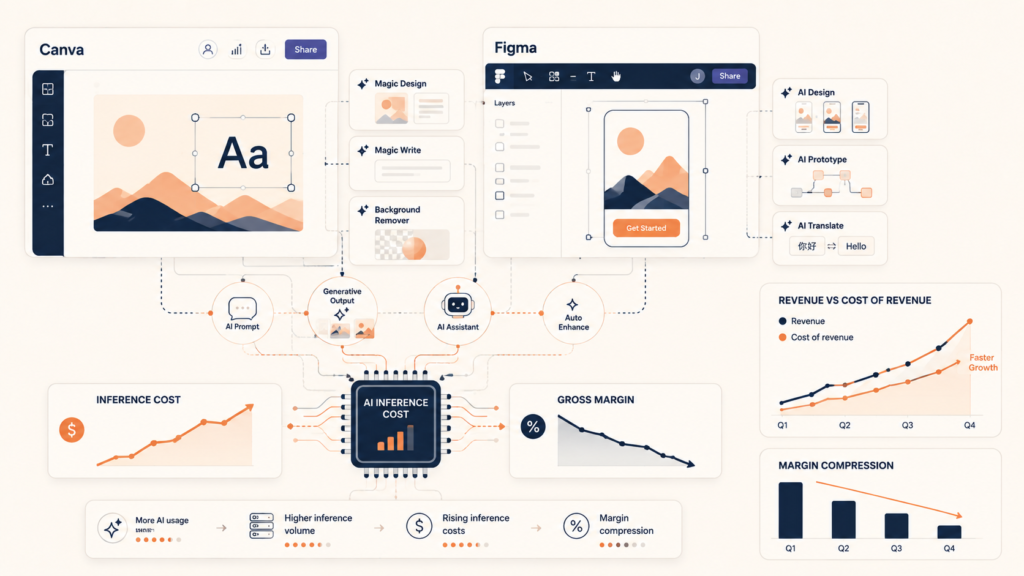
| TL;DR: Every AI feature a design company ships comes with a bill it didn’t have before. Inference costs scale with usage, and that is now showing up in real financials. Canva slowed its AI rollout to fix the unit economics before they broke the business. Figma’s cost of revenue grew more than twice as fast as its revenue in a single quarter. Both are now building pricing models to recover that cost, and how well that works will define the next chapter of the SaaS business model. |
For a decade, software companies operated on a promise: build the product once, sell it to millions, and watch margins grow. Every new customer added revenue while the incremental cost of serving them remained relatively low. That simple math was a big part of what made the SaaS model so valuable.
Generative AI changed the equation.
When users started demanding AI features, the cost of serving each request showed up on the income statement. It was not a one-time investment, but a recurring bill that grows with usage. Unlike traditional SaaS features, many generative AI interactions carry an inference cost that grows with how intensively customers use the product.
Canva cut its expected revenue growth rate by a third because of it. Figma’s free cash flow margin fell from 24% in Q2 2025 to 14% in Q2 2026. The two companies shared those numbers within five days of each other, pointing to the same broader pressure. The question now is whether this is an early warning for the rest of the industry or simply the cost of doing AI right.
The Cost That Didn’t Exist Before
SaaS was built on a structural advantage. The incremental cost of serving another customer was generally low relative to the revenue that customer generated. Every new seat added to the top line while the cost base grew slowly.
Inference doesn’t work that way.
Every AI request costs money to process. Derek Hernandez, PitchBook’s senior research analyst covering SaaS and AI, described it to Fortune this way:
His analogy sharpens the point. Training a model is like building a Ford F-150. Inference is the gas, the mechanic bills, and everything it costs to actually keep that truck running. Traditional SaaS already had ongoing infrastructure costs. Generative AI adds another cost that scales much more directly with how intensively customers use the product.
For instance, Canva users on AI 2.0 are creating three times as many designs as they did on the previous version. That jump in usage is exactly what makes the economics harder to manage.
Businesses consuming AI face the same need for visibility from the other side of the bill. WitnessAI is designed to show which employees, agents, and activities are driving AI spending as usage grows.
Two Companies, Same Pressure, Different Disclosures
Canva CEO Melanie Perkins told Fortune that demand for AI features “significantly exceeded” expectations. Rather than roll out broadly and bleed margin, the company chose to slow the launch, rebuild the architecture, and fix the unit economics first.
Figma’s cost of revenue more than doubled year-over-year, from $27.9 million in Q2 2025 to $60.5 million in Q2 2026. Revenue grew 48% in that same period. Whereas GAAP gross margin compressed from 89% to 84% as a result. AI inference is one documented contributor to that cost pressure, although Figma does not break out exactly how much of the increase came from AI specifically.
The company remains profitable on a non-GAAP basis, posting $36.1 million in non-GAAP operating income for Q2. It also raised full-year revenue guidance by $40 million, to between $1.463 billion and $1.467 billion. So this is not a business in distress. The bigger issue is what happens to margins as AI usage continues to grow.
Over 80% of Figma’s paid customers with more than $10,000 in ARR were consuming AI credits weekly as of June 30, 2026. That level of adoption makes the cost of AI consumption increasingly difficult to separate from the broader margin story. For software companies using AI to build products, that spending can require even more detail. CodeROI is trying to connect AI-assisted development activity to the R&D record behind a tax claim.
Hernandez told Fortune that both companies are “the biggest signals” that AI is changing SaaS’s cost structure. One showed it through a slowdown while the other showed it through a margin line.
What the Numbers Mean for What Comes Next
Canva continues to evaluate a potential IPO. While 2026 had previously been discussed as a possibility, the company may now be looking at 2027. And if it does go public, improving unit economics beforehand will be more than a technical exercise; it will be a business necessity.
Canva has reduced cost per AI task by nearly 90% since launching Canva AI 2.0 in April. That is a significant improvement. However, usage is rising just as quickly, leaving Canva to balance lower costs per task with a much larger volume of AI consumption.
Figma has been public since July 2025, so investors can already see these economics playing out quarter by quarter. It is beginning to monetize AI consumption through credit add-ons and pay-as-you-go usage. Over 50% of paid customers with more than $10,000 in ARR were already using the Figma agent weekly as of July 31, 2026. That shows just how quickly AI usage is becoming part of the product experience.
The old SaaS playbook assumed that once you built the product, the hard part was over. Canva and Figma are showing that with AI, shipping the feature is just the beginning. The real work is making it economically sustainable at scale.