| TL;DR: Before an insurer offers coverage, underwriters must piece together information about a business from application forms, property records, and past claims. Convr’s DocData brings those details into a risk summary in minutes, highlighting inconsistencies that may need clarification. Brokers can use it to review applications before submission, while underwriters get a clearer starting point for assessing the business. This helps them focus on evaluating risks and following up on important details before deciding on coverage and pricing. |
Before an insurer agrees to cover a business, someone has to piece together what it does and what could go wrong. That information is spread across several documents, from the application form to records of past claims. For instance, an application may describe a business’s operations, while its claims history reveals incidents that aren’t mentioned in the application.
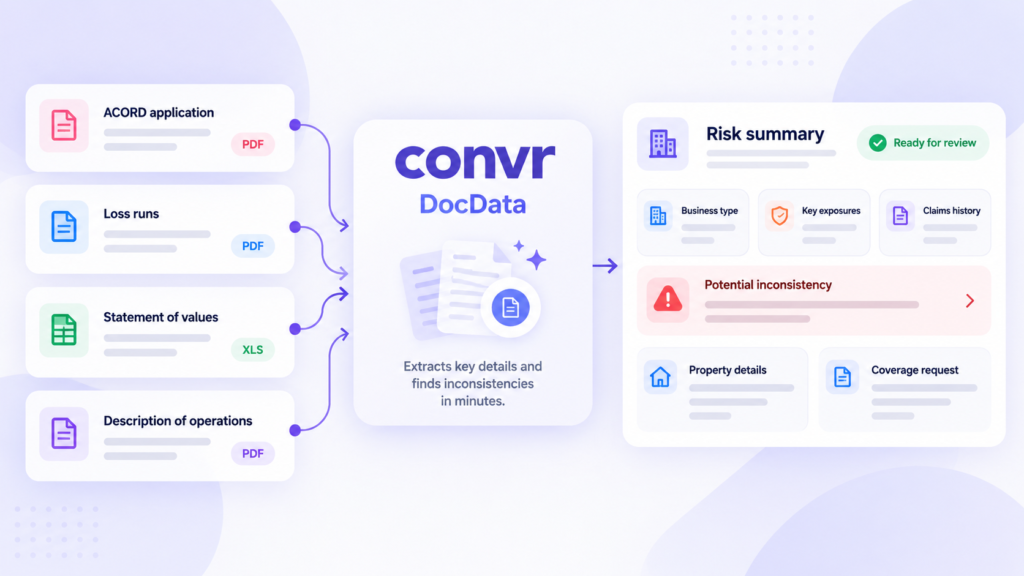
Convr’s DocData, launched on September 8, is commercial insurance submission processing software built to speed up that work. Brokers and underwriters upload the application documents and get a risk summary back in minutes.
That launch comes at a time when insurers are competing for business but cannot afford to overlook details that could affect a risk assessment. It also raises a practical question: does a faster read lead to a better underwriting decision?
Insurers are Competing, but Clear Information Still Matters
Commercial insurance buyers have more room to negotiate across much of the market. Global commercial insurance rates fell 5% in the third quarter of 2026, according to Marsh. This marked the ninth consecutive quarterly decline, reflecting sustained competition among insurers.
However, falling rates don’t mean insurers take every account. They still need to separate the risks they want from the ones that need a closer look. Clear submissions help underwriters assess applications with fewer follow-ups, while giving buyers a better chance of securing terms that reflect their actual risk.
Aon’s second-quarter market overview says high-quality risk data and clear submissions are becoming more important to winning favorable renewal terms.
For brokers, the goal is a submission an insurer can assess without chasing missing details. For underwriters, it is getting to the substance of an account quickly. Both need a usable picture of the business before the conversation can move forward.
The Application is Only Part of the Account
Each insurance document captures a different part of a business and its risks. ACORD forms are standardized applications containing information about the business and requested coverage. Loss runs record previous insurance claims, while statements of values list properties and their insured values, often in spreadsheets.
A description of operations gives context to the claims history, and property details show what could be exposed to damage. Commercial insurance submission processing software helps bring those records together for review. The summary needs to retain details such as the types of work a business performs, its previous claims, and the value of its insured properties.
For example, a contractor applies for liability coverage. Its ACORD form describes the business as residential remodeling. Its loss runs, however, show a past property-damage claim arising from work on a commercial building. The difference does not necessarily mean either document is wrong. When read together, however, they raise a question about the kind of work the contractor actually takes on.
Document-heavy legal work creates a similar challenge. Law In Order’s approach to AI-assisted document review separates what software can surface at scale from the relevance and judgment calls that still need a professional to interpret the evidence in context.
An underwriter would want clarification before preparing a quote, and a broker would rather resolve the issue before sending the submission. If left unexplained, the discrepancy could delay the insurer’s response or affect the coverage terms and pricing.
An Accenture survey of 430 senior underwriting executives across life and property and casualty insurance found that 65% considered ineffective systems a major challenge. In the same survey, 40% cited poor information access or organization.
This is where DocData brings AI insurance submission processing to this early document review. According to Convr, it summarizes a business’s operations, potential exposures, and loss history using information from the uploaded files. It also flags inconsistencies, such as the difference between the contractor’s stated operations and its claims history.
“Carriers, MGAs, and brokers share the same interest in perfecting application data while reducing handling time,” said Convr founder Harish Neelmana.
In practice, brokers can use the summary to check an application before sending it, while underwriters can use it as a starting point for their review.
DocData Returns a Risk Summary without an IT Project
To use DocData, users first request access. Once approved, they upload documents through convr.io, and Convr says the summary is ready to download within minutes. Each submission can include up to three attachments, such as ACORD forms, loss runs, statements of values, and spreadsheets.
According to the company, DocData requires no integration work or changes to the system an insurer uses to administer policies. That could make it easier for insurers to test the tool, particularly when integration is already a concern. In an April 2025 Lloyd’s Market Association survey of 81 London-market firms, 46% cited integration as a barrier to AI adoption.
With the platform, brokers and underwriters can try insurance submission summary software without first taking on a wider technology project.
Faster Reading Has to Lead to a Useful Next Question
In June 2026, Coleman Parkes surveyed 350 senior commercial and specialty underwriters in the US and UK for hyperexponential. Among respondents, 51% said AI had primarily saved time on manual administrative work. Only 21% reported improvements in decision quality.
Saving time on document review doesn’t automatically improve underwriting decisions. Insurance AI is running into the same issue elsewhere in the workflow. Majesco’s insurance AI agents can complete routine claims work faster, while employees still handle exceptions and make the decisions that require judgment.
For a summary to be useful, it must retain details that could influence an underwriter’s assessment, such as previous claims or the value of an insured property.
For instance, when DocData flags a discrepancy, such as the one in the contractor’s records, the underwriter knows where further clarification is needed. The broker or applicant may still need to provide that information.
The same preparation-versus-decision boundary appears in financial investigations. Feedzai’s Farol gathers case information and prepares material for fraud analysts, while the analysts still review the evidence and make the final judgment.
Ultimately, DocData’s job is the overview. Deciding what coverage to offer, and at what price, stays with the underwriter.
Five Familiar Accounts Can Make the Trial More Informative
Convr offers five free submissions during a user’s first five days and recommends testing the tool on familiar accounts. After all, that gives reviewers a reference point for judging insurance document processing software, since they already know the business behind each summary.
Reviewers can check whether the tool captures known claims and exposures or overlooks anything important. They can also go a step further and assess how much time the summary saves and whether they still need to spend considerable time verifying or clarifying the information.
Cost is another consideration when insurers evaluate AI tools. In the same Lloyd’s Market Association survey, 48% of firms cited cost combined with uncertain returns as a barrier to adoption. DocData’s free submissions allow buyers to assess the summaries before paying for more submissions. After the trial, users pay per submission by credit card, with charges based on the number of submissions processed.
DocData is the Front Door to Convr’s Underwriting Workbench
DocData is one part of Convr’s broader AI Underwriting Workbench, which offers AI underwriting software for commercial insurance, including intake automation, submission prioritization, risk insights, and workflow capabilities. Convr positions the platform as the place to start. Buyers who find the summaries useful can add those capabilities later without repeating onboarding.
Underwriting AI has already shown it can save time. A faster read becomes more useful when it shows what needs closer attention. DocData is built for that first read, so underwriters can spend their time judging the risk instead of piecing it together.