| TL;DR: AI is helping law firms research and draft faster, but clients still need to understand what they are paying for. BigHand’s research highlights a gap between widespread AI use and changes to how work is organized. Firms still need to account for review and legal judgment when assessing savings. Experienced support staff often hold knowledge about that work, yet retirement puts it at risk. Preserving their knowledge could help firms explain delivery costs, while leaving clients and lawyers to agree on how the savings should be shared. |
Many law firms are using AI to speed up research and first drafts. Clients may get answers sooner, but a faster draft does not settle what the finished work should cost.
If a task takes fewer hours, should the bill fall with it? And how should the fee account for the expertise and checking needed to make the answer reliable?
To answer those questions, firms need to know where the time goes on each matter and why some jobs take longer than others. After all, experienced support staff often know exactly where the extra work comes from.
Briana McCrory, Chief Marketing Officer & EMEA Revenue Officer at BigHand, spoke with SaaSTake about what she is seeing across legal tech. She points to a growing risk as firms rethink work around AI: experienced support staff may retire, taking with them knowledge the firm has never written down.
Clients are Doing More of the Work Themselves
Clients are using AI too, and it is changing how much work they send to outside firms.
Everlaw and Wakefield Research surveyed 300 US in-house legal professionals in 2026. Among the departments that hire law firms, 54% are outsourcing less because of AI. Before hiring an outside firm, these clients consider what their in-house lawyers can handle with AI.
These clients still need outside lawyers, but firms have to show what they add beyond what clients can do in-house. And that’s where the traditional billable hour becomes harder to defend. McCrory puts it like this:
“For decades, the billable hour has been the measure of legal work,” she said. “But just because something takes less time doesn’t mean the expertise, judgement or value of the advice has reduced.”
In other words, fewer hours don’t automatically mean less value. That does not mean every AI-assisted task should cost the same as before. However, when the hours go down, firms need another way to show clients what the advice is worth.
The same pricing tension appears in Burford Capital’s view of law firm economics. AI can give lawyers hours back, but firms and clients still have to decide who receives the financial benefit of that efficiency.
Clients Expect New Fee Models, but Firms are Still Catching Up
Clients are increasingly expecting law firms to rethink their fees. Thomson Reuters found that 71% of in-house legal professionals expect outside firms to change how they charge. So far, only 28% of law firms say they have changed their pricing in response to AI.
That gap is at the heart of the problem, according to McCrory. He adds:
Clients aren’t necessarily seeing lower bills yet. Axiom surveyed 510 in-house legal leaders and CFOs at large companies across six countries for its 2027 budget report. Of those surveyed, 59% said law firm fees had risen while AI was presented as added value.
So firms have to explain what clients are paying for when AI is part of the process. Clients may expect lower bills, while lawyers still have to stand behind their advice and check that the work is accurate.
US ethics guidance also sets limits on how lawyers can bill for AI-assisted work. The American Bar Association’s Formal Opinion 512 says lawyers billing hourly must charge for the time they actually spend. That can include entering information into an AI tool and reviewing what it produces.
The opinion also requires flat fees and other arrangements to be reasonable. Flat fees give clients more certainty, but firms still need to understand the work before setting a price. For instance, if AI speeds up drafting but review still takes considerable time, firms need to account for both when calculating the fee.
A Faster Draft is Only Part of the Job
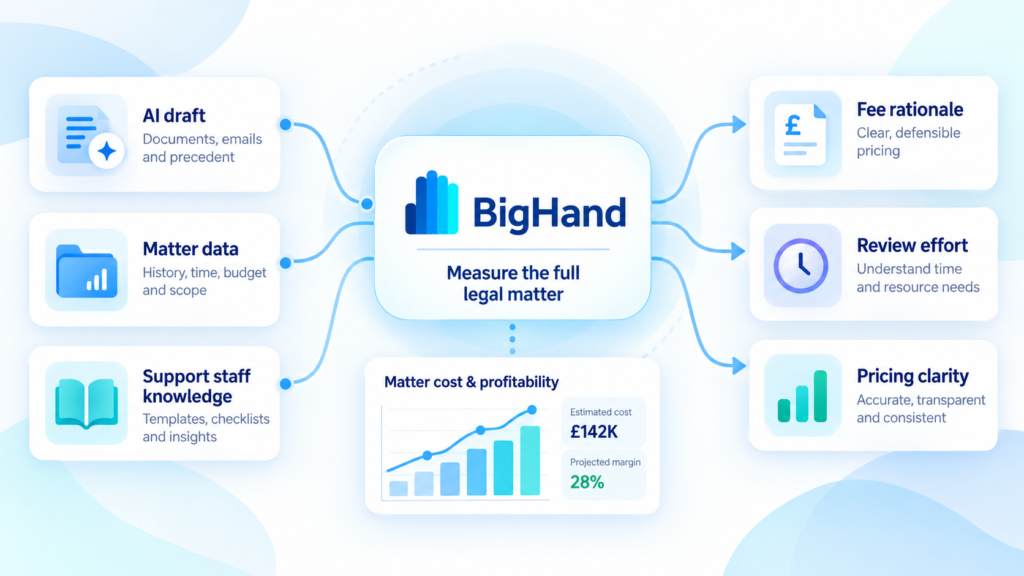
BigHand makes pricing and workflow software for law firms. Its 2026 Legal Workflow Leadership Report surveyed more than 800 law firm leaders and managers across the UK and North America. It found that 96% of firms use AI in support services, but only 27% have redesigned their workflows around it.
Law firms can run into the same gap after adopting the technology. Harbor’s research into legal AI adoption found firms could track things such as licenses, training, and usage while still struggling to measure whether AI was creating business or client value.
However, generating a draft is only one step in the process. Someone still has to check it and decide whether it is ready for the client. The same report found that 46% of firms say AI output needs extra supervision, and 45% are spending more time checking work. These findings do not show how the additional review time compares with the time AI saves across a completed matter.
If nobody owns that step, a faster draft just lands sooner in someone else’s queue. And unless firms measure the whole job, including review, they won’t have the numbers to explain what AI actually saves or how that affects their fees.
Support Staff Departures Put Essential Knowledge at Risk
McCrory believes the legal industry focuses too much on technology and lawyers and too little on the people who keep the business running. These roles include secretaries, executive assistants, pricing specialists, and finance professionals. They know where things tend to go wrong, which exceptions need special attention, and whom to contact when the usual process breaks down.
Those exceptions can be difficult to capture because experienced employees may no longer think of them as separate decisions. Caddi found the same problem while mapping legal workflows for automation, where routine-looking processes often depended on knowledge employees had developed through repetition.
A departing head of pricing can take years of commercial knowledge with them. An experienced assistant may know which simple-looking request needs far more preparation than anyone expects.
That makes the prospect of retirement particularly concerning. BigHand’s research found that 51% of firms expect to lose 21% to 50% of their support staff to retirement within five years. And 29% call the lack of a standard way to hand over that knowledge a major challenge.
McCrory has a simple question for managing partners and COOs:
It’s a question that can reveal gaps faster drafting won’t fix. A firm may have records of past fees but no note on why some matters ran over budget. Its written procedures may also skip the exceptions long-serving staff handle every day.
Pricing AI Work Starts Before the Invoice
The debate about AI and legal fees usually centers on the hours a tool saves. But here’s the harder part: does a firm understand its own work well enough to price it? That understanding rarely sits in a system. Instead, it lives with the people who have done the work for years.
Firms that capture this knowledge before those people leave will be better placed to show clients what an AI-assisted matter really took to deliver. After all, clients are already asking that question. And when firms can answer it with more than a timesheet, they have a stronger basis for explaining their fees.