| TL;DR: AI is making patent research faster, but speed alone does not make a match useful. Patent owners, licensing teams, and IP counsel still need to know whether a product actually connects to the claim and what evidence supports that connection. ClaimHit V3 searches broadly for possible matches, filters weak candidates, and builds evidence-backed claim charts that professionals can examine before deciding what deserves further attention. |
Patent research has always been constrained by time. A company may own hundreds of patents, but determining which ones actually are being infringed by products can require extensive technical and legal work. AI is changing that equation by making it possible to examine far more patents and product material in less time.
That sounds like a straightforward win. However, it isn’t quite that simple. In February, a federal judge fined lawyers $12,000 after AI-generated material in a patent case contained fictitious quotations and legal citations. The episode exposed a larger problem for patent intelligence. AI can widen the search dramatically, but the results still need to trace back to real products and evidence.
ClaimHit released V3 into that gap. The platform searches for products connected to a patent claim, then checks those matches against supporting evidence. That points to a question the market is about to face. What makes an answer useful when both sides can run the same analysis?
Patent Analysis is Moving from Scarcity to Abundance
Patent portfolios have traditionally been narrowed using signals such as citation counts, family size, and how broadly the claims are written.
Those measures help teams decide where to look first. However, they do not directly answer a more commercial question: which products in the market may actually be covered by the claims?
Even the signals used to prioritize patents have their limits. A 2013 study using licensing revenue from tens of thousands of patents found that citations did not rise neatly with value. The most valuable patents drew fewer citations than patents in the middle of the range.
What is changing is how much direct investigation can now be done. AI is reducing one of the biggest constraints in patent research: the amount of analyst time available to examine patents and products. That change is already visible across AI patent search tools, where semantic and AI-assisted search can surface relevant patents without relying only on traditional keyword queries.
According to Reuters, AI patent search tools are already being used in patent litigation to search prior art and review technical material. They can also help lawyers prepare patent infringement searches and claim charts, cutting the volume of material that has to be read manually.
The commercial market is moving toward the same kind of patent-to-product analysis. In June, Questel and PioneerIP announced a patent-to-product workflow that matches portfolios against products already on sale, aimed at licensing and enforcement decisions.
The point is not that search no longer matters. It is that search is becoming easier to scale. As more patents and products can be examined directly, the ability to search broadly becomes less of a constraint. The harder question is what happens after the search. What matters is whether the matches found in that search actually hold up when someone opens the evidence behind them.
ClaimHit Starts with the Claim and Shows its Work
ClaimHit released V3 in July after a soft launch at IPBC Global in San Diego. The company says more than 20 patent owners and licensing executives tested it using patents they already knew well.
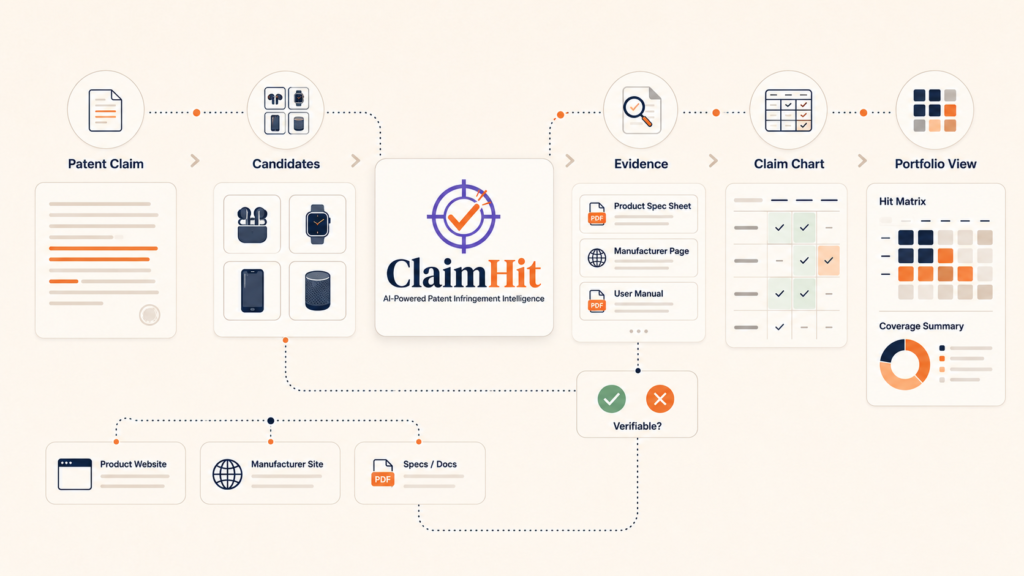
The platform starts with the claim rather than with statistics about the patent. Several AI models propose possible products, alongside searches across the open web, product and specification libraries, citation records, and competitor data.
ClaimHit then checks whether those products fit what the claim actually requires. Its methodology confirms each candidate against a live source, tests whether it is the right category of product, and traces it back to a manufacturer page. Products that fail those checks are dropped, and the user can see which ones were dropped and why.
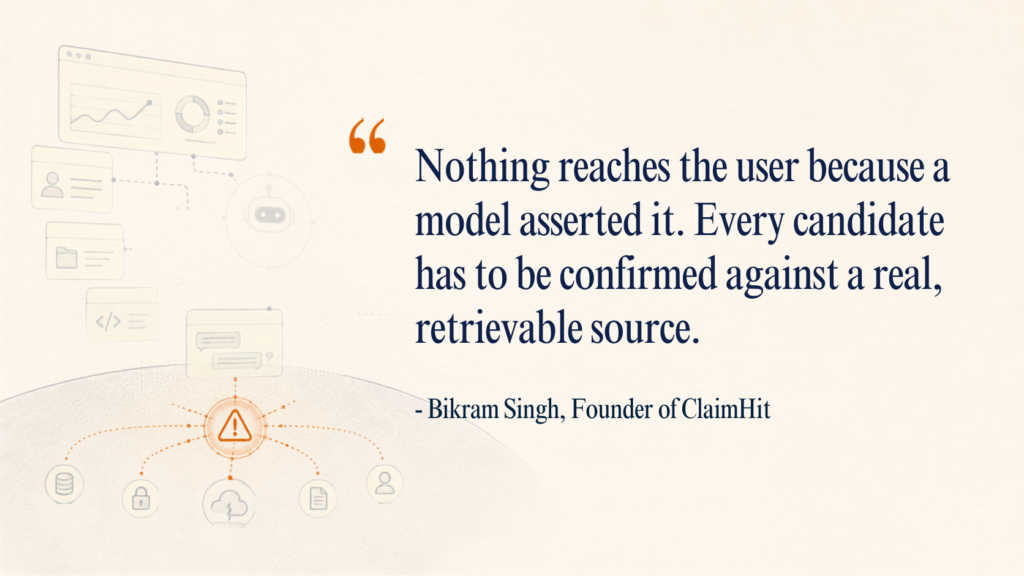
Bikram Singh, ClaimHit’s founder, said that separation between discovery and evidence is deliberate. He adds:
From there, a user can choose a product and generate a claim chart. The chart breaks the patent claim into individual requirements and maps each one against supporting evidence about the product, giving the user a more detailed patent claim analysis.
That distinction between an AI signal and a legal conclusion appears elsewhere in IP too. CopySight treats similarity scores as a reason for further review, rather than treating the score itself as a finding of infringement.
The Hit Matrix Turns a Portfolio into a Market Map
V3 also moves beyond looking at one patent at a time.
Its Hit Matrix places patents across one side of a grid and companies across the other. When a patent has a product that fits its claims, the cell fills in. The grid builds while the search runs, so a user watches the pattern take shape, then opens any filled cell to examine the evidence behind it.
That creates a different way to read a portfolio. If several patents point toward products from the same company, a licensing team can examine that cluster together. One patent appearing across products from several companies may deserve closer commercial attention. An empty row can also be informative, because it means the search found no sufficiently supported match within the evidence it examined.
“In practice the matrix is the map, not the message,” Singh told SaaSTake.
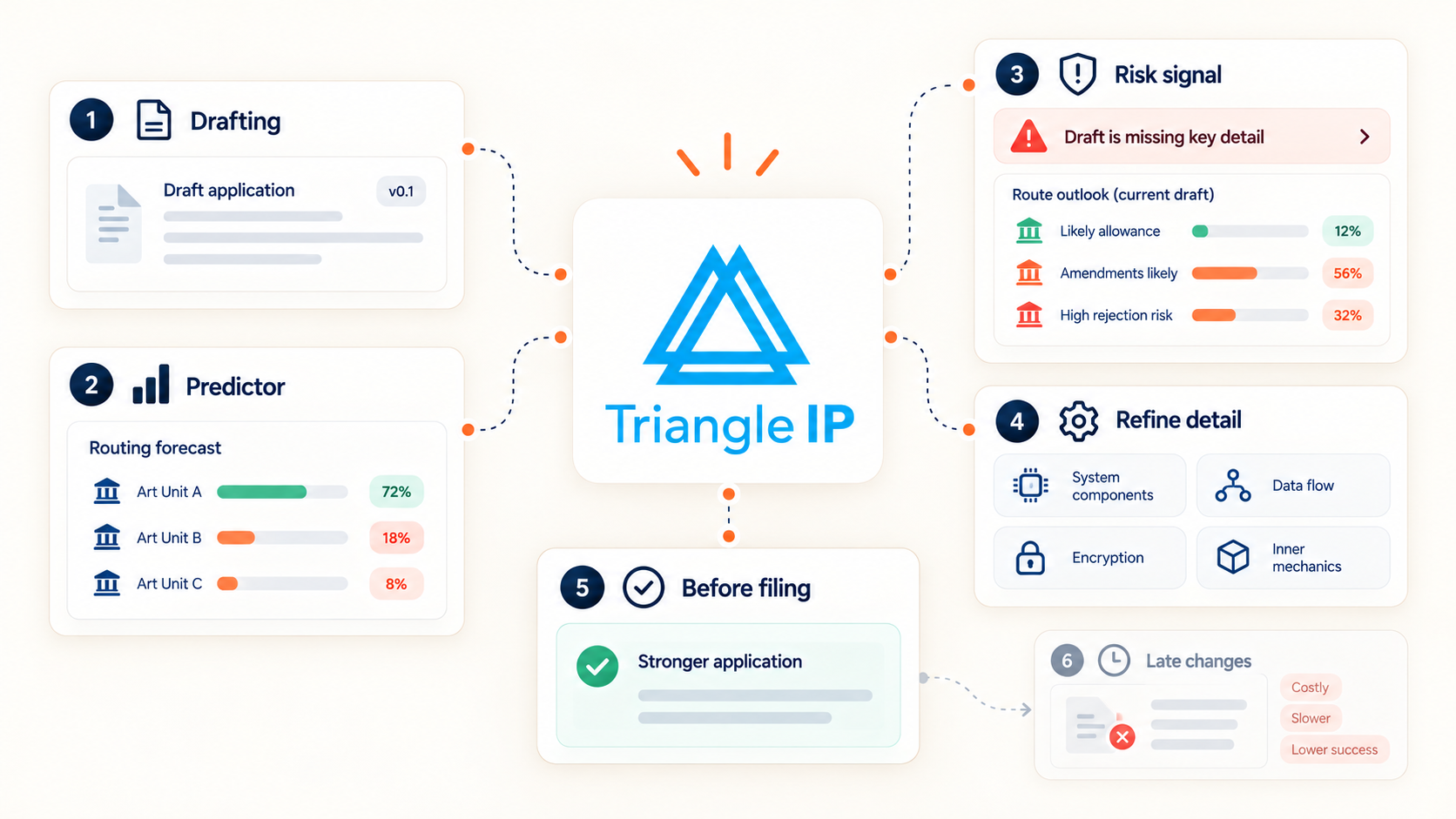
He says teams still choose the strongest patents from that map and build detailed charts for counsel before anyone is approached. Once counsel is needed, there is another decision to make: which attorney should handle the work. Triangle IP’s Prosecutor Analysis Tool uses historical USPTO data to help enterprises compare individual prosecutors before hiring them.
That makes the matrix useful for an early question: where is there enough evidence to look closer? For anyone evaluating a portfolio commercially, the grid answers a question a score cannot. It shows how far into the market a patent actually reaches.
SEPs Show Why More Analysis Needs Better Evidence
The same change is becoming visible in standard-essential patents, or SEPs. These are patents that may cover technology needed to implement an industry standard.
The volume of SEP data is growing, but so is the amount that has gone through additional verification. In June, PATENTSCOPE added pool-verified SEP records covering more than 9,000 patent applications. These records have gone through verification by participating patent pools rather than relying only on the patent owner’s declaration that the patents are essential.
A month later, the database widened its broader SEP coverage from more than 206,000 to over 450,000 distinct patent records by adding related ETSI patent-family information. That creates a much larger pool of information to analyze, but more data also makes it harder to distinguish useful records from claims that still need to be checked.
In other words, the pool is getting bigger. So is the need to know what can actually be trusted.
AI is pushing in the same direction by making portfolio-wide SEP analysis more practical.
Portfolio-wide SEP analysis is becoming economically practical for the licensor and for the company implementing the standard. Both licensors and companies implementing standards can increasingly examine entire portfolios rather than relying on small samples.
Moreover, both can produce their own claim charts. The analysis itself is no longer necessarily the scarce part. The question stops being who has an analysis and becomes whose analysis survives being checked. That is where the evidence question becomes harder to avoid.
According to Singh:
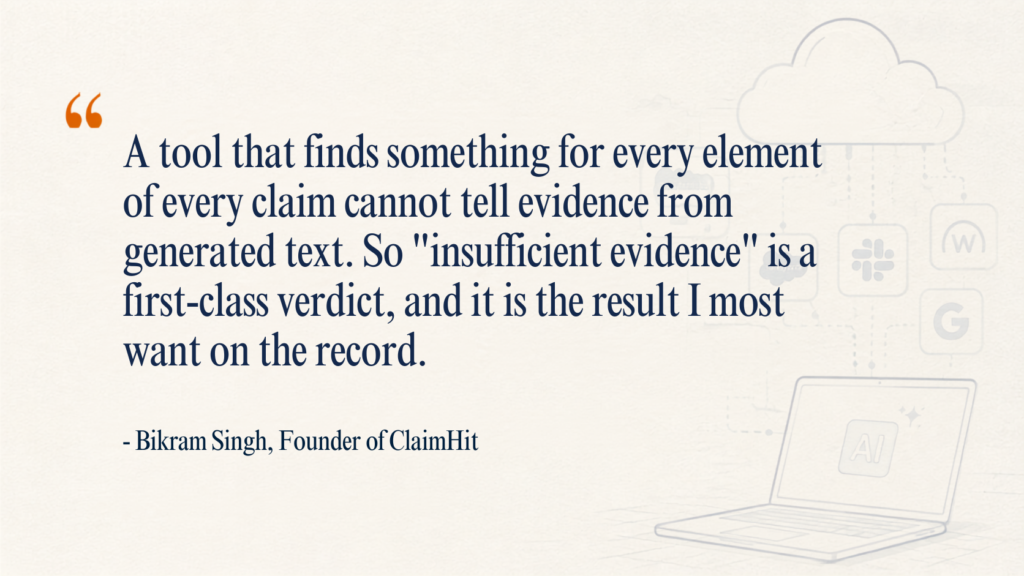
He says ClaimHit also tracks which release of a standard a chart is built against. Requirements can change between versions, and something mandatory in one release may be optional in the next.
The Value is Moving from More Answers to Better Evidence
For years, patent intelligence was limited by how many patents and products a team could afford to investigate properly. AI is loosening that constraint. Broader searches are becoming practical, and first-pass analysis can now arrive much faster.
That changes what carries value. As AI makes it easier to generate candidate matches, finding one is only the beginning. What matters increasingly is the evidence underneath it and whether another professional can independently check it.
ClaimHit has built V3 around both sides of that process. It searches broadly for candidates, while keeping a record of what it rejected alongside what it retained. The company describes its output as preliminary research rather than a legal determination, with final judgment left to qualified counsel.
Ultimately, patent intelligence is moving toward a different test: not simply how many answers AI can produce, but how clearly the strongest ones can be traced back to evidence.