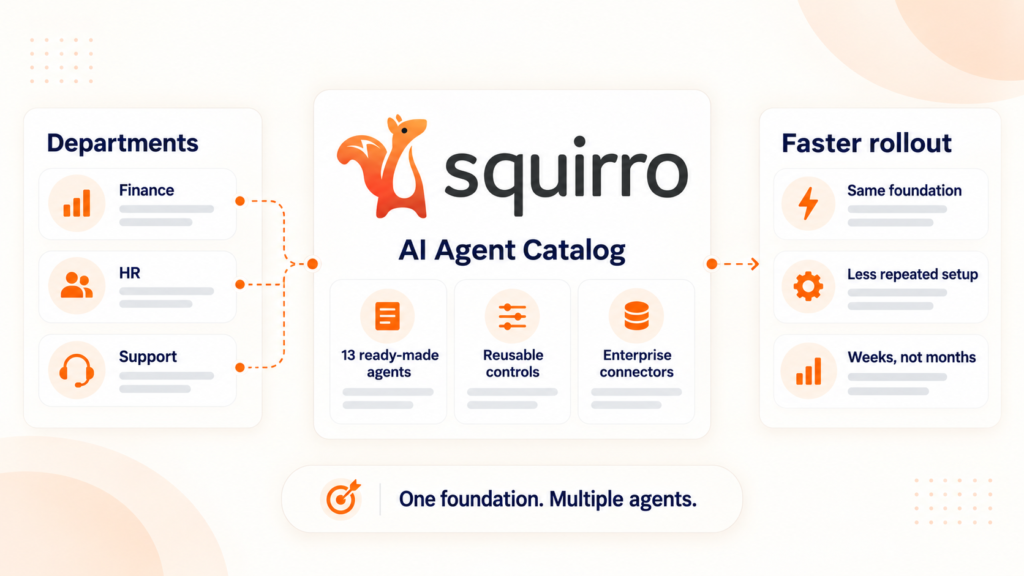
| TL;DR: Adding AI agents across departments can mean repeating the work of connecting systems and securing approvals. Squirro’s catalog of 13 ready-made AI agents is designed to reuse that groundwork when another agent is introduced. It can shorten deployment from months to weeks in regulated businesses, depending on the task. For enterprise buyers, each agent becomes worth judging by how much easier it makes the next one. |
A bank’s first AI agent, set up to search regulatory documents, finally clears compliance. Getting there meant deciding what the agent could read and lining up every approval it needed.
Then another department asks for an agent to answer expense-policy questions. Soon after, a third request lands.
Suddenly, the hard part isn’t the agents themselves. It’s the security and integration work behind them. And if each new agent needs months of that same preparation, adding AI across departments becomes a much bigger commitment.
So does the bank really have to do it all again?
In July, enterprise AI company Squirro launched a catalog of 13 ready-made AI agents for areas such as finance and HR. That’s the problem the AI agent catalog is meant to address.
More Departments Mean More Systems to Connect
More companies are now using enterprise AI agents in several departments, not just one. In McKinsey’s August 2026 survey, 56% of respondents said their organizations used AI in three or more functions, up from 51% a year earlier. The more departments that adopt AI, the more systems, data sources, and permissions those agents have to work with.
Each department brings its own information and processes. Sales might need customer records and past proposals. HR needs employee policies, and not everyone should see all of them. So an agent can’t just have access to everything and call it a day. It has to work within those limits before it can be useful.
In an interview with SaaSTake, Léo Dufour, GTM Lead at Squirro, said the AI model is actually the easy part. The harder work often starts once the model has to fit into a real business. Newer vendors, he said, often learn this the hard way:
That difficulty also appears in research on software suppliers. Paragon, which provides integration software, surveyed 600 B2B SaaS leaders in 2026. Integration reliability was the most frequently cited barrier to deploying agents, with 52% of respondents naming it. By comparison, 34% cited model hallucinations, or invented answers.
Even a capable model needs reliable access to the systems employees already use. After all, an agent can’t do much if it can’t get to the information it needs. That integration layer is also a major consideration when evaluating enterprise agentic AI platforms, where connector depth, governance, and auditability can matter as much as the agent itself.
When another department wants an agent, those same connections have to be considered again.
The First Deployment Does More Than One Job
The catalog gives buyers several ready-made agents to choose from. One agent can search regulatory documents and show its sources. Another can turn a customer request into an SAP quotation.
Those are very different jobs. However, they don’t necessarily need completely different groundwork underneath.
Reuse is becoming part of the agent conversation elsewhere too. Bit Cloud gives coding agents context about components a company has already built, so they can start with what exists instead of recreating it.
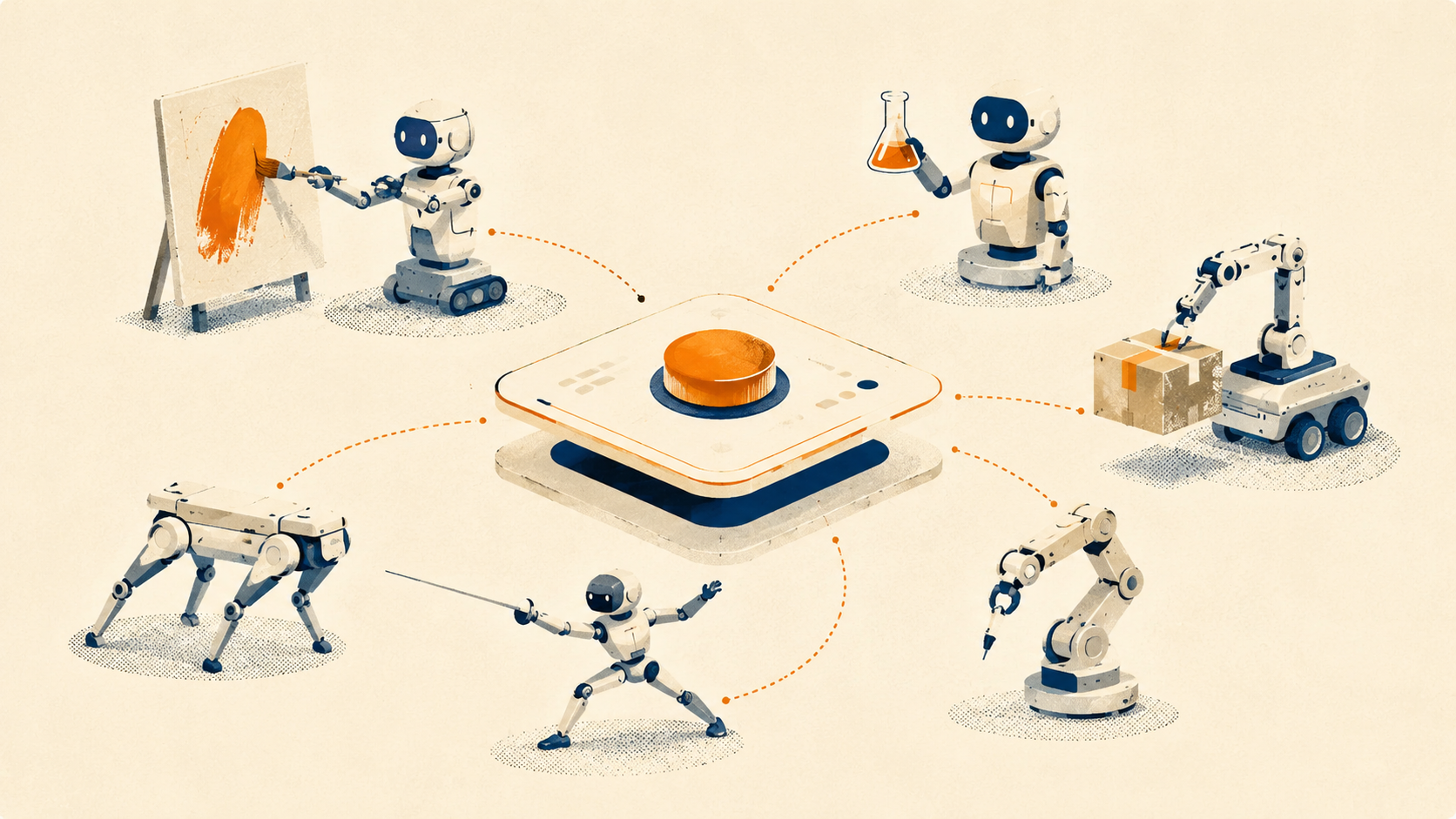
The agents also share the same underlying setup. That includes the system connections and compliance work that later agents can build on. Dufour said work with institutions like Deutsche Bundesbank has shown how much enterprise buyers need before they adopt anything. Access controls and full audit trails, he said, are essential for enterprise buyers.
That’s why the first AI agent deployment is such a big job. It determines what information the agent can use and how the organization checks its answers.
For the bank, all that work gets the regulatory search agent into employees’ hands. If some of that work carries over to the expense-policy agent, it pays off a second time.
The Second Agent Changes the Deployment Calculation
In regulated businesses, Dufour said, the first security and compliance review alone can take months. But once it’s approved, the next agent doesn’t have to go through the same process from scratch.
He explained what happens after that first review:
Still, deploying the second agent faster doesn’t necessarily mean deploying it with less scrutiny. An agent answering expense questions needs different information from one preparing quotations. Each still needs permissions suited to its job.
That becomes harder as the number of agents grows. Oak’s work on AI agent identity governance shows why enterprises also need visibility into what each agent can access and who remains responsible for it.
Microsoft takes the same approach to governing enterprise agents. It recommends standard connections that departments can reuse, with a fresh review of every new data source and permission.
For the bank, the expense agent could build on connections and approvals already in place, while still getting the access it needs for its own job.
The Next Agent Still Has to Work with What’s Already There
Of course, reusing a connection only helps if it works with the systems the business already runs.
Dufour said Squirro’s 200-plus deployments give it a head start when customers need to connect another system or meet another compliance requirement. He added that its compliance frameworks have been tested in audits and its platform used in high-stakes environments. He said that experience is difficult for newer vendors to replicate:
The bank is unlikely to replace every application that holds relevant information. After all, its agents still have to work with the systems it already has.
Those connections also create another layer to manage. Salt Security is looking at how agents reach company applications and data through APIs and MCP, including whether they use tools beyond the access their role requires.
The Setup Has to Change with the Business
For the bank, the expense agent won’t be the last request. Down the line, it might swap out its document system or buy another business. Either change could force its agents to work with new sources of information.
Dufour said changes like these mean updating what’s already in place rather than starting again. In practice, new data sources and compliance requirements can be added without rebuilding everything from scratch.
In the end, Squirro is asking buyers to judge AI differently. Not just by what an agent can do on day one, but by what it leaves behind for the next.