| TL;DR: Companies keep investing in AI even when spending exceeds budgets, leaving finance teams to explain where the money went. CloudZero’s AI Signals shows which departments and employees are spending, what work they use AI for, and when costs rise unexpectedly. This helps teams investigate increases, but proving value requires evidence of results. A bigger AI bill may be justified if it means more customer requests resolved or useful work completed. |
A rising AI bill can mean very different things. Employees might be getting useful work done faster, or an automated process might be making costly AI calls without producing anything useful. Finance needs to know whether the extra spending is paying off, but the invoice rarely provides that answer.
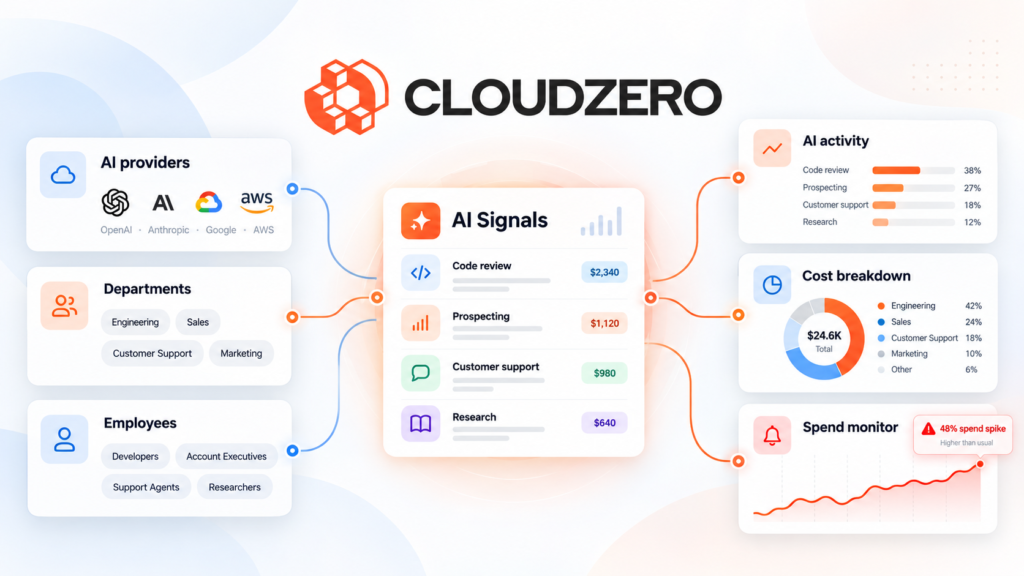
That gap is what CloudZero is targeting with AI Signals, which it announced on September 23. The product breaks AI spending down by department and person, then names the work behind it, such as code review or prospecting.
The launch comes as companies try to decide how much more to spend on AI. They want employees to keep finding uses for it, but they also need to explain why the spending should continue. And yet even when AI budgets run over, very few companies are choosing to stop.
Going Over Budget Does Not Mean Stopping
The pressure is visible in Futurum’s September survey of 1,636 enterprise technology decision-makers. Nearly 47% reported AI spending above budget. Among those running over plan, only 17.2% said they paused or reduced the initiative.
More commonly, respondents requested additional funding or absorbed the extra cost and reconciled it later. Staying committed comes with trade-offs, though. Among the 297 organizations shifting money within IT, 60.9% reduced spending on external contractors and consultants. In other words, an AI overrun can affect decisions well beyond the department generating it.
That does not make the shift wrong. A productive AI investment may deserve more funding. The harder part is proving that productivity produced something financially useful. Vaital’s AI implementation work starts with operational problems that can be tied to measurable costs or business results, rather than treating faster employee work as the outcome on its own.
The challenge, however, is that finance teams cannot decide where to invest more confidently unless they can distinguish productive AI use from avoidable costs.
AI Spending is Scattered and Hard to Predict
Companies often pay for AI through multiple vendors and business units, making total spending harder to track. McKinsey’s research on enterprise AI costs highlights this challenge. This makes AI cost management harder, especially when companies cannot see their total spending in one place.
An organization might pay for employee subscriptions while also funding AI features inside its products. Each provider may record usage differently, which makes it harder for finance teams to calculate total AI spending.
AI agents add another complication. They may use several AI models and software tools to complete one task, with each step adding to the cost. As a result, the final bill can be difficult to predict.
The same problem sits behind WitnessAI’s approach to AI cost management, which traces spending back through employees, agents, tasks, and model choices instead of leaving finance with only the provider’s total bill.
A Stanford Digital Economy Lab paper found that runs of the same coding task could use up to 30 times as many tokens as one another. Tokens are the units providers use to measure model input and output. What’s more, using more tokens did not reliably produce more accurate results.
CloudZero Puts a Name to the Work
CloudZero helps companies trace technology spending to the products and customers driving those costs. AI Signals applies that approach to employee AI usage, breaking spending down by the activities behind it. This gives finance teams a clearer basis for AI spend management when costs rise unexpectedly.
According to CloudZero, the Overview dashboard combines spending across providers and models, then categorizes it into more than 35 business activities.
Instead of just showing how many tokens a department used, the dashboard shows what employees used AI for, from debugging code to researching accounts.
Monitors, the second capability, watches for unusual AI spending and sends alerts through email or Slack. The alerts identify the people and activities behind the increase, helping the department investigate what drove the extra cost.
In the announcement, CloudZero’s VP of Finance, Dan Carducci, described AI as “the most evasive line in my forecast.”
For finance teams, that means forecasting AI spending and investigating unexpected increases before those costs pile up. For finance teams, that means forecasting AI spending and investigating unexpected increases before those costs pile up. This kind of visibility is central to AI FinOps, which focuses on understanding and managing AI spending as usage grows.
CloudZero says prompt and session data remain inside the customer’s own cloud environment. That may ease concerns about exposing sensitive conversations. Organizations would still need to understand what usage data CloudZero collects and who can access it.
A Spending Spike Can Be Good News
Not every spending spike signals waste. A company’s AI bill can rise because employees are using AI more often, even as the cost of each token falls. Token prices have fallen more than 90% since 2023, according to the Silicon Data Token Expenditure Index. Yet spending on large language models has doubled since late 2025, as companies run more AI agents and automate more workflows.
Software providers are seeing the same economics from the other side. Canva and Figma’s experience with rising AI usage shows how stronger adoption can increase computing costs even when the underlying product is performing well.
Suppose a support team’s AI bill rises because employees are processing more customer requests. If service quality holds and the cost per completed request falls, the increase might justify further investment. By contrast, the same increase caused by an AI tool repeatedly retrying failed tasks would call for a different response.
Some AI vendors already bill by the finished job. Fin, Intercom’s AI customer service agent, charges $0.99 per outcome, such as a resolved conversation, rather than per token.
That pricing model ties the charge to a defined result. CloudZero takes a different approach, helping finance teams trace AI costs to the activities behind them.
For companies pursuing AI cost optimization, that distinction can help identify where spending is justified and where it needs to be reduced. As AI use grows, companies need to understand both what they’re paying for and what those expenses deliver.
When is More AI Spending Worth It?
CloudZero is entering a market where other vendors are also linking AI spending to business results. In August, IBM opened a public preview of Apptio AI Value & ROI. It lets customers evaluate AI initiatives against selected measures, such as shorter cycle times or avoided costs.
Knowing that marketing used AI to draft content explains the expense, but not its value. To understand the return, finance also needs to know whether the team published that content and whether it helped achieve a measurable result. In the 2026 Wharton and GBK Collective AI adoption report, 35% of managers and more senior respondents tracking a growth measure reported strongly positive returns. Only 13% of those tracking efficiency alone said the same.
CloudZero sums up its approach as capping the accident rather than the bet. Ultimately, the payoff comes when companies can distinguish a bill that deserves to grow from one that needs reining in.