 uses the same natural-language approach for data-security investigations, letting teams question findings while keeping the eventual action subject to human approval. For instance, an analyst can ask how much data each computer on the organization's network transferred over the last 24 hours. The [generated query appears alongside an explanation](https://investigator.corelight.com/docs/nlq.html) of how the system interpreted the question and constructed the search. More importantly, analysts can inspect and change the query instead of treating the AI's answer as final. This makes it easier to understand how a search was constructed, an important part of making natural language network investigation auditable. Rather than relying on an opaque answer, analysts can examine the query and its results directly. So, when evaluating this capability, buyers weighing AI alert triage tools should ask to see the generated query alongside its results.](https://saastake.com/wp-content/uploads/2026/11/Auditable-AI-Investigation-Flow_11zon-1024x576.png)
| TL;DR: An AI tool can flag a threat without giving analysts enough evidence to act. Checking its conclusion can mean repeating the investigation. Corelight’s Agent Builder Library gives AI agents documented steps to follow and connects verdicts to supporting network evidence. Its Natural Language Query lets analysts ask follow-up questions in plain English, then inspect and edit the searches it generates. The goal is to help analysts verify findings without starting over. |
An AI system flags a possible data theft. It names the computer involved and labels the activity suspicious enough to investigate. The analyst reviewing it still has a decision to make: does the evidence justify that conclusion?
If the analyst has to repeat every search the AI performed, the automation hasn’t removed enough of the investigative work.
Security operations centers, or SOCs, need findings their analysts can check before acting. That is the buying problem behind AI SOC tools with auditable investigations.
Corelight, which turns network activity into evidence for security teams, addresses that need with two capabilities introduced in September. The update adds reusable investigation playbooks and plain-English searches. For buyers, that raises a practical question: how much work should remain between an AI verdict and a human decision?
Security Teams Need Help They Can Verify
The pressure to automate is understandable. In ISACA’s 2025 research, 55% of respondents said their cybersecurity teams were understaffed.
However, automation doesn’t always reduce the workload. Security tools can also create work of their own. Splunk’s State of Security 2025 found that 46% of respondents spent more time maintaining tools than defending their organizations. Only 11% trusted AI completely for mission-critical tasks.
With trust that low, buyers evaluating AI SOC tools need more than faster recommendations. They need findings analysts can verify without having to repeat the investigation.
Fraud teams face the same problem after an alert. Feedzai’s Farol assembles case information for investigators while leaving the final judgment with the analyst.
In the announcement, Vijit Nair, Corelight’s senior vice president of product, described speed without expertise as “just fast guessing.” To address that gap, Corelight says its new tools make that expertise available to AI agents through reusable investigation guidance.
Playbooks and Network Records Show How the AI Reached Its Verdict
An AI investigation is easier to audit when analysts can see the steps the agent followed. Corelight’s Agent Builder Library puts that expertise into reusable triage playbooks and investigation decision trees that can guide automated SOC investigations. Supporting guides explain what each data field means and how analysts can follow connections between devices, users, and other entities.
The company says each AI verdict links back to the playbook used, the behavior that triggered the alert, and the evidence supporting it. For buyers comparing AI SOC investigation tools, the important question is whether vendors can demonstrate that trail rather than simply describe it.
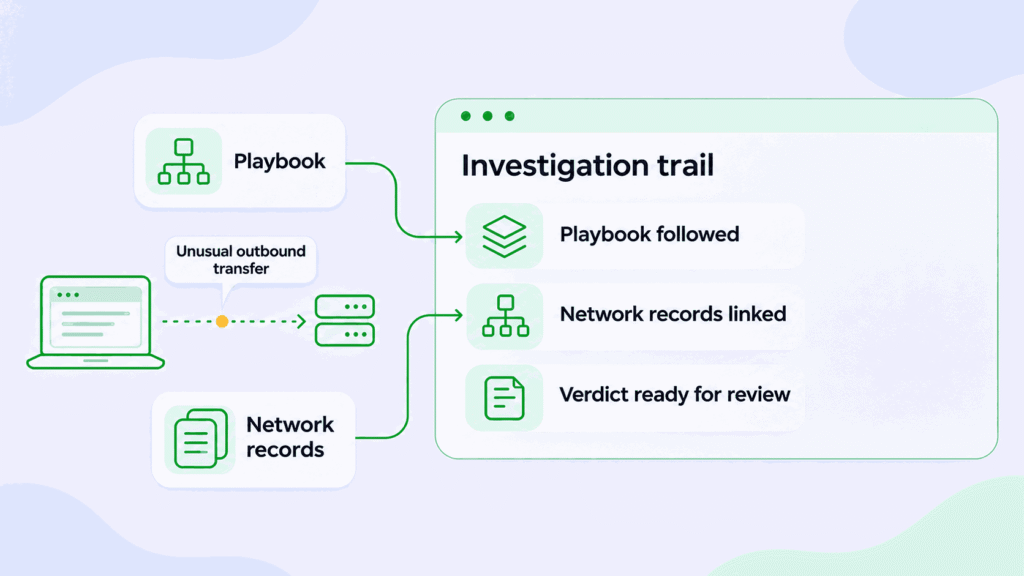
Consider a hypothetical alert about unusually large outbound transfers. An analyst would want to see which computer sent the data and where it went. They would also want to know how unusual the activity was for that computer. A persuasive summary alone would not answer those questions.
Legion Security’s DragonClaw approaches the problem from another angle. Its orchestration layer uses an organization’s existing security workflows and analyst knowledge to coordinate agents and answer investigation questions.
This is where network evidence becomes important. Corelight builds on Zeek, the open-source network security technology created by its founders, to provide detailed records of network activity. Analysts can use those records to check whether an alert is supported by what happened on the network. Corelight’s own attack simulations suggest that the evidence supplied to an AI agent can influence its findings more than the model it uses.
After all, in explainable AI security operations, a result is only as useful as the evidence supporting it. The data deserves as much scrutiny as the AI.
An Explainable Verdict Can Still Be Wrong or Slow to Check
A visible trail makes review possible but does not prove an investigation is correct. The UK National Cyber Security Centre has flagged this risk. AI assistance could speed up investigations, it says, but poorly supported AI can create false confidence or miss important context.
There’s another distinction buyers need to consider: transparency and efficiency are not the same thing. A system can document every step and still leave analysts rechecking each query and record. That makes its decisions easier to review without making the investigation much faster.
Accuracy is another concern. An AI system can produce different results when given the same task more than once. In an August 2026 experiment, Cisco Talos tested 66 model and reasoning combinations on a synthetic log-review task. Scores varied substantially across some configurations, and adding more reasoning effort did not consistently improve results.
Corelight’s playbooks focus on the investigation process itself. The company says their logic is deterministic, meaning fixed rules decide which step comes next based on the evidence. However, that consistency applies to the investigation steps, not necessarily to every answer the AI model produces.
Plain-English Search Makes the Next Question Easier to Ask
Even a well-documented finding can leave an analyst needing another search. Corelight’s Natural Language Query converts questions written in plain English into LogScale queries that analysts can run in its Investigator platform.
Teleskope’s Kosmo uses the same natural-language approach for data-security investigations, letting teams question findings while keeping the eventual action subject to human approval.
For instance, an analyst can ask how much data each computer on the organization’s network transferred over the last 24 hours. The generated query appears alongside an explanation of how the system interpreted the question and constructed the search.
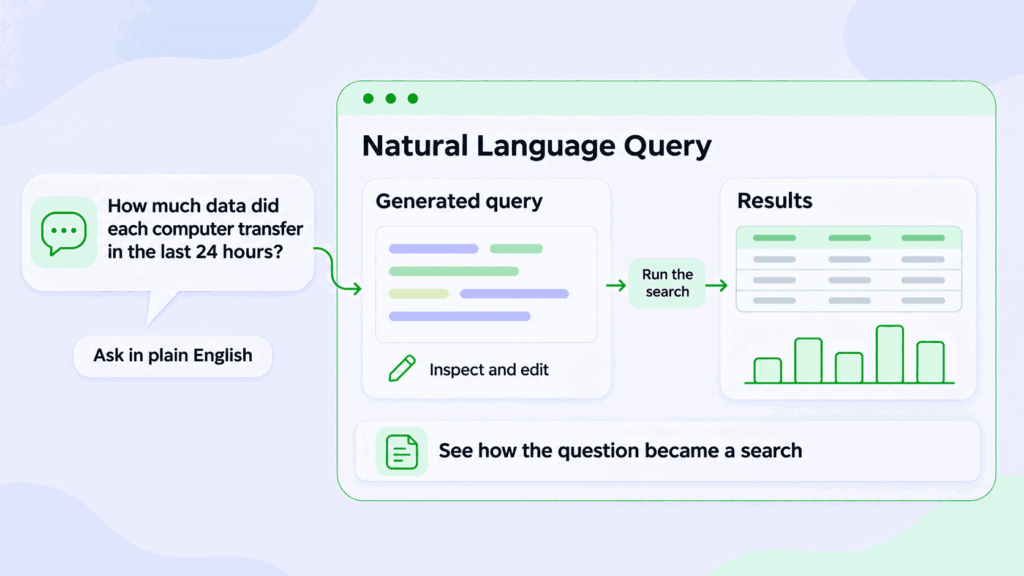
More importantly, analysts can inspect and change the query instead of treating the AI’s answer as final. This makes it easier to understand how a search was constructed, an important part of making natural language network investigation auditable. Rather than relying on an opaque answer, analysts can examine the query and its results directly.
So, when evaluating this capability, buyers weighing AI alert triage tools should ask to see the generated query alongside its results.
Can Buyers Reuse Investigation Playbooks in Private Environments?
Regulated organizations often restrict where AI can run. Corelight says customers can export its SOC investigation playbooks and use them with their own AI agents, SOAR workflows, and privately hosted AI models.
This is particularly relevant for organizations using air-gapped environments, where systems have no external network connection. The exported playbooks can be brought into those environments. In Corelight’s announcement, Omdia analyst Andrew Braunberg called logic that runs outside a vendor’s cloud “a primary evaluation criterion” for many buyers.
There is an important distinction, though. Exporting the library does not mean every Corelight AI feature runs offline. Natural Language Query, for instance, requires customers to enable the GPT Private Data integration. Buyers should confirm where each feature’s model runs and whether data leaves their network. They should also ask how updates reach a disconnected system.
One Alert Can Show How Much Work an AI SOC Tool Saves
For network-focused security teams, a practical way to assess these capabilities is to request a demo using a representative alert.
Buyers should follow it from the first signal to the final recommendation, then compare investigation and review time with their usual process. They should also note any unanswered questions an analyst still needs to resolve.
Ultimately, that puts Corelight’s proposition to a practical test. Its documented investigation process has to help analysts reach a supported decision with less work. As AI takes the first look at more alerts, that result will say more about a tool than a polished verdict alone.