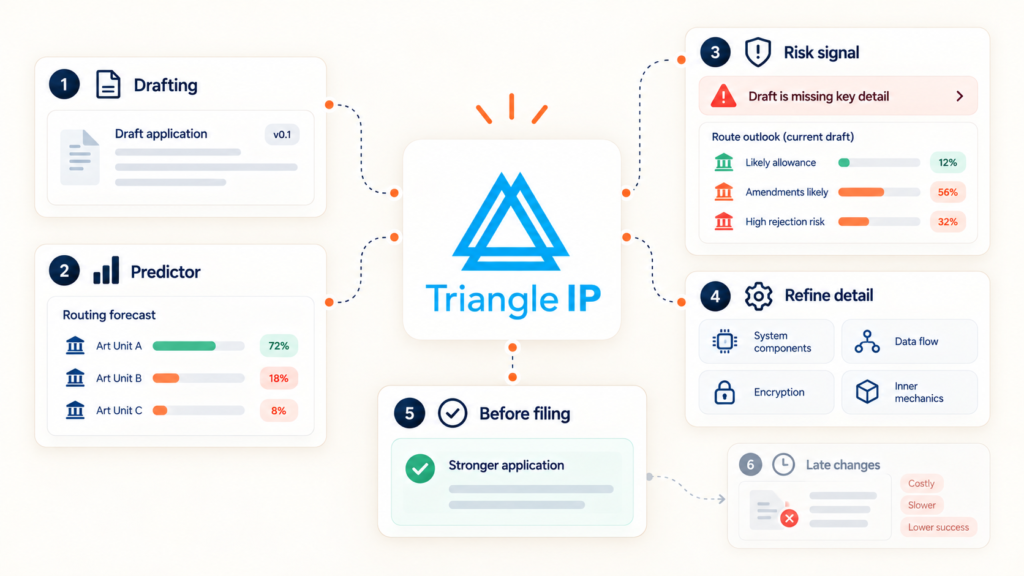
| TL;DR: Patent teams often discover how difficult the prosecution process is for certain applications only after the patent office assigns an examiner. By then, changing how the invention was presented is much harder. Triangle IP’s Predictor estimates the likely CPC classifications and art units before filing, along with the terms influencing that route. IP teams can run it from an early idea summary, refine the application as more detail emerges, and predict again while there is still room to act. |
A company can spend thousands of dollars drafting and filing a patent application. It may only later discover that the USPTO has classified and routed it into an examination area with a relatively low historical allowance rate.
By then, the application is already in prosecution. The examiner has been assigned, and changing how the invention was originally presented is no longer straightforward. What looked like a strong commercial idea can turn into years of responses, amendments, and legal bills.
Thomas Franklin, the founder of Triangle IP, has watched that happen throughout his 25-plus years as a patent attorney. He argues that prosecution strategy should start earlier. Through Triangle IP, he developed Predictor, a tool that helps patent teams forecast how an application may be classified and where it may land before they file it.
But seeing a difficult path ahead is only part of the problem. The harder question is what patent teams can still change before filing. Franklin says the answer once came down to replacing a few words. Today, the patent office is looking much deeper into the invention.
The USPTO Decides Where Your Application Goes
Before an examiner sees a utility patent application, the USPTO has to classify and route it. Cooperative Patent Classification, or CPC, codes describe the subject matter covered by its claims and play an important role in deciding who receives it. In 2020, the USPTO began using an automated system that compares those codes with examiners’ classification portfolios and considers their workloads before assigning the application.
Where the application lands can affect what happens next. After all, the examiner begins testing the invention against earlier work, and each objection can trigger another costly round of amendments.
Patent teams can use AI patent search tools to surface relevant prior art earlier, but that still leaves a separate question: which part of the patent office will examine my application?
Franklin puts it plainly:
“Once the case has been assigned to an examiner, there’s no real way to sit there and say, ‘Well, it should go somewhere else… Give me a better examiner.’ It doesn’t work that way.”
An examiner can still challenge a clear misclassification after receiving a new case. Beyond that, he says, the drafting stage is where patent professionals have the most room to influence where the application goes.
Not Every Patent Application Follows the Same Path
The different prosecution paths depend on how the invention is classified and where it is examined. Predictor estimates the CPC codes likely to apply to a draft and the Art Units where it may land, along with historical allowance rates for both.
Franklin uses encryption to illustrate the difference. An application that describes the underlying technology in detail may point toward computer architecture, where the historical allowance rate is closer to 80%. If the same underlying invention mentions encryption only briefly while focusing mainly on a commercial process, it may point toward business methods, where the rate, let’s say, is roughly 10% to 40%.
The differences can be even wider across CPC’s and Art Units. For art units alone, Predictor’s data shows historical allowance rates ranging from about 1% to 98%.
None of these rates determine whether a particular application will receive a patent. But they give patent teams historical context of the prosecution environment the draft may encounter.
Technical Detail Matters More Than Word Choice
It wasn’t always this hard to influence the system. About a decade ago, Franklin says, swapping “money” for “resource” could sometimes be enough to affect how an application was classified. Early prediction tools made those trigger words easy to spot.
According to him, the classification technology grew more sophisticated in response. He compares the back-and-forth to basketball, where the head fakes of 30 years ago would fool no defender today. The office’s 2020 switch also allowed routing to draw on more than one CPC code per application.
He says:
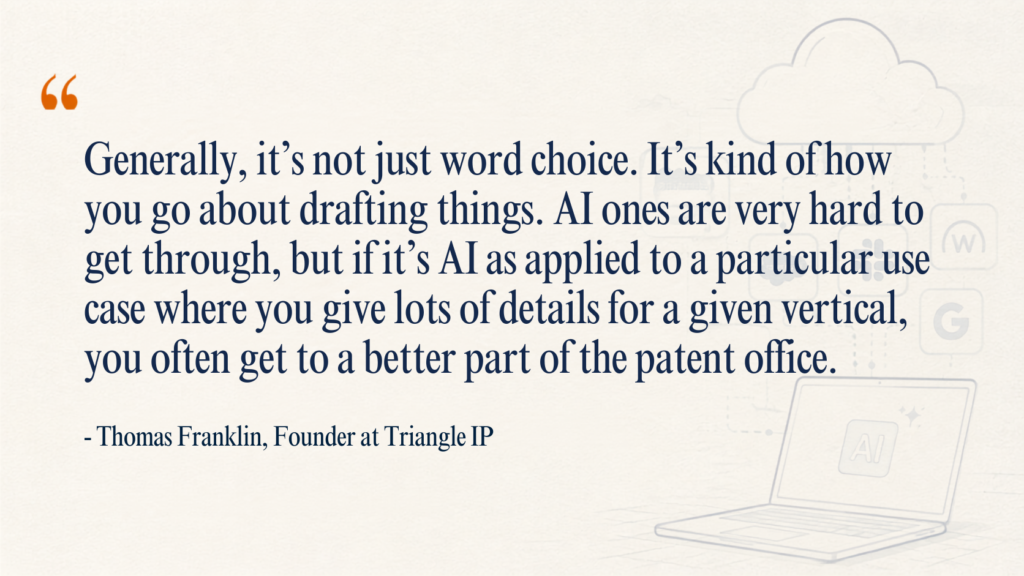
What makes the difference, Franklin says, is the technology behind the commercial process. He looks for details such as how information moves between systems or where encryption is applied. That is the level of detail he wants inventors to include in the draft.
Take graphical user interfaces as another example. A GUI invention described mainly through what appears on the screen may land in a tougher examination area. However, applications may land differently when the draft goes deeper into the system that makes the interface work.
The Predictions Show What the Draft is Missing
Franklin has long used prediction software to test a draft before it is filed. Predictive analytics is also becoming a broader part of patent intelligence software, alongside search, portfolio analysis, and drafting support.
Triangle IP’s Predictor tool estimates the CPC codes likely to be assigned to an application and the art units where it may land. It also highlights which terms in the draft are influencing those predictions.
Franklin reads the output as a pattern rather than a verdict. As per him:
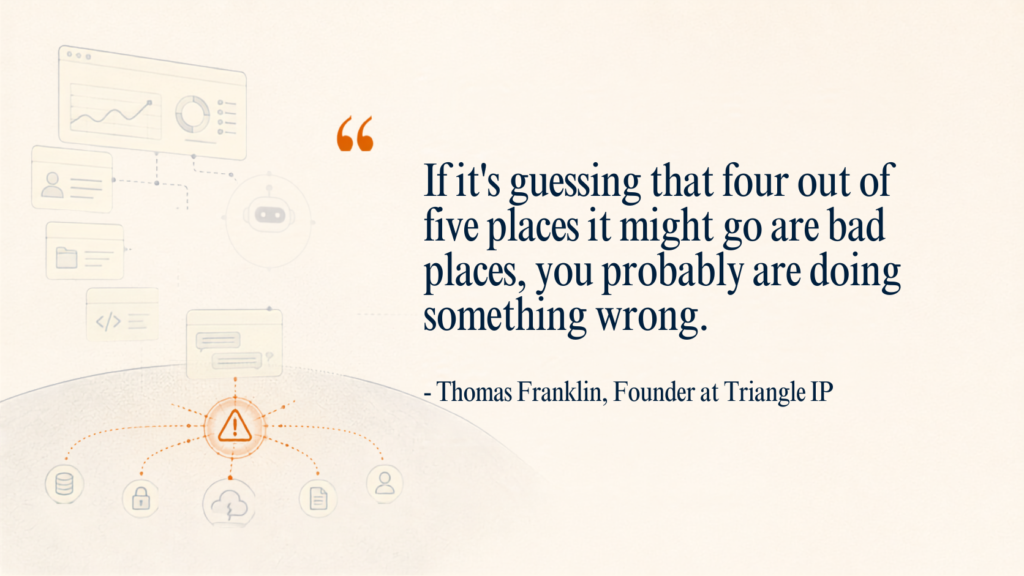
From there, he then compares the terms behind favorable and difficult predictions to see where the invention needs more technical detail. He has run the exercise so often that he now drafts largely by instinct. From the first meeting, he presses inventors for technical detail.
The Same Data Can Tell A Client to Stop
Prediction is usually framed as a way to improve prosecution strategy by identifying historically difficult areas before filing. Franklin sees equal value in using it to decide whether an application is worth pursuing at all.
A difficult forecast might send him back to the client for more technical detail. It could also show that the application is likely to reach a part of the patent office where the historical allowance rate is very low. Prosecution there may run through several costly rounds of argument.
Franklin recalls inheriting a case that had already landed with a difficult examiner. According to Franklin, the examiner told him during an interview that she had not approved a patent application in 20 years. By then, the application was already in prosecution, leaving fewer options for changing course.
Predictor brings some of that visibility forward. If repeated predictions point only toward CPC codes or Art Units with very low historical allowance rates, a patent team may decide that the expected prosecution cost no longer makes sense for the invention. In some cases, the better business decision may be to stop and put those resources toward another idea.
But that decision does not have to come from a single prediction. The forecast can evolve along with the invention.
See the Road Before You Take It
An invention rarely goes from idea to filing in one step. It gains technical detail, input from other inventors, new claims, and eventually a full draft. Each of those stages creates a new version of the invention to test.
That makes prediction more useful as a loop than as a checkpoint. Run it when the idea is still rough. Run it again as the invention develops. Run it again as the claims take shape.
The stronger habit may be a simple one: predict, refine, and predict again. The application is evolving. The prediction should too.