
| TL;DR: Prime Intellect’s $130 million funding round reflects growing enterprise demand for greater control over AI models, data, and infrastructure. Anthropic’s temporary suspension of Fable 5 offered a timely example of why relying entirely on frontier AI providers can become a business risk. |
Enterprises are building more and more important workflows on AI infrastructure they do not control. The temporary suspension of Fable 5 showed why that matters.
In June, Anthropic suspended access to the model after the US government export-control directive. The company announced the decision publicly and restored access in less than three weeks.
For most people in the AI industry, it was a small incident that quickly passed. However, for enterprises considering whether to build critical workflows on proprietary models, it highlighted a much bigger risk. They may use the model or build around it, but they still do not control whether it remains available.
That concern is now creating a market of its own.
The Risk Nobody Priced In
Enterprise AI adoption followed a familiar pattern. Companies found a frontier model that worked, integrated it, and built workflows, automations, and product features around it. Then they kept expanding its use.
Very few stopped to ask one operational question: what happens if the model goes away?
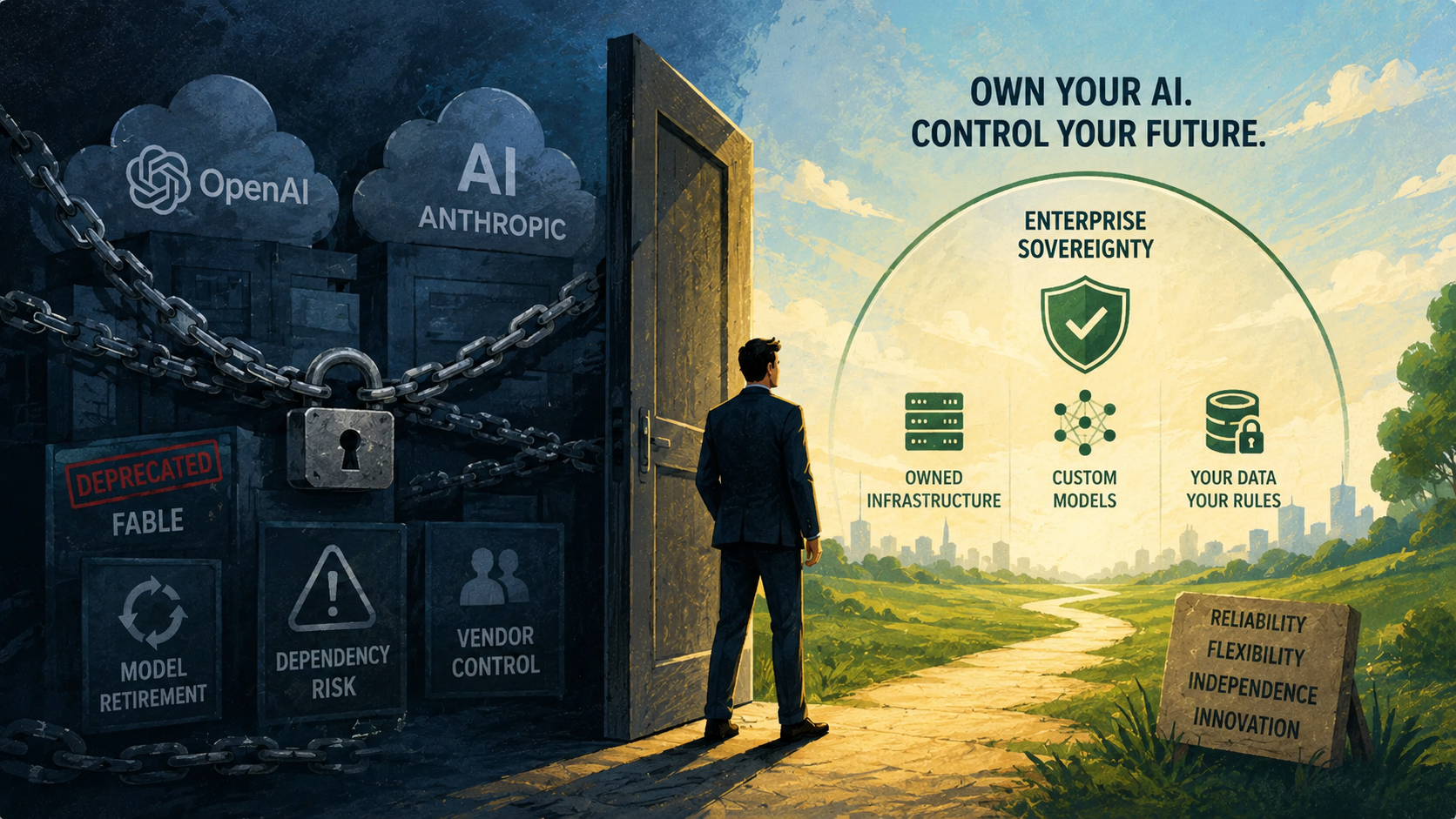
That risk is no longer hypothetical. Anthropic temporarily suspended Fable 5, while both Anthropic and OpenAI have deprecated or retired models as their product roadmaps evolved. These labs make decisions based on their own priorities, compute capacity, and future plans. Maintaining continuity for every enterprise using their models is only one part of that process.
For years, companies accepted this dependency because frontier models were difficult to replace. Use the capability and accept the risk. That calculation is now changing, and the temporary Fable suspension shows why.
Why Building and Optimizing Your Own AI Is Becoming Possible
Building and optimizing proprietary AI systems was beyond the reach of most enterprises until recently. The compute costs were too high. The right machine learning talent was difficult to find. And the necessary tools were fragmented and difficult to assemble.
Reinforcement-learning post-training is helping change that. Instead of waiting for a frontier lab to release a better model, companies can train models using their own products, workflows, and performance data. They can optimize them for specific tasks and continue improving them as they are used in production.
Prime Intellect describes this as owning the model optimization loop. Companies can connect training, evaluation, deployment, and inference instead of treating them as separate processes managed by different providers.
You do not need the full range of capabilities offered by a frontier model if you can build something that performs better for your specific use case. Over time, that model can become more closely aligned with your product and workflows. That shift has turned AI sovereignty from a broad idea into a practical infrastructure decision.
What Enterprises Are Actually Buying
The market emerging around this shift is already real. Ramp used Prime Intellect to train a 35-billion-parameter model that could find answers inside spreadsheets. It outperformed Claude Opus 4.6 on spreadsheet search while running 27% faster and 4% more accurately, and at a lower cost than Claude Haiku.
The important part is how Ramp approached the problem. Instead of waiting for a frontier lab to release a better model, it trained a specialist model around the workflow that mattered to its product.
That result gives enterprises a practical reason to reconsider how they buy AI. They are not only looking for model capability. They also want more control over how models are trained, evaluated, deployed, and improved.
Prime Intellect brings these components together through a stack that includes compute, large-scale reinforcement learning, environments, sandboxes, evaluations, inference, and deployment. Customers can use the parts they need without being tied to one complete vendor system.
The company reports that more than 6,000 customers are already using different parts of this stack, including AI startups, enterprises, and teams building their own models. That demand grew to more than $100 million in annualized revenue in under a year.
That does not suggest a small or isolated concern. It suggests that many companies were already waiting for a practical way to gain more control over their AI systems.
The Data Problem Is the Other Half of the Story
Reliability is one concern. Data control is the other, and it may be the more urgent issue for legal and procurement teams.
Enterprises that send proprietary information through OpenAI or Anthropic are still relying on infrastructure they do not own. Both providers offer commercial data protections and say that business and API data is not used for model training by default.
Even then, customers still depend on their contractual terms, data retention practices, service availability, and infrastructure controls. In regulated industries, that level of dependency can become a blocker before the conversation even begins.
Training and self-hosting an open-weight model on infrastructure you control can reduce the impact of a frontier lab’s deprecation schedule and data-handling policies. Using another hosted provider, however, removes one form of dependency without removing every infrastructure or data-governance concern. For some buyers, greater control over deployment and data is not just preferable. It may be a requirement.
The Sovereign AI Argument Is Now a Buying Signal
Prime Intellect CEO Vincent Weisser has said publicly:

Source – TechCrunch
A year ago, that may have sounded like a founder’s manifesto. Today, it connects more directly with procurement concerns around data residency, model portability, infrastructure control, and overdependence on a small number of vendors.
Nation-states are building their own compute infrastructure. Some enterprises are also bringing more model development and optimization in-house. The logic is similar. A government does not want a foreign lab controlling its intelligence infrastructure. An enterprise does not want an outside vendor controlling its entire AI stack. The concern is similar at every level. Only the stakes are different.
AI sovereignty is no longer just a talking point. Requirements around data residency, deployment control, and vendor independence are already appearing in government and public-sector procurement. These concerns are becoming increasingly important for enterprise buyers as well.
What the Fable Suspension Actually Did
The Fable suspension is unlikely to be remembered as a major industry event. It was a short interruption involving a newly launched model. A few months from now, it may barely be mentioned.
The dependency it highlighted will remain. The incident showed that model access can change because of regulatory, commercial, or technical decisions outside a customer’s control.
This is a structural issue rather than a problem specific to Anthropic. Companies move quickly, integrate deeply, and often delay asking what would happen if the infrastructure they depend on changes.
The demand for greater enterprise AI independence existed before Fable was temporarily suspended. The incident offered a timely example of the concerns investors, technical teams, and enterprise buyers were already discussing.
We believe that Prime Intellect’s $130 million funding round should be viewed in that context. Enterprises are no longer only asking which model performs best today. They are asking who controls the model, where their data goes, how the system can be improved, and whether the infrastructure will remain available when they need it.
Prime Intellect is betting that these questions will shape the next phase of enterprise AI adoption. Its early growth suggests that many companies are already preparing for that shift.