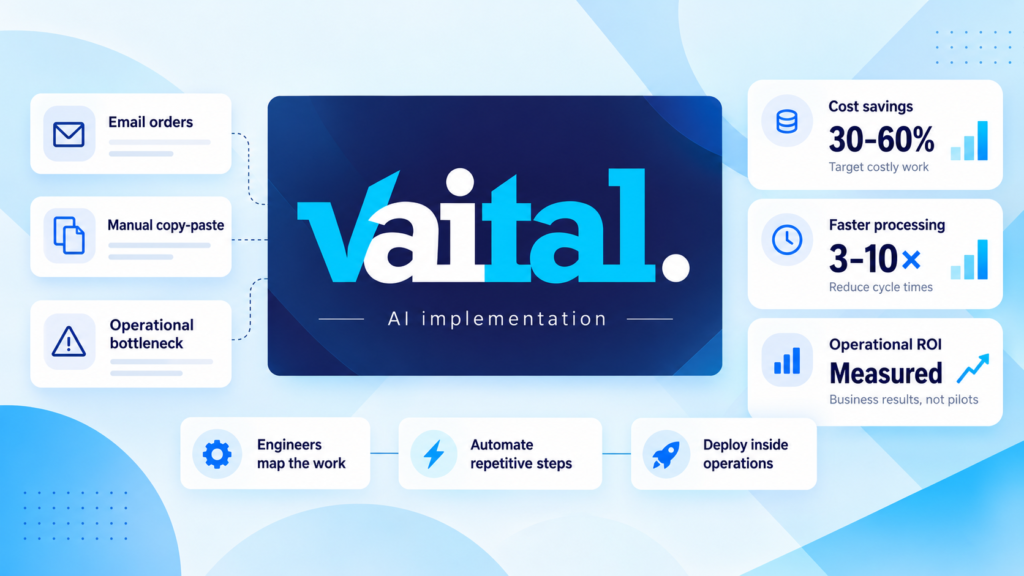
| TL;DR: Businesses want AI to improve earnings, but helping employees work faster does not automatically produce a financial return. Vaital puts engineers alongside employees to understand how work gets done and build custom AI systems into existing operations. The aim is to connect AI spending to measurable business results. As larger technology companies invest in similar approaches, the focus is expanding from what AI can do to what it delivers once businesses put it to work. |
A customer needs pallets of plywood picked up and emails the trucking company. The request arrives in seconds, but booking the pickup takes more work. Someone has to read the shipping document and type the details into the order system. Meanwhile, more requests keep coming in.
At PITT OHIO, a U.S. trucking and logistics company, this happened hundreds of times a day. Vaital, an AI strategy and engineering firm, helped the carrier automate it, cutting order handling costs by 70% through a targeted AI implementation.
Larger technology companies are also investing in AI engineering teams that help businesses put AI to work. Vaital takes a similar approach, placing engineers alongside employees to understand their day-to-day problems. But here’s the question: What does it take for this approach to save businesses real money?
AI Spending is Up, But the Returns are Harder to Find
Vaital is growing fast. It entered the 2026 Inc. Regionals Pacific list at No. 118, then debuted on the Inc. 5000 at No. 119 in the AI and Data category.
That growth comes at a time when businesses are pushing more money into AI while still figuring out how to get a return on it. In McKinsey’s August 2026 survey, 80% of respondents said AI improved their individual productivity. Only 37% could point to any impact on company earnings.
The gap isn’t surprising. Employees may finish tasks faster, but that doesn’t automatically lower costs. After all, businesses still need to find ways to turn those time savings into financial gains.
That measurement problem appears in legal AI too. Caddi argues that an hour saved does not automatically translate into an hour of financial value, which is why it looks for operational work where the business impact can be measured more directly.
Vaital CEO and co-founder David Yunger thinks too many leaders focus on hours saved rather than the financial impact of AI. He wants them to focus enterprise AI efforts on problems that affect profit or competitive advantage instead.
Engineers Start with the Work Employees Know
Vaital calls its implementation staff Forward Deployed Engineers. Yunger said they focus on the part of the work that causes the biggest problems, rather than starting with a list of things AI could do.
“FDEs don’t sit in an ivory tower writing 100-page slide decks about possibilities,” Yunger told SaaSTake.
At PITT OHIO, the work with Vaital began with a half-day planning session for its executives, which produced a ten-point AI roadmap. However, the first project came from the customer operations team, whose director wanted to automate pickup requests.
Her team handled those requests by hand. Yunger said the part of the job they hated most was manually cutting and pasting customer details from each shipping document.
Each request took five to 15 minutes. Customers sent the information in different formats. Employees repeated the same steps for every order, even though no two orders looked alike. When someone was out, or a request arrived over a weekend, customers waited.
Speeding up one step does not always fix the process around it. Majesco’s work with insurance AI agents looks at the same problem in claims, where a task can happen faster while the customer still waits for the next person or approval.
Vaital and the carrier built N@TE, short for No Touch Email. It pulls the shipment details from each email and creates the pickup order in the carrier’s system. Customers keep emailing as before.
Keeping the existing workflow intact can be as important as the AI itself. Squirro has made a similar point about enterprise agents: much of the difficult implementation work begins when AI has to connect reliably with the systems a business already uses.
Since deploying N@TE in 2025, PITT OHIO reports that it processes orders 30 to 60 times faster and cuts handling costs by 70%. The company also reports 99% accuracy in extracting and entering order data.
In other words, the project began with a routine task that was costing the company time and money. Fixing that specific problem gave the company a clear way to measure the results.
People Still Handle Part of the Work
According to Yunger, N@TE now handles 70% of incoming orders without anyone touching them. Employees still handle the remaining 30% of orders. He said this gives them more time to focus on those requests. It’s worth separating the two figures here: the 70% of orders handled without human intervention is different from the 70% cut in handling costs.
AI automation wasn’t just about processing requests faster. Vaital and PITT OHIO also had to decide which orders needed human attention and help employees adjust to the new system.
Yunger said N@TE surpassed manual data entry within 80 days. He put the accuracy of manual entry at around 80%.
Getting employees on board proved harder. You see, Yunger said many at PITT OHIO were skeptical about AI before the project began. He added:
Yunger said N@TE helped change employees’ views. They could see how AI handled a familiar task instead of worrying about what the technology might mean for their jobs.
No one was laid off because of the deployment, Yunger said. PITT OHIO created a Director of AI role instead, to take similar systems into other parts of the business.
That outcome stands in contrast to broader concerns about AI and jobs. In McKinsey’s survey, 39% of respondents expected AI to reduce headcount over the following year, while 14% said it had reduced their workforce in the previous year.
A Custom System Opens a Wider Business Opportunity
Vaital’s work with PITT OHIO has since expanded beyond N@TE. The firm says the partnership now supports a multi-year AI strategy. It isn’t keeping the system to itself, either. Vaital is also offering N@TE to other carriers and shippers.
PITT OHIO has reported a U.S. patent and joint licensing agreement, which could open the system to other transportation companies.
Vaital isn’t the only company pursuing this goal. On July 2, 2026, Microsoft announced a $2.5 billion investment in a new unit of about 6,000 experts placed inside customer businesses. AWS had committed $1 billion to a similar effort two days earlier.
The common goal is to make AI work inside the systems businesses already run, rather than leave companies to figure out implementation on their own.
Yunger argues that midmarket companies shouldn’t have to spend $20 million on consultants to start using AI. After all, as the PITT OHIO example shows, the first step can be as simple as fixing a costly task that starts in an inbox.