| TL;DR: A customer can get the right answer from an AI assistant and still fail to finish what they came to do. We spoke with Inbenta CEO Melissa Solis about what happens in that gap, and why it matters as financial institutions ask AI to do more than answer questions. |
A banking customer has a question. They search the help center, find the instructions, and try to follow them.
But somewhere between knowing what to do and actually doing it, they get stuck.
So they call support. The agent picks up, and the customer has to explain the problem all over again.
Nothing in that journey necessarily failed on its own. The help center may have surfaced the right information. The AI assistant may have answered correctly. The agent may eventually solve the problem. Yet the customer still had to move between channels to finish one task.
That raises a harder question for banks investing in AI-powered support: if the AI answered correctly but the customer still could not complete what they came to do, was the interaction actually successful?
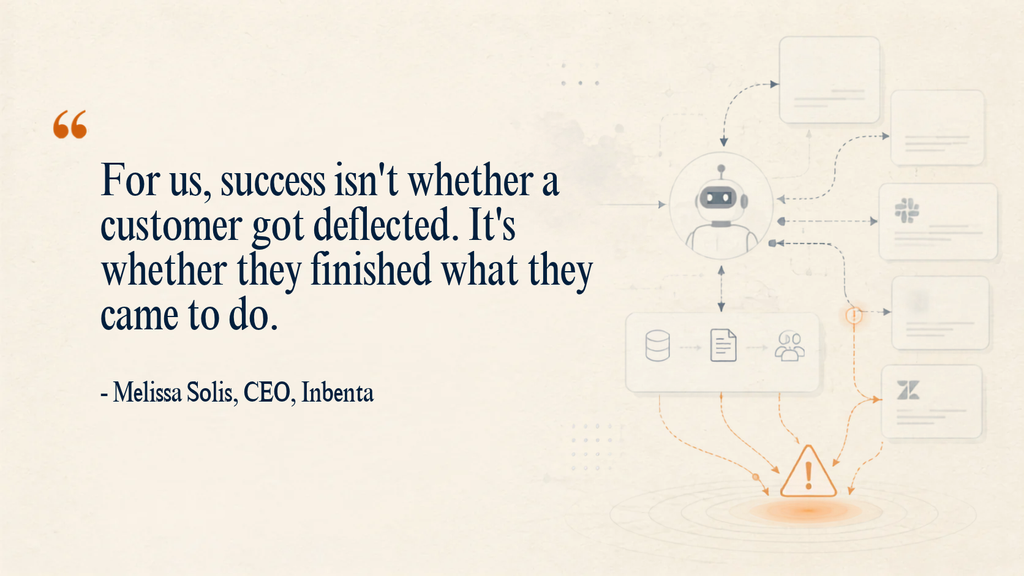
When we spoke with Inbenta CEO Melissa Solis after FinovateFall, she described the next challenge as closing what she calls “the gap between an answer and a result.”
Customer Service Learned to Count Answers Before It Learned to Count Outcomes
Digital self-service gives banks several ways to handle a customer’s question before it reaches a support agent. Search, AI assistants, and guided self-service can all help customers find information or work through an issue on their own.
But a customer not making a call tells a company only part of what happened.
They may have found what they needed and completed the task. Or they may have read the instructions, tried to follow them, and stopped somewhere along the way.
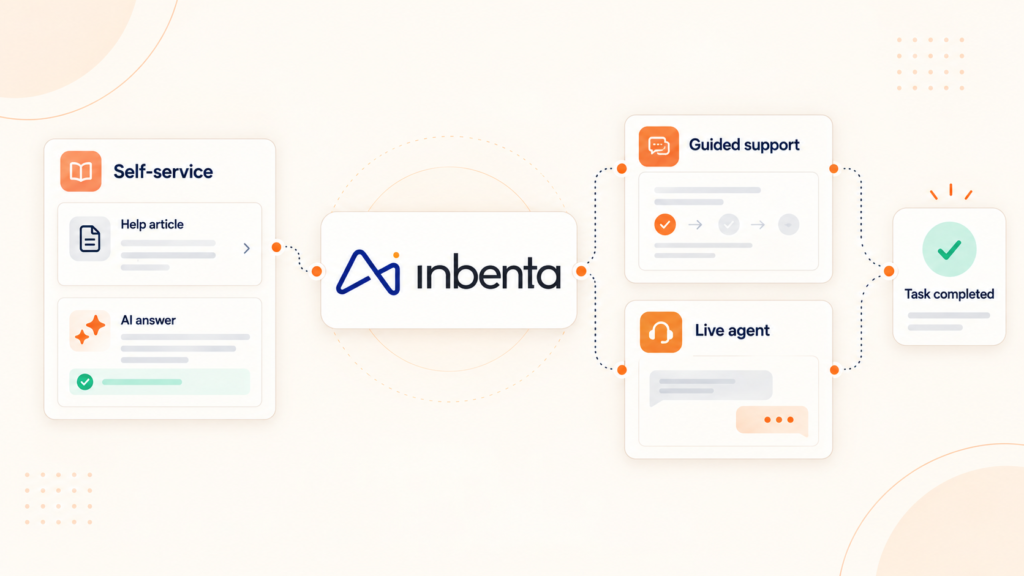
Solis told SaaStake that Inbenta is looking beyond whether the interaction simply ended in self-service. In the journey she described, the AI assistant handles what it can, guidance appears when the customer needs help completing something, and a live agent can step in without forcing the customer to start over.
“The customer feels like one conversation carried them from question to done,” she said.
That changes how Inbenta defines a successful support interaction.
The Hardest Part of Self-Service Can Begin After the Answer
Solis describes what comes next as a progression.
“We think about this in three stages: answering questions, guiding workflows, and then agents that take action,” she told SaaStake.
Each stage asks something different of the technology. An answer gives the customer information. Guidance helps them work through a task. An AI agent that takes action goes further by doing something on the customer’s behalf, part of a broader move toward AI taking on work inside banking systems.
Inbenta’s AI assistants draw from company-approved knowledge to answer customer questions, while Learn+ adds interactive walkthroughs that help someone work through a digital process rather than leaving them with instructions alone. Solis told SaaStake that Inbenta wants that guidance available across the journey, including on a website, within an AI assistant, and when a live agent steps in.
But the progression is not simply about giving AI greater autonomy.
For now, the important shift sits between the first two stages. Answering can tell a customer what needs to happen. Guidance can stay with them while they try to make it happen.
The question then becomes where that extra guidance can make the biggest difference.
Inbenta Is Trying to Intervene Before the Customer Gives Up
Inbenta is looking closely at a specific point in the support journey: when a customer has tried to help themselves and is close to giving up.
“We’ve learned that guided support matters most at the moment someone is about to give up,” Solis told SaaStake. “That’s the moment right before a call.”
What changes at that point is the kind of help the customer receives. An article can explain a process, and a video can demonstrate it. An interactive walkthrough lets the customer work through a simulated version of that process step by step.
Solis pointed to a large U.S. bank as an example. Inbenta’s FinovateFall material identifies the bank as Wells Fargo and says its guided-learning technology was associated with an estimated 588,000 deflected calls in one year, representing about $5.88 million in savings.
The numbers are useful, but where the intervention happens is just as important to this story. Inbenta is trying to reach the customer after instructions have stopped being enough, but before abandoning self-service becomes the only obvious next step.
That also changes what a handoff to a human can look like. Solis said that when a live agent does need to step in, they can share the same guided walkthrough rather than forcing the customer into an entirely new support journey.
The result Inbenta is working toward is not a journey in which a human never becomes involved. It is one in which needing more help does not mean starting over.
Doing the Task Raises the Standard Again
Guidance still leaves the customer in control. They can follow the walkthrough, decide what to do next, and complete the task themselves.
The next stage Solis described changes that relationship. The same shift is beginning to appear in other regulated workflows, as AI moves from answering questions into operational work. If an AI agent begins taking action on the customer’s behalf, the institution has to account not only for what the system says, but also for what it does.
That is why Solis said each stage has to earn trust before the next one. For Inbenta, that starts with the information underneath the system. Its Encore platform structures company knowledge before deployment and is designed to make responses traceable back to their source. Solis told SaaStake that the knowledge is checked before it goes live so a financial institution can understand why the AI produced a particular response.
The need for that accountability also came up in Inbenta’s conversations at FinovateFall.
“The idea that stayed with us is that banks are done buying AI promises. They want proof,” Solis said.
She said financial-services leaders told Inbenta that they already had AI tools that had not progressed beyond pilots. What they wanted instead, she said, was the ability to know what an AI would say, understand why it said it, and measure whether the customer’s problem was actually solved.
The progression raises the standard at each step. When AI answers, the information has to be reliable. When it guides, it has to help the customer move through the task. And if it begins taking action, the institution also needs to understand and account for what happens next.
A customer who gets stuck does not care whether the problem began in the help center, the AI assistant, or somewhere else in the journey. They only know they still need help.
Solis has seen that from the other side too. Before leading Inbenta, she spent 15 years answering phones. As she put it, the customer on the other end “doesn’t care about the technology. They care about being helped.”
AI may change how much of that journey happens before a human needs to step in. It may eventually complete more of the work itself.
But the call disappearing cannot be the only sign that the technology worked.
The call may disappear. The obligation to solve the problem does not.