| TL;DR: Profound tracks how brands appear across AI platforms, but its more interesting capabilities sit beneath the visibility score. It connects brand mentions with prompts, citations, regions, personas, sentiment, and real-user query data. That gives marketing teams several ways to investigate why a brand appears and where it is being overlooked. The platform looks particularly useful for enterprises with several markets and audiences. Smaller teams may find the depth impressive, but potentially more than they need. |
A client asks why three competitors appear in ChatGPT, but their brand doesn’t.
You check the same question. This time, the brand appears.
Now what do you report?
That is the question I kept coming back to while watching Profound’s product walkthroughs. Checking a few prompts manually can tell you what happened in that moment. It cannot tell you how often it happens, whether the result changes by platform, or which sources keep shaping the answer.
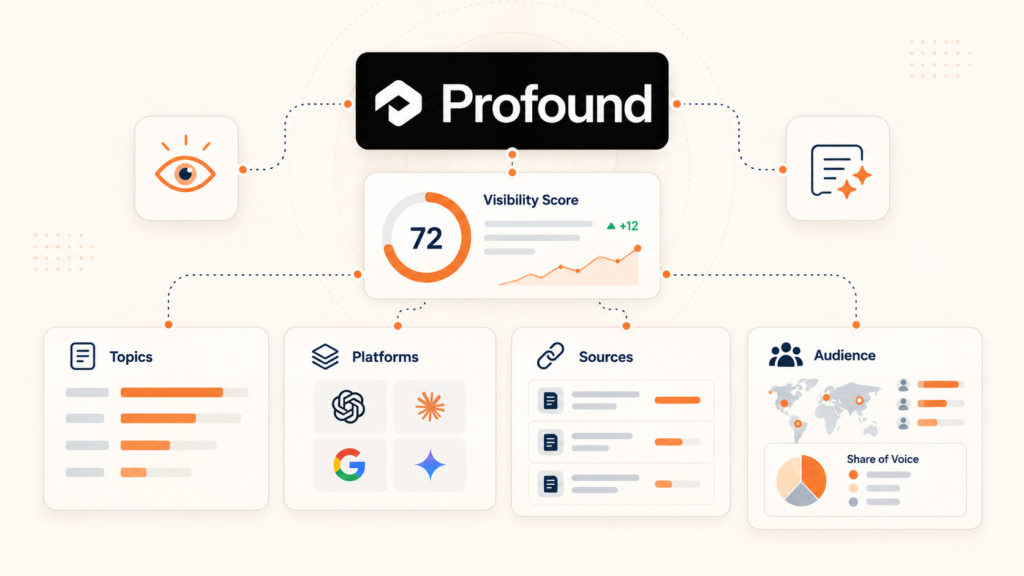
Profound is an AI visibility platform built to answer those questions at scale. It tracks how brands appear across ChatGPT, Gemini, Perplexity, and other answer engines. It then shows you the prompts, competitors, citations, locations, and audience profiles behind those results.
This Profound review looks at what you can actually learn from that data, and whether those insights are useful enough to change what you do next.
Profound Treats Prompts as the Starting Point
You start by choosing the topics you want Profound to track.
In one walkthrough, Profound used Ramp as an example. Ramp is a financial operations platform that offers corporate cards, expense management, and other tools for managing business spending.
The topics being tracked included corporate cards, expense software, and purchasing cards. Profound then generated longer, conversational prompts for each.
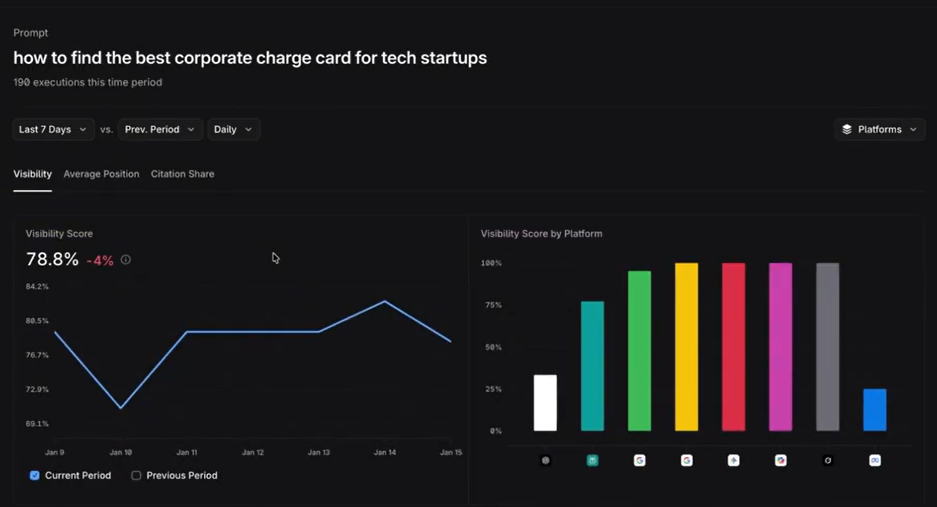
Someone searching Google might type “corporate card software.” In ChatGPT, the same person may ask, “How do I find the best corporate charge card for a tech startup?”
Source – YouTube
Profound connects the two. It can start with a broad term such as “corporate card software,” then uncover the longer questions people ask AI platforms about it.
It can also build the topics and prompts by looking at the company’s website, industry, and competitors. Marketing teams that already know which questions they want to monitor can upload their own prompts instead.
I would still pay close attention to what goes into that list. Every visibility percentage depends on the questions being tracked. Add more prompts where the brand is absent, and the score falls even if its performance on the original prompts has not changed.
This is where Prompt Volumes stood out to me during the demo. It shows questions people ask across ChatGPT, Gemini, Perplexity, and Claude. Marketers can also inspect related prompts, locations, demographics, and the intent behind those conversations.
I found this more useful than relying on a list created internally. It helps you see whether people are actually asking about the topic and how they phrase those questions.
I would prioritize the areas where three things overlap: the topic is commercially relevant, people are asking about it, and the brand rarely appears.
The Visibility Score Needs Context Before it Means Anything
Visibility measures how often a brand appears across the prompts Profound runs. If the score is 70%, the brand appeared at least once in 70 out of every 100 answers within the selected dataset.
Simple enough.
But the walkthrough also showed why I would not report that number by itself.
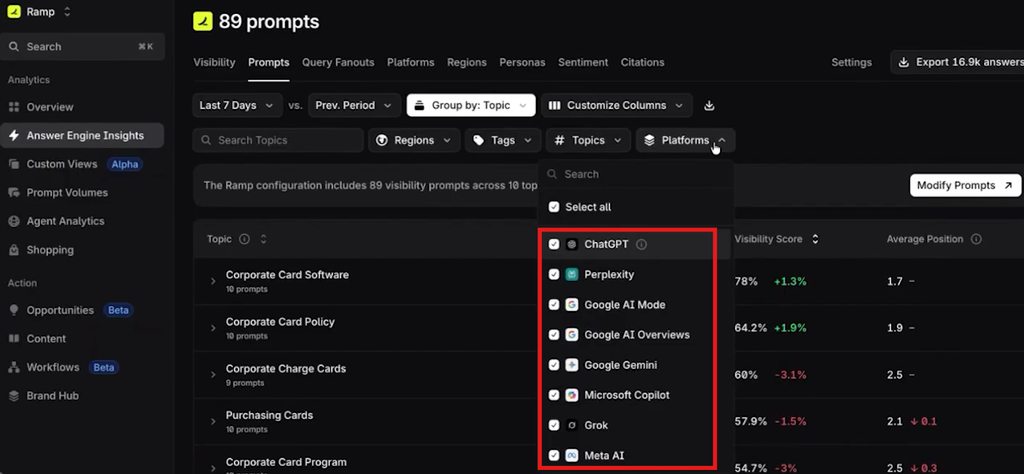
The score can combine results from ChatGPT, Google AI Mode, AI Overviews, Gemini, Grok, Meta AI, Copilot, and Perplexity. A brand may perform well on one platform and poorly on another. Combine them all, and the average can hide those differences.
Source – Profound
The same issue applies to topics. A company can look healthy overall while disappearing from questions close to a buying decision.
I liked that Profound lets you move beyond the overall score and see performance by topic and prompt. You can sort topics by low visibility, compare rankings, and inspect large movements over time.
That creates a more useful question than “Did our score go up?”
You can ask, “Which commercially important topic are we still absent from?”
The platform also tracks share of voice, average position, competitor rank, and change over time. These metrics help you see whether the problem is that the brand is missing entirely or simply being outranked.
Still, none of those metrics explain what caused the result. For that, I would move quickly to the prompts and citations underneath.
Repeated Checks Make the Data More Credible
AI answers are unstable. Ask the same question twice, and you may receive different recommendations, sources, or wording.
Profound handles this by running prompts repeatedly through headless browsers. The company says this more closely reflects what a person sees in the actual answer-engine interface than an API call would.
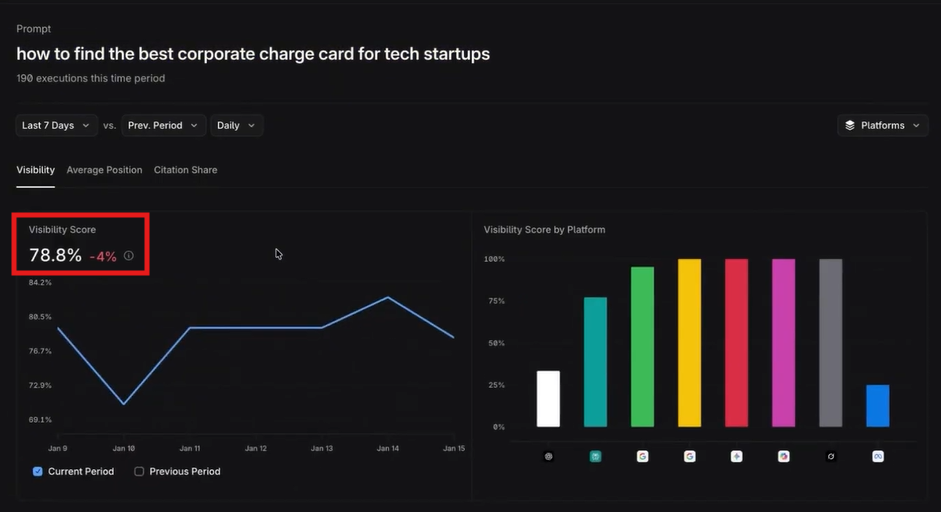
In the Ramp walkthrough, Profound had sent one prompt 190 times over seven days. Ramp appeared in 78.8% of those responses. Across the account, the platform had run almost 17,000 prompts during the same period.
Source – YouTube
One ChatGPT screenshot only shows you what happened once. Repeated checks show you whether it keeps happening. That makes the 78.8% figure more useful because it shows how often Ramp appeared across repeated runs.
Profound also records the platform, location, brand position, full answer, search queries, and citations for each execution. I could examine one response instead of trusting the percentage alone.
There is a trade-off, though. More prompts, engines, locations, and personas create richer data and far more to interpret. Brands need to know which questions matter before expanding their tracking.
Citations Show Where AI Visibility is Coming from
The citations section was the part I wanted to explore most.
If an answer engine keeps recommending a competitor, the useful question is not only how often the competitor appears. I want to know what information keeps supporting that recommendation.
Profound collects the sources cited across its tracked answers and shows which domains and pages repeatedly influence them. That lets you see what sources are influencing those recommendations, rather than just which brands get mentioned.
What you find can change the content plan.
If answer engines regularly cite company blogs for a topic, creating or improving owned content may be a sensible route. If review sites and industry publications dominate, publishing another article on the company website may not solve the problem. The marketing team may need digital PR, partnerships, or stronger third-party coverage.
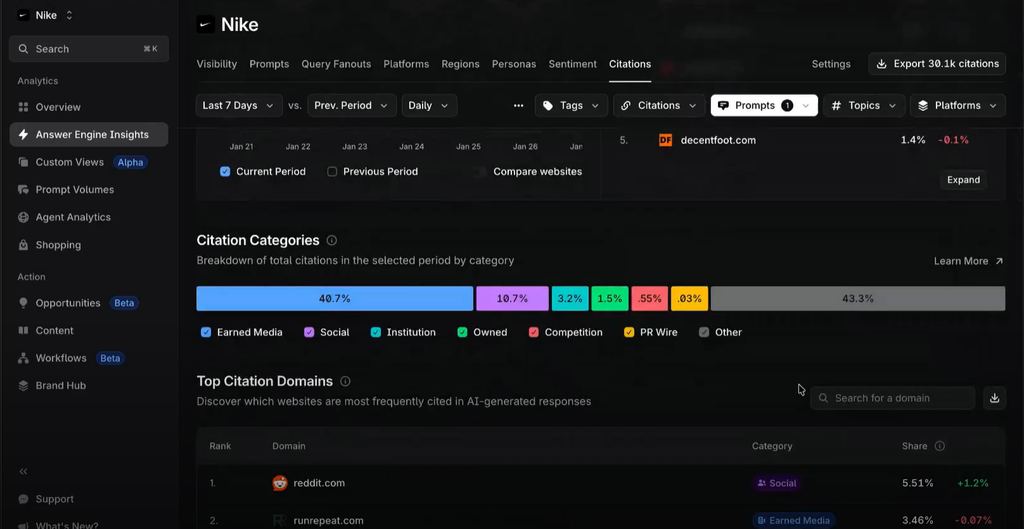
The page-level view goes deeper. In the Nike demonstration, one URL accounted for 16% of citations from Nike’s web properties. Profound connected that page with the prompts it helped answer.
Source – Profound
That gives marketers a specific page and set of prompts to investigate. Why is the page useful across several questions? Does it answer related needs? Could existing pages follow the same principles?
I would treat citations as evidence of the sources answer engines rely on, not as a guaranteed recipe. Copying the format of a frequently cited page does not ensure another page will receive the same treatment.
Even so, it is far more actionable than knowing the brand has a 54% visibility score.
Query Fan-Out Reveals How One Question Becomes Several Searches
Profound also shows query fan-out.
When someone asks an answer engine a question, the system may translate it into several searches before producing a response. Profound exposes those searches from the browser work log.
This was a genuinely interesting layer.
A marketer may optimise for the original question while missing the searches used to research it. Query fan-out lets you see what happens between the question and the final answer.
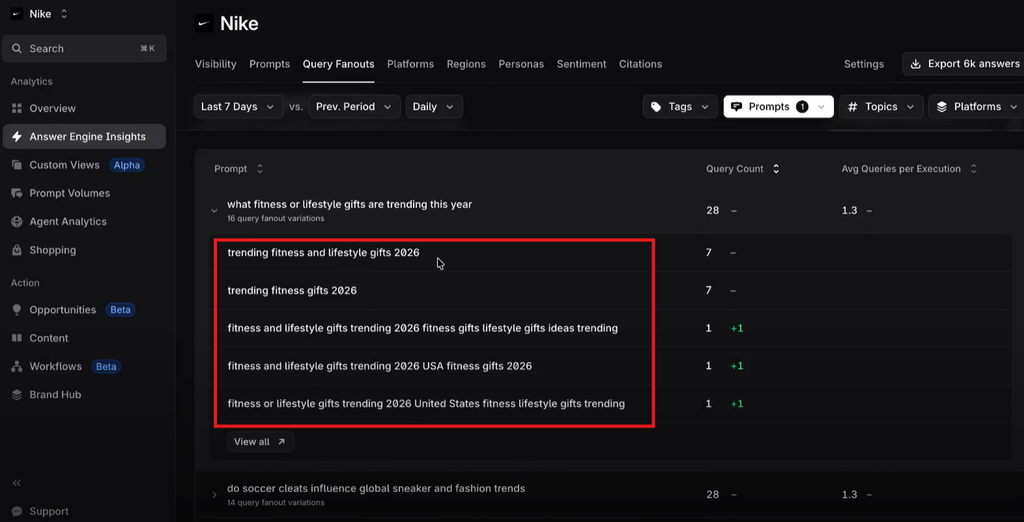
A broad question about trending fitness gifts can lead to narrower searches. Those searches can help explain why certain pages were pulled into the answer and cited.
Source – Profound
I can see this helping with content briefs. Instead of writing around one exact prompt, a writer can look at the related questions the engine investigates and cover the topic more fully.
I would not turn every generated query into a heading. The value is in seeing how the engine breaks down the subject, then deciding which parts genuinely belong in the content.
Regions and Personas Expose the Average User Problem
An overall visibility score assumes there is one typical searcher. Real buyers are rarely that tidy.
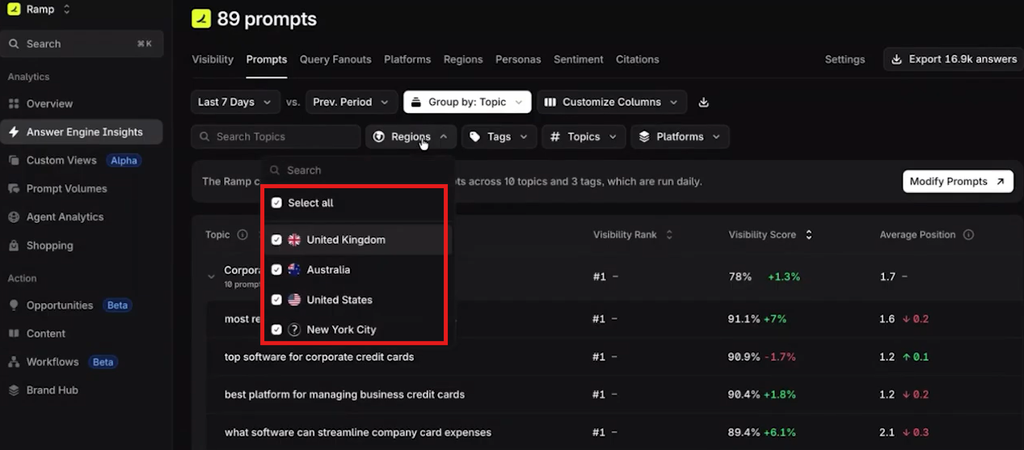
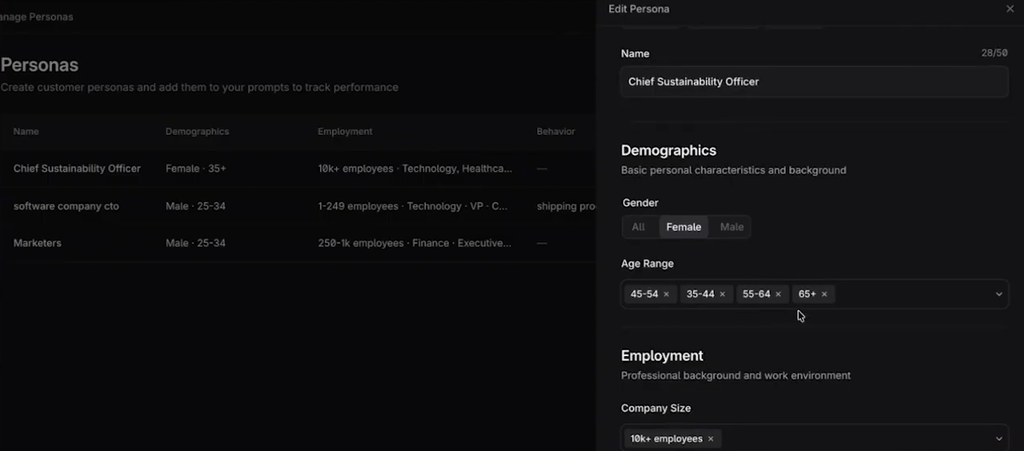
Profound can send prompts from different locations and add personas to reflect different types of buyers. In one walkthrough, the platform demonstrated how a marketer and a chief sustainability officer could receive different recommendations for the same category.
Source – YouTube
Personas can include roles, industries, company characteristics, pain points, and motivations. Regions are simulated using browsers in specific locations.
This matters more when a brand operates across multiple markets. A brand may appear in the United States but struggle in the United Kingdom. A product may reach marketers but be overlooked for technical buyers.
Source – YouTube
Without those segments, both experiences get folded into the same overall score.
There is a catch, though. A persona constructed inside the platform is still a simulation. It can show how an answer changes with different contexts, but I would not assume it perfectly reflects a real buyer’s past behavior.
I would start with a few important regions and buyer groups, then expand if the differences are meaningful.
Sentiment Connects Opinions with Their Sources
Visibility tells you whether a brand appears. Sentiment asks what the answer says when it does.
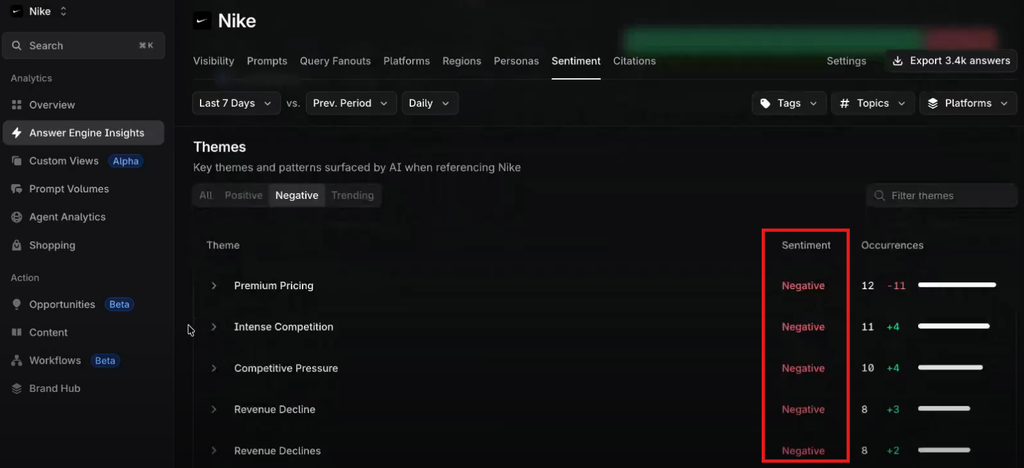
In the Nike walkthrough, Profound separated positive and negative themes, including concerns about pricing and narrow fit. Users could examine the prompt, answer, and sources behind each opinion.
Source – Profound
This matters because being mentioned is not automatically helpful.
A brand could increase its visibility while answer engines repeatedly describe it as expensive, limited, or unsuitable for a particular audience. The headline metric improves, while the brand looks worse to potential buyers.
Linking sentiment back to citations also shows where those opinions are coming from. A brand can see whether the opinion comes from its own website, app-store feedback, editorial coverage, or comparison content.
I would still be careful about treating sentiment labels as definitive. Context can be mixed, and a limitation for one buyer may be an advantage for another. The actual answer matters more than the percentage attached to it.
Profound is Moving from Measurement Into Execution
Profound’s agents and workflows are designed to help brands act on those findings. The platform can help identify opportunities, produce reports, and support content creation using the data collected elsewhere in the product.
If a topic has low visibility, competitors keep getting cited, and query fan-out reveals a clear gap, you have something to turn into a brief, an update, or outreach.
But this is where I would keep human judgment firmly involved.
The platform can surface a gap. It cannot decide whether the business has the expertise or reason to publish on it. An influential source may not be appropriate for outreach.
Who Will Get the Most from Profound?
Profound feels built for brands whose AI visibility cannot be explained with one score.
A global company may need to compare countries. A multi-product business may want separate views for different categories. A B2B company may care whether a CFO sees different recommendations from a marketing leader. Profound lets them dig into each variation separately.
Agencies with enterprise clients may also find that depth useful, especially when a client wants to know why a competitor keeps appearing.
A smaller organization with a short prompt list may not need every layer. It really comes down to how many markets, audiences, and visibility questions it needs to track.
Final Verdict
The feature I would come back to first is not the dashboard. It is the trail Profound creates from a weak topic to the prompts, sources, and searches influencing it.
That trail makes the platform useful. A low score alone gives me something to report. Profound gives me somewhere to investigate.
I would still want a disciplined workflow around it. The platform can point you toward plenty of opportunities, but the marketing team still has to decide which ones are worth pursuing.
Profound looks strongest when AI visibility has become too complex to track manually. If the problem is still small enough for a spreadsheet and a few weekly checks, its depth may be unnecessary.