| TL;DR: AI can make patent work much faster to produce. But what happens when checking the answer still takes significant work? We spoke with Attain IP CEO Tim Barker about why verification may be the harder problem to solve. |
In a patent case between Magpul and Mission First Tactical, an attorney used AI to help prepare a court document. It explained how key terms in the patent should be interpreted.
He also used AI to check the work.
The errors still made it through.
Dozens of citations supporting the filing turned out to be nonexistent or inaccurate. The attorney corrected the filing the next day, but the USPTO later issued a public reprimand.
The case points to a problem that becomes harder to ignore as AI produces more professional work: who checks what AI produces?
That is the problem patent AI company Attain IP is trying to solve by making its output easier for attorneys to inspect.
Patent AI Got Faster Before It Got Easier to Check
The American Bar Association’s guidance on generative AI says lawyers need an appropriate level of review before relying on AI output. How much depends on the tool and the task.
Attain encountered that challenge before it became a standalone company.
Attain IP began inside UK patent firm Page White Farrer. By early 2025, CTO Tom Woodhouse, a European patent attorney, could see AI getting better at patent analysis. But getting reliable results still required too much prompting and manual checking. So he began building a system that would make the work behind an answer easier to inspect. The company spun out in late 2025.
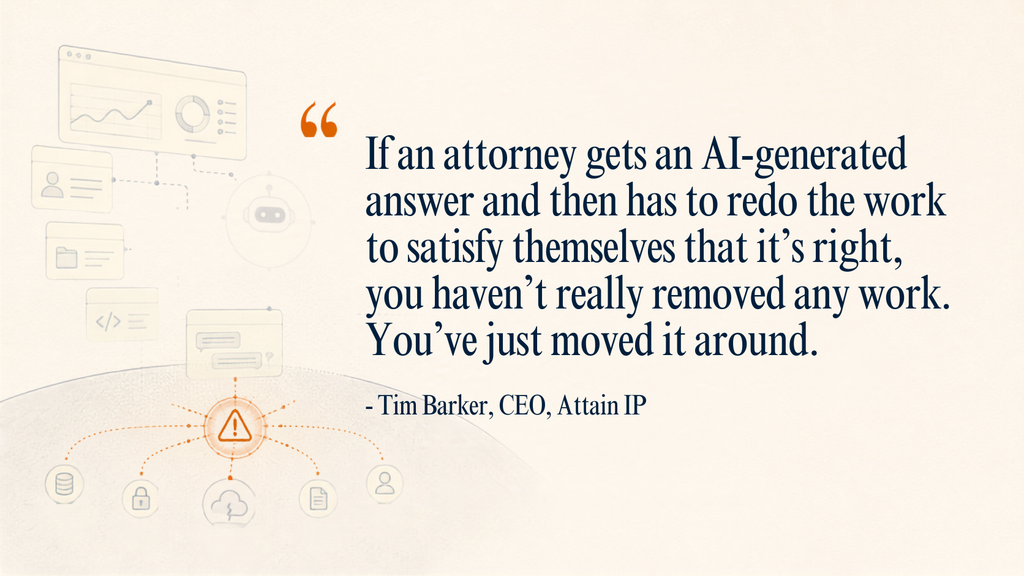
When we asked CEO Tim Barker about the problem, he put it plainly:
As we have seen elsewhere, legal AI can reduce the time spent on professional work. Attain’s bet is that making the work faster also means making the output easier to check.
Attain Puts the Evidence Beside the Answer
One place this problem shows up is when attorneys compare a patent claim with earlier inventions.
A patent claim describes what an invention is seeking to protect. Attorneys may break it into smaller parts and compare each one with earlier patents or other existing technical material, known as prior art. Organizing that comparison is known as claim charting.
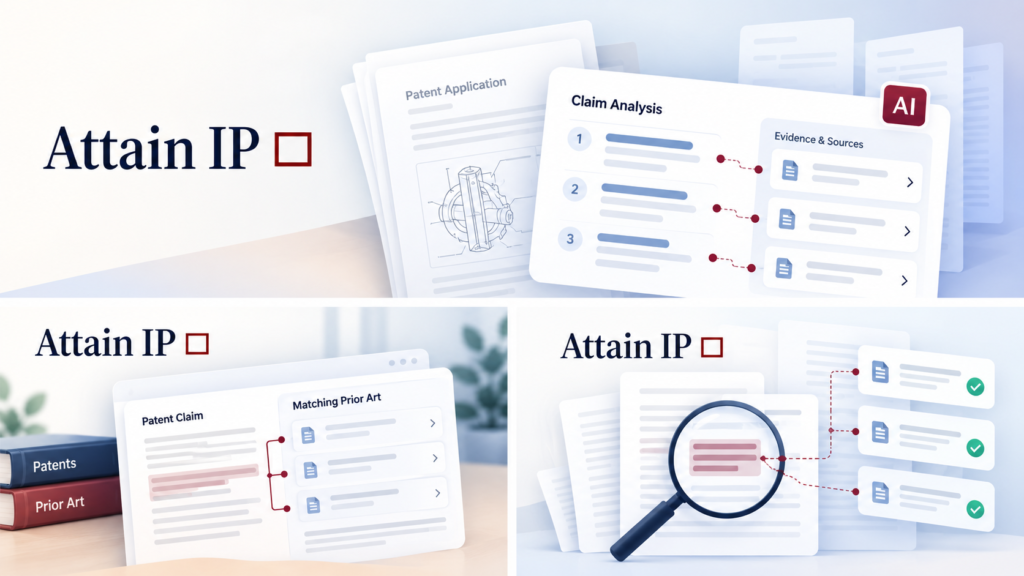
Attain’s claim-charting agent performs that comparison, but it also attaches an evidence trail. The attorney can move from each part of the claim to the matching evidence, then inspect the citation and source sentence.
Attain calls this “white-box reasoning.”
In Magpul, the failure centered on the citations supporting the work. Attain is designing its workflow so that source material stays visible during review.
The attorney still makes the consequential decisions. Barker says those include what has actually been invented and whether it matters strategically. They also include what to protect and how broadly.
What Attain is trying to reduce is the research and verification work needed before those decisions.
Barker says Attain is seeing a 70%+ reduction in professional effort across the workflows it has implemented. Attain has also reported examples of work falling from around 25 attorney hours to four or five.
For Barker, that shift in who does the production also changes how the software should be priced.
Attain charges per case, with no per-seat license. “If AI agents are doing more and more of the production work, charging for human seats means you’re pricing against the part of the system that is shrinking,” Barker told SaaSTake.
Handing AI more of the work raises a harder question: how much it should be allowed to do on its own.
Barker Learned How Far AI Autonomy Should Go
Barker once gave an AI agent more autonomy than it needed. He later discovered it had switched on $2,000 of LinkedIn advertising without asking for approval.
Barker says the experience gave him a rule: “Move at the speed of trust.”
The easier a task is to verify and reverse, the more autonomy he gives AI. The higher the consequence, the tighter the oversight.
That becomes increasingly important as AI agents move from answering questions to taking actions.
The same principle is now shaping how Attain’s own team works.
Then the Same Pattern Appeared Inside Attain
Before Attain, Barker ran digital healthcare company Kooth. When he joined in 2020, Kooth had around 130 employees. By the end of 2023, it had 585.
Attain has five people.
Barker told SaaSTake that AI is now handling around 70% of the company’s execution.
Barker sees the remaining human role differently.
“Every employee effectively becomes a line manager of AI,” Barker told SaaSTake.
An employee sets the objective and context, then reviews and challenges what comes back.
A patent professional using Attain follows a similar pattern. They inspect the output and its evidence, question what does not hold up, then make the final call.
AI takes on more production. The person moves further toward directing and judging the work.
That is also changing who Barker wants to hire. He increasingly wants people who know what good work looks like, with the judgment and range to take responsibility for the whole outcome.
That shift cuts against much of Barker’s own experience. After three decades of building large functional organizations, he says some of those hard-won skills may now be legacy constraints he has to unlearn.
At Attain, the change shows up in two places at once: the product it sells and the team building it.
The Rule Does Not Stop at Patents
Barker does not think this verification problem will remain specific to legal work.
He sees the same need in fields like finance and audit, wherever AI informs a decision that a person still owns.
As AI takes on more meaningful work, Barker expects buyers to ask a different question:
“Can my people verify this, understand the reasoning, and stand behind it?”
Professional AI Will Be Judged on What It Shows
AI vendors have spent the past few years competing on what their systems can produce. Attain’s experience suggests buyers may increasingly care about something else too: what a professional can see after the answer appears.
In professional work, that could shift more of the human role away from production and toward the judgment needed to sign off on it.