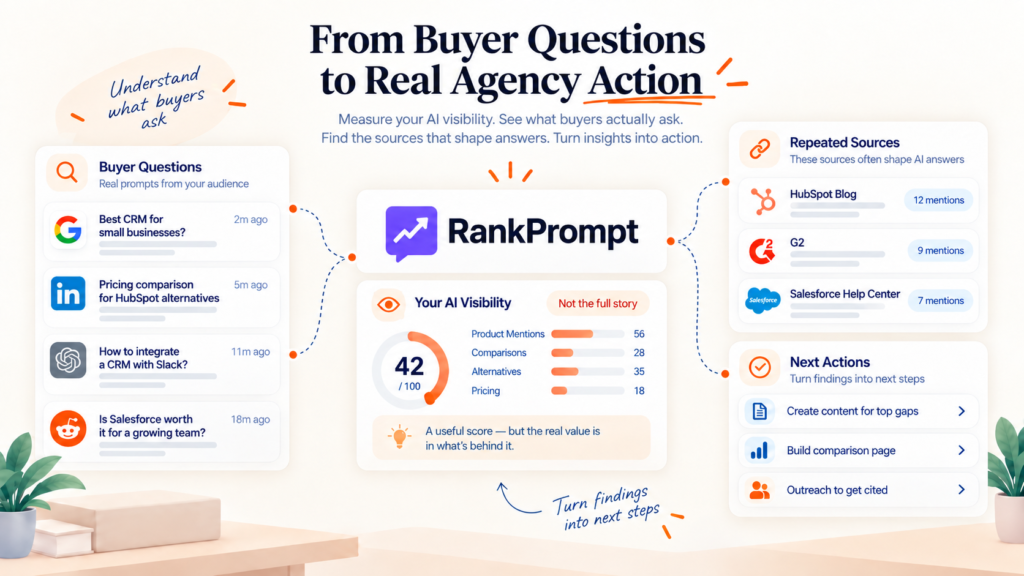
| TL;DR: Rank Prompt tracks how often a brand appears in answers from ChatGPT and other AI platforms. But the more useful part of the demo was seeing what sits behind that visibility: which buyer questions the brand is missing from and which sources AI keeps citing. That gives agencies somewhere to investigate instead of just another score to report. The catch is pricing. Credits determine how much monitoring you can actually do, regardless of how many brands your plan allows. |
Think of the last time a client searched for their own brand in ChatGPT.
Maybe three competitors showed up, and they didn’t. Maybe they appeared for one service but disappeared for another.
Either way, the next question lands on the agency: why them and not us?
AI visibility is becoming fairly easy to measure. The harder part starts after you find the gap. Why does a competitor keep showing up? Which sources are helping them get there? And what should you actually change?
I recently sat through a live product walkthrough with George Shamblin, VP of Growth at Rank Prompt, to see how the platform approaches that second part of the problem.
I haven’t run Rank Prompt on our own client campaigns yet. What I did see was how George moves from a visibility score to the prompts, competitors, citations, and actions underneath it.
That’s the part I wanted to understand.
Source – Rank Prompt website
Rank Prompt Started With a Client Asking the Same Question
George traced Rank Prompt’s origins to work his team was already doing inside a digital marketing agency.
Roughly two years ago, he said, one of the agency’s larger clients searched ChatGPT and couldn’t find its own brand. The agency already handled the company’s digital marketing. That left the client asking an uncomfortable question: if we’re spending this much, why aren’t we showing up?
George said the team first built a simple system that ran 10 ChatGPT prompts a day. It tracked where each answer got its information. They later began using the approach with other clients before developing it into Rank Prompt.
That backstory explains the product better than a feature list does.
Telling a client they’re missing from an AI answer is easy. Explaining why is the harder conversation.
The Visibility Score Is Only as Good as the Prompts Underneath It
Every Rank Prompt report starts with the questions you want AI platforms to answer.
During the demo, George selected four categories with five prompts each and ran them across four AI platforms. That produced 80 checks, and the report was ready in roughly two to three minutes.
Rank Prompt can generate those prompts automatically. In the demo, they looked like buyer questions rather than keyword fragments. One asked for the “best branding agency in Miami for a startup launch.”
But George’s own advice was not to rely blindly on the generated list. He recommended choosing prompts that reflect what your buyers actually ask. Rank Prompt also lets users upload their own.
That matters because the percentage at the top of an AI visibility report depends on the questions underneath it.
Grow & Convert demonstrated this problem in its analysis of AI visibility metrics. Adding two relevant prompts where a brand had no visibility dropped its overall score from 26.7% to 20%. Yet the brand hadn’t lost visibility on any prompt it already tracked.
So before I’d worry about whether a visibility score went up or down, I’d look at the prompt set producing it.
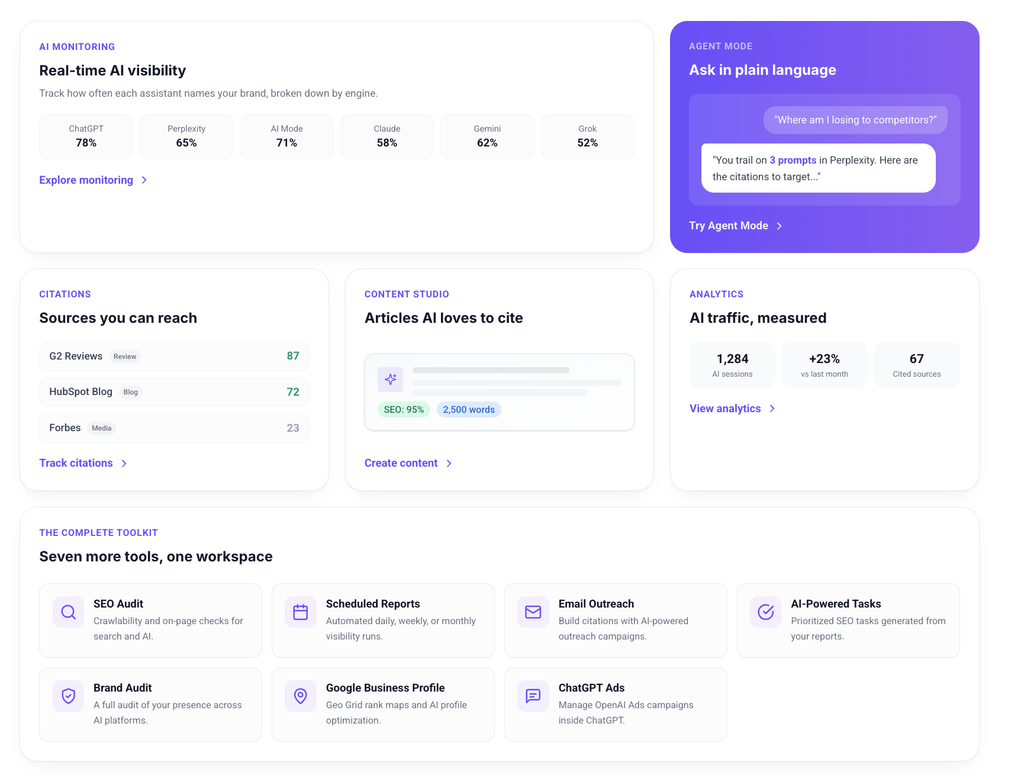
Rank Prompt currently tracks ChatGPT, Perplexity, Google AI Mode, Claude, Gemini, and Grok. But once the report ran, I found myself paying less attention to the overall number than to how that visibility broke down.
The 23% Score Was the Least Interesting Number in the Demo
The demo brand had an overall visibility score of 23%. On its own, that didn’t tell me much. Is it good? And visibility for what, exactly?
The category breakdown showed where the brand was more and less visible. Paid media was one of the stronger areas at 30%, while the brand appeared less often for branding-related questions.
George put the branding problem simply: people asking these AI systems about branding agencies weren’t really hearing about this company.
Now the agency had a specific gap to investigate.
“Your visibility score is 23%” starts a conversation about a metric. But “Buyers asking about branding agencies aren’t hearing your name” starts a conversation about what to fix.
And once you know where the brand is missing, the next question is obvious.
Who keeps appearing instead?
The Sources Behind the Answers Changed the Investigation
Rank Prompt lets you move beneath the overall score and inspect the prompts, competitors, and sources connected to the answers.
This was the part I found most useful.
A competitor appearing once wouldn’t make me rewrite a content strategy. A competitor repeatedly appearing across buyer questions would make me investigate.
The same goes for citations.
Across the 80 checks in the demo, George estimated that roughly 400 different brands appeared. But one competing agency stood out for another reason: a single resource from that company had been cited 10 times.
That’s the kind of detail that changes the question. Instead of asking what to publish next, you can ask why this particular page keeps becoming part of the answer.
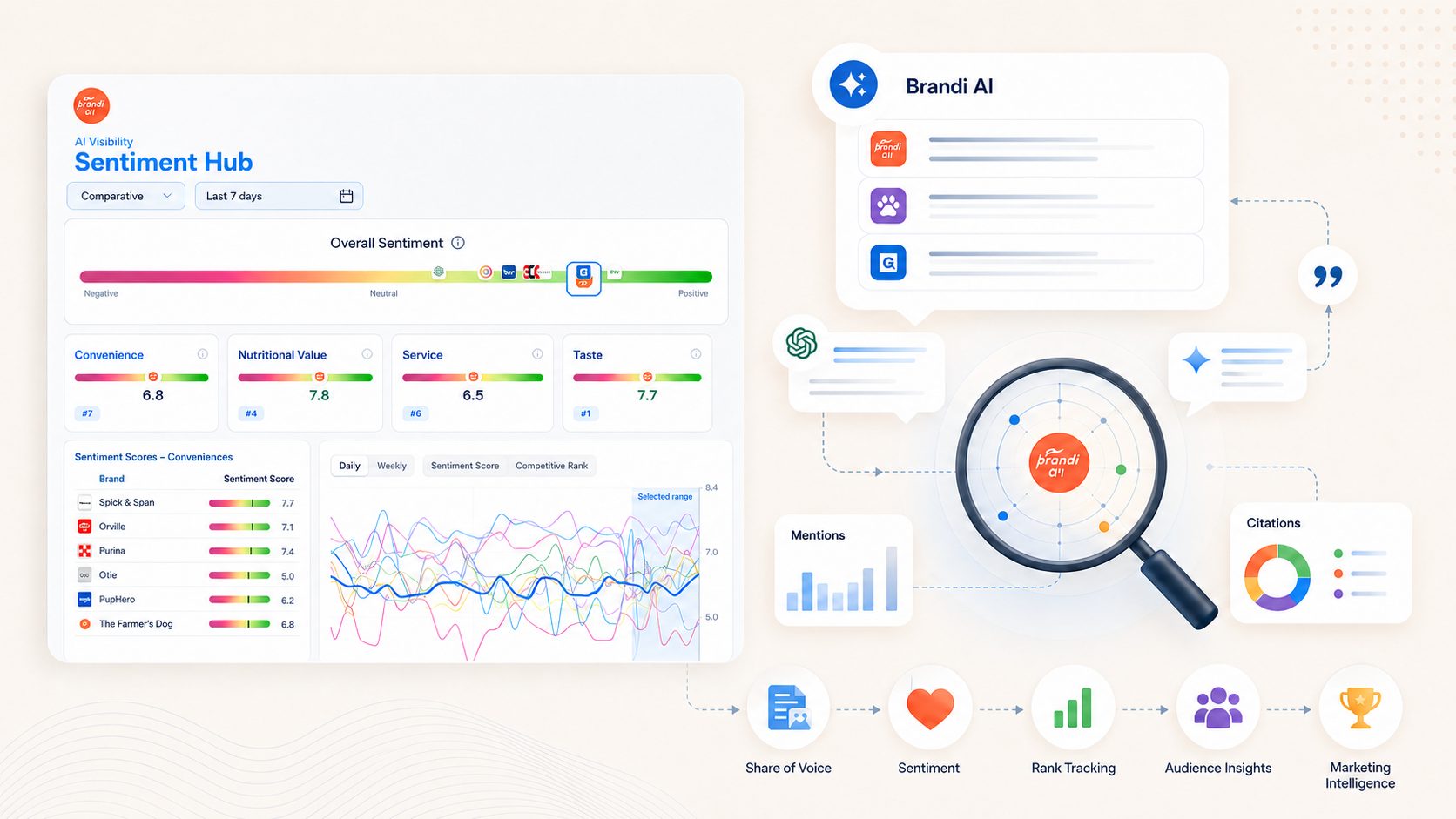
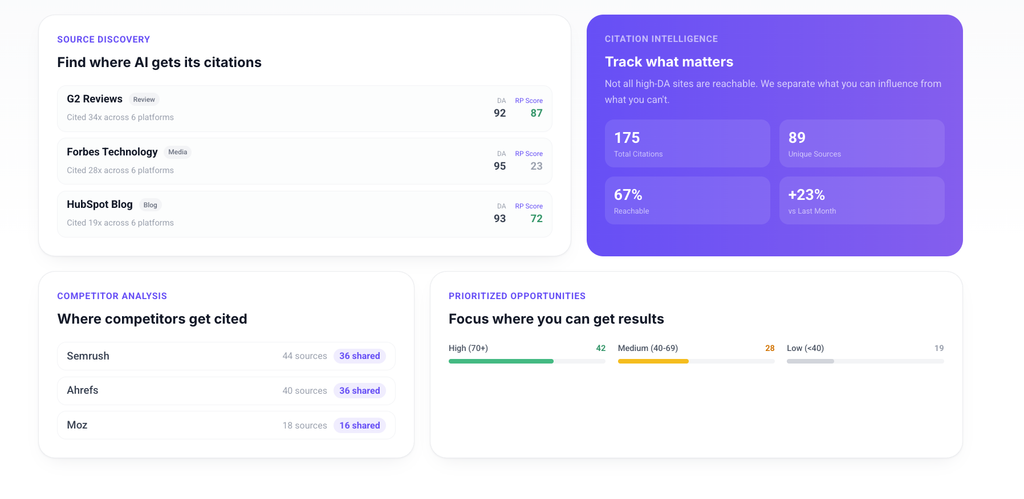
Rank Prompt’s own platform reflects that logic. Alongside visibility monitoring, it surfaces the sources AI systems cite and connects those findings with outreach and other actions.
Source – Rank Prompt website
George described the citation strategy in two stages. In the short term, he said, the goal is to get clients into the pages AI already cites. Over time, the aim is for the client’s own site to become one of those sources.
That distinction matters.
Not every AI visibility problem can necessarily be fixed by publishing another page on your own website. Sometimes the clue sits somewhere else on the web.
One Report Is a Snapshot. The Pattern Across Reports Is More Interesting.
AI answers change, and George was upfront about that. He recommended looking at repeated reports rather than putting too much weight on one run.
The demo account belongs to Anderson Collaborative, an agency that shares team members with Rank Prompt. It had already run 42 reports on its own brand, covering roughly 4,900 results, so the people using it were already familiar with the platform.
Between the two most recent reports, visibility had increased across several AI platforms.
I wouldn’t treat that as proof that Rank Prompt caused the improvement. The demo showed the movement, not what caused it.
The citation history was more interesting.
In this account, some of the same sources kept appearing across reports. Clutch.co, for example, had consistently been the top cited source and was being cited even more in recent runs.
George noted that listicle placements aren’t the right move for every brand. In this case, though, he saw Clutch.co as worth pursuing.
The source that matters can differ by client. For one company, it could be a comparison site. For another, it might be YouTube or a specialist publication.
What matters is the pattern.
If the same source keeps appearing across dozens of reports, I’d want to understand why before deciding where to invest.
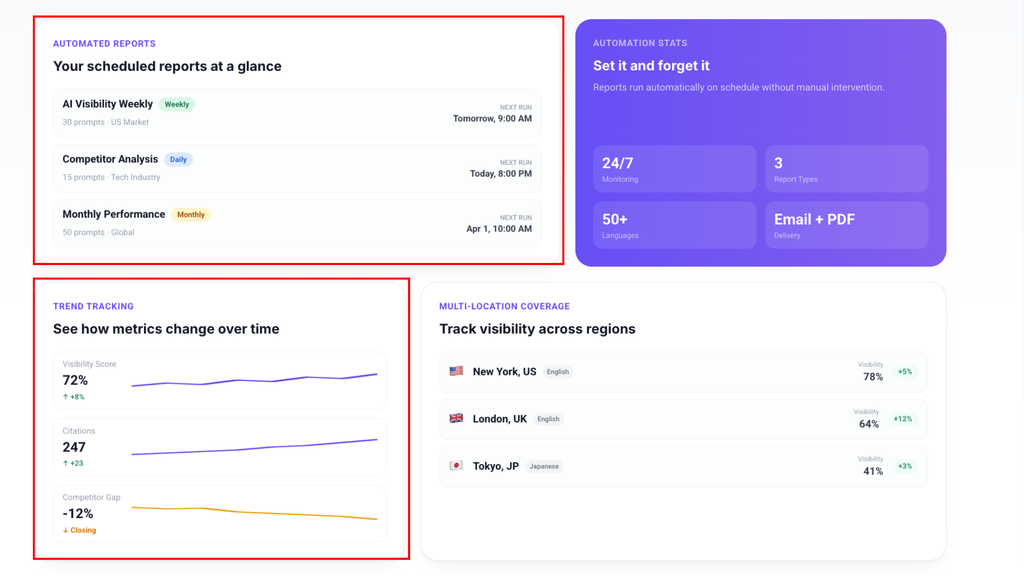
Rank Prompt also supports scheduled reports, so nobody has to rerun the same report by hand each time.
Source – Rank Prompt website
Finding the Problem Is Only Useful If the Next Step Makes Sense
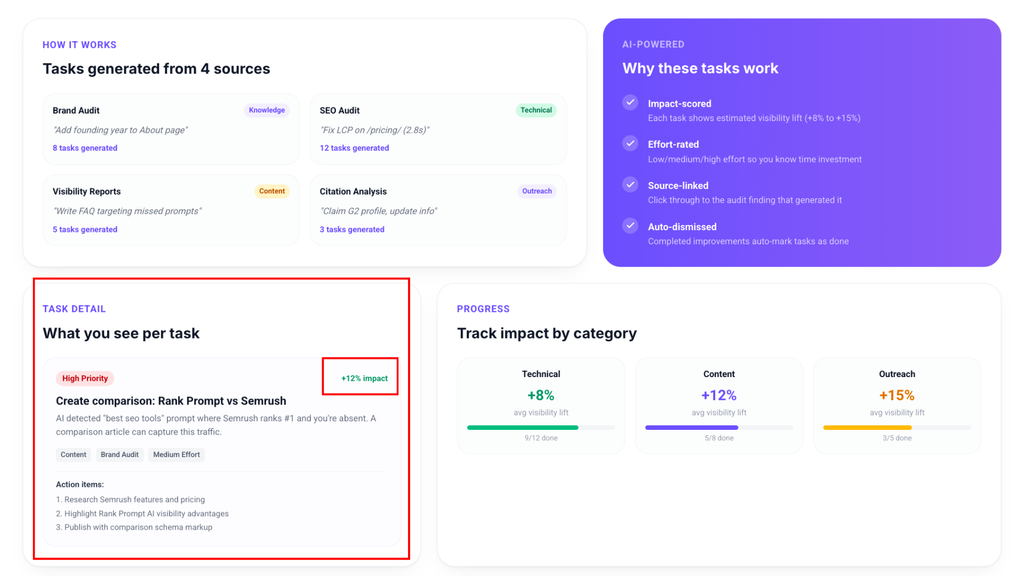
Once the report identifies a gap, Rank Prompt can turn findings into potential tasks.
The branding weakness from the demo didn’t simply disappear into the dashboard. One recommendation was to create content explaining the difference between a branding agency and an advertising agency.
That gives the recommendation a traceable reason for existing.
Other suggestions included smaller opportunities such as FAQs and supporting pages.
This is the point where I’d start being more critical.
Generating a task is easy. The important question is whether the problem has been diagnosed correctly enough for that task to deserve someone’s time.
Rank Prompt’s website shows how those recommendations are structured. Tasks can be generated from visibility reports, citation analysis, brand audits, and SEO audits, with impact and effort estimates attached.
Source – Rank Prompt website
There’s one number in that graphic I would not take at face value: the estimated visibility impact attached to a task.
I haven’t run those recommendations through a live campaign, so I’d treat an estimated lift as a prioritization signal, not a forecast.
The outreach workflow has the same limitation for this review.
Rank Prompt can surface sites that appear as sources and help run email campaigns to reach them. But George didn’t think this brand had run an outreach campaign yet, so I didn’t see results.
That makes the path from finding a problem to acting on it fairly clear.
What Happens If the Report Starts Doing the Work?
One report is manageable.
Repeat the process across dozens of clients, and someone still has to make sense of everything those reports uncover.
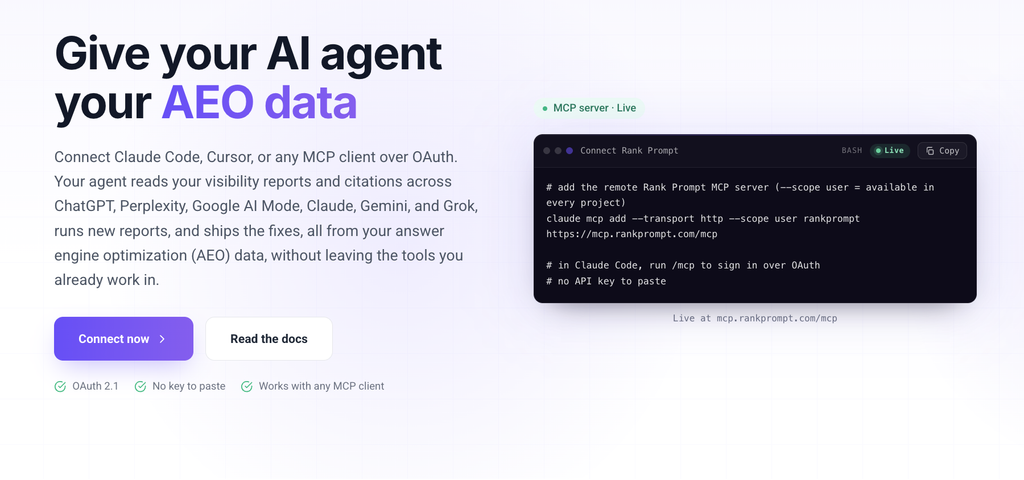
Rank Prompt’s more ambitious answer is to let AI agents work with the data.
Its MCP server and API can bring Rank Prompt data into tools such as Claude Code and Cursor. During the demo, George described how agencies connect these tools to report data and turn findings into action lists.
Source – Rank Prompt website
In practice, the shift looks like this:
Traditional workflow:
Run report → find problem → create task → do the work
Rank Prompt’s direction:
Run report → diagnose problem → generate action → potentially execute through an agent
George gave one agency example I liked. Connect the workflow to your calendar, then ask the agent which quick wins could fit before the next client call.
For some of the team’s own clients, he said the automation goes further. An identified content gap can move into article creation and publishing.
That’s also where I’d slow down before automating everything.
An agent can identify a content gap and draft an article. That doesn’t mean the article deserves to become a source an AI system trusts.
The same applies to outreach. Automating an email is easy. Identifying a publication genuinely worth earning a mention from is the valuable part.
The harder question is what an agency should actually let the agent do without review. Drafting something is one thing. Publishing it or contacting a source on a client’s behalf is another.
There’s a practical consideration too. These workflows require more technical comfort than simply chatting with ChatGPT or Claude. Agencies unfamiliar with tools such as Claude Code may need more help getting there.
Pricing Looks Simple Until You Count the Credits
Rank Prompt doesn’t charge purely by the number of brands. Each plan combines a brand allowance with monthly credits.
At the time of writing, Rank Prompt’s pricing looks like this:
| Plan | Monthly price | Billed annually | Monthly credits | Brands |
| Starter | $49 | $39.17/month | 150 | 10 |
| Pro | $89 | $71.25/month | 500 | 100 |
| Agency | $149 | $119.17/month | 1,000 | 500 |
| Agency Plus | $299 | $239.17/month | 2,000 | 1,000 |
The Agency Plus limit of 1,000 brands sounds enormous, but credits are the number I’d look at first.
Rank Prompt currently bundles ChatGPT, Perplexity, Claude, and Google AI Mode together at one credit per prompt. Gemini and Grok each add another credit per prompt. An AI-generated article uses 10 credits.
Now take an agency with 50 clients. If it tracks 50 prompts for each client and runs the report four times a month on the four bundled platforms:
50 clients × 50 prompts × 4 reports = 10,000 credits a month.
Agency Plus includes 2,000.
Add both Gemini and Grok, and the same reporting schedule would consume 30,000 credits.
That doesn’t make the plan bad value. It changes what the headline “1,000 brands” actually means.
For comparison, the included 2,000 credits could cover this on the four bundled platforms:
20 clients × 25 prompts × 4 reports = 2,000 credits.
That feels like a much more useful calculation for an agency.
So the real question isn’t how many brands you can add. It’s how many prompts each client needs, across which platforms, and how often you want to check them.
Rank Prompt has a credit calculator on its pricing page, so I’d recommend running your client portfolio through it before choosing a plan.
Rank Prompt currently offers a full first AI visibility report for free without requiring a credit card. Paid plans then include a seven-day trial with 50 credits, which does require a card.
Who Should Consider Rank Prompt?
Based on what I saw, Rank Prompt makes the most sense for agencies and marketing teams that have moved beyond simply asking:
Are we showing up in ChatGPT?
If you manage several brands, there’s more here than a visibility percentage. You can see which buyer questions you’re losing and which sources keep shaping the answers. If you’re still deciding which platform fits your team, we’ve also compared 14 AI visibility tools across factors such as LLM coverage, prompt tracking, reporting, and pricing.
The agency case becomes stronger when you keep the prompt list focused and rerun it consistently. That’s when category and citation patterns can become more meaningful.
I’d be more cautious if you want to monitor hundreds of prompts for every client across every platform at high frequency. Rank Prompt can accommodate a large number of brands, but your reporting cadence and credit usage will determine what that actually costs.
For an in-house marketer with one brand, the free first report is the easiest test. It shows whether the data below the score gives you more than a simpler visibility check.
Final Verdict
I wouldn’t choose Rank Prompt for the visibility score alone.
What made the demo useful was the path below the score. A weak category could be traced to the sources shaping AI answers, giving the agency something specific to investigate.
What I haven’t seen yet is whether acting on those findings improves visibility.
For agencies with focused prompt lists, I’d start with the free report. See whether the citation data changes what you’d actually do for a client, then watch how quickly your reporting schedule uses credits.
That’s the test I’d care about more than the visibility score itself.
Disclaimer: This Rank Prompt review is based on a live product walkthrough and publicly available Rank Prompt documentation. The product screenshots shown in this article are from Rank Prompt’s public website, not the live demo. I have not run Rank Prompt on client campaigns. Pricing and product details were checked at the time of writing and may change.