| TL;DR: A trading idea can sound promising and still fall apart once it is turned into clear rules and tested against real market data. Until recently, doing that usually required coding, technical expertise, and multiple tools. Horizon Trade is using AI to change that, turning plain-English ideas into strategies traders can test, refine, and evaluate before real money is involved. |
For years, there was a wide gap between thinking of a trading strategy and being able to test one. Turning that idea into something a computer could evaluate meant defining exact rules, finding reliable market data, writing code, and checking how those rules would have performed in the past.
AI is starting to remove the coding part. However, trust has not moved nearly as fast. While 57% of affluent US. investors now use AI for financial tasks, only 7% said it had the biggest influence on their last major investment decision.
Horizon Trade is targeting that gap with an AI trading platform. The startup raised a $2 million pre-seed round from Entrée Capital and launched in July 2026 with more than 23,000 people on its waitlist. It now has 4,800-plus active traders, and more than 19,500 strategies have been created.
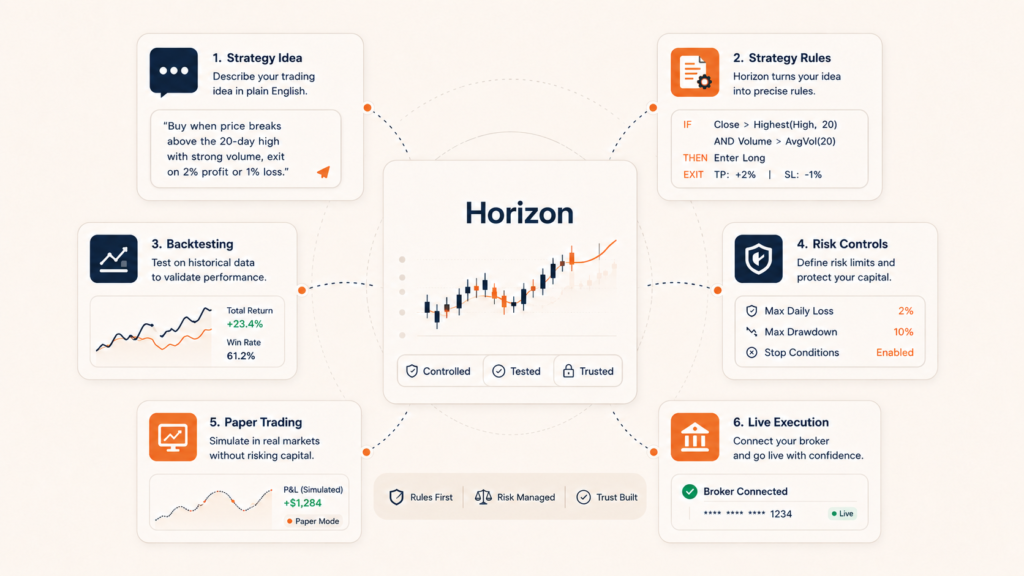
The basic idea is simple enough: a trader can describe an idea in everyday language, test it against past markets, refine it, and then connect the strategy to a broker. Horizon’s launch comes at a moment when the technical barriers around systematic trading are starting to fall across the industry.
The Coding Barrier to Systematic Trading Is Falling
Horizon Trade closes the gap between a trading idea and the market. A trader describes a strategy in plain English, and the platform builds rules that can be tested against years of historical data.
For years, that step was the reason a lot of trading ideas never got tested. You could have the idea, but getting it into a form a computer could understand was another matter entirely. An afternoon that once went into fixing code can now go into testing several versions of an idea and discarding the ones that fail.
That is the broader promise of no-code trading: the trader does not need to become a programmer before finding out whether an idea survives testing. Vibe coding is lowering a similar technical barrier in software, where people can now build applications without traditional development skills. And, on paper at least, that makes experimentation much less intimidating.
Laurenz Bauer, Marketing Manager at Horizon, told SaaSTake:
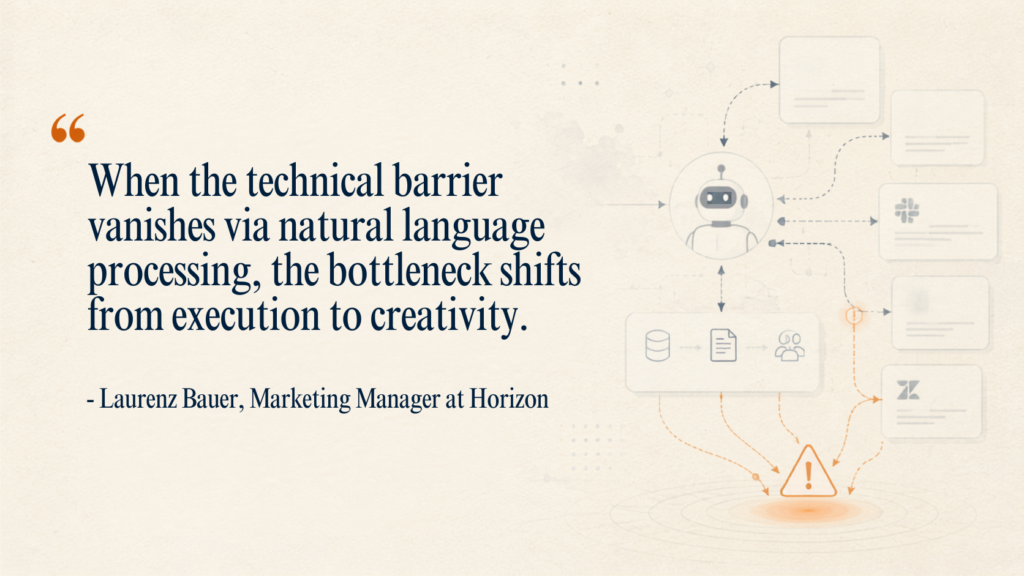
Put simply, that changes the job. Less of a trader’s time goes into translating an idea for a computer. More goes into judging what is worth testing. The catch is that when testing gets easier, it also gets easier to test too much. The shift creates a problem of its own.
Testing More Ideas Can Make Bad Strategies Look Convincing
When you run enough versions of a strategy against the same historical data, one will eventually look brilliant. That is where things can get tricky. That result may just be a strategy fitted unusually well to the past.
Bauer describes the faster experimentation as a “fail fast” loop, which helps traders reject weak ideas sooner. That sounds useful, and it can be. However, it also means the distance between a good experiment and a bad one can shrink very quickly, because generating another strategy takes almost no effort.
However, there is one problem: overfitting.
A strategy can perform beautifully on the data it was built around and then fall apart when conditions change. The more freedom traders have to keep tweaking an idea, the easier it becomes to mistake a good historical fit for a genuinely good strategy.
Horizon says its tests account for those costs rather than leaving them out, including fees, delays before an order reaches the market, and the difference between the expected price and the price actually available. Once those real-world costs enter the equation, a strategy that looked strong in a backtest can look very different.
Horizon’s Investor Sees the Next Robinhood. Horizon Makes a Different Comparison.
Entrée Capital’s Avi Eyal set the bar high in Horizon’s launch announcement, saying the company could become the “next Robinhood.”
Horizon draws the line elsewhere. “While Robinhood gamified impulsive trading, Horizon is democratizing systematic trading,” Bauer told SaaSTake.
That distinction matters because making trading easier has not always come without consequences. Robinhood dramatically reduced the friction involved in placing a trade, but its use of gamification also drew regulatory scrutiny. In 2024, the company agreed to pay Massachusetts $7.5 million and overhaul its digital engagement practices following a state enforcement case.
Horizon is removing a different kind of friction. The user is not getting an easier buy button. They are creating rules that keep acting long after the original decision. And that changes the nature of the problem: easier strategy creation also means the controls around execution matter.
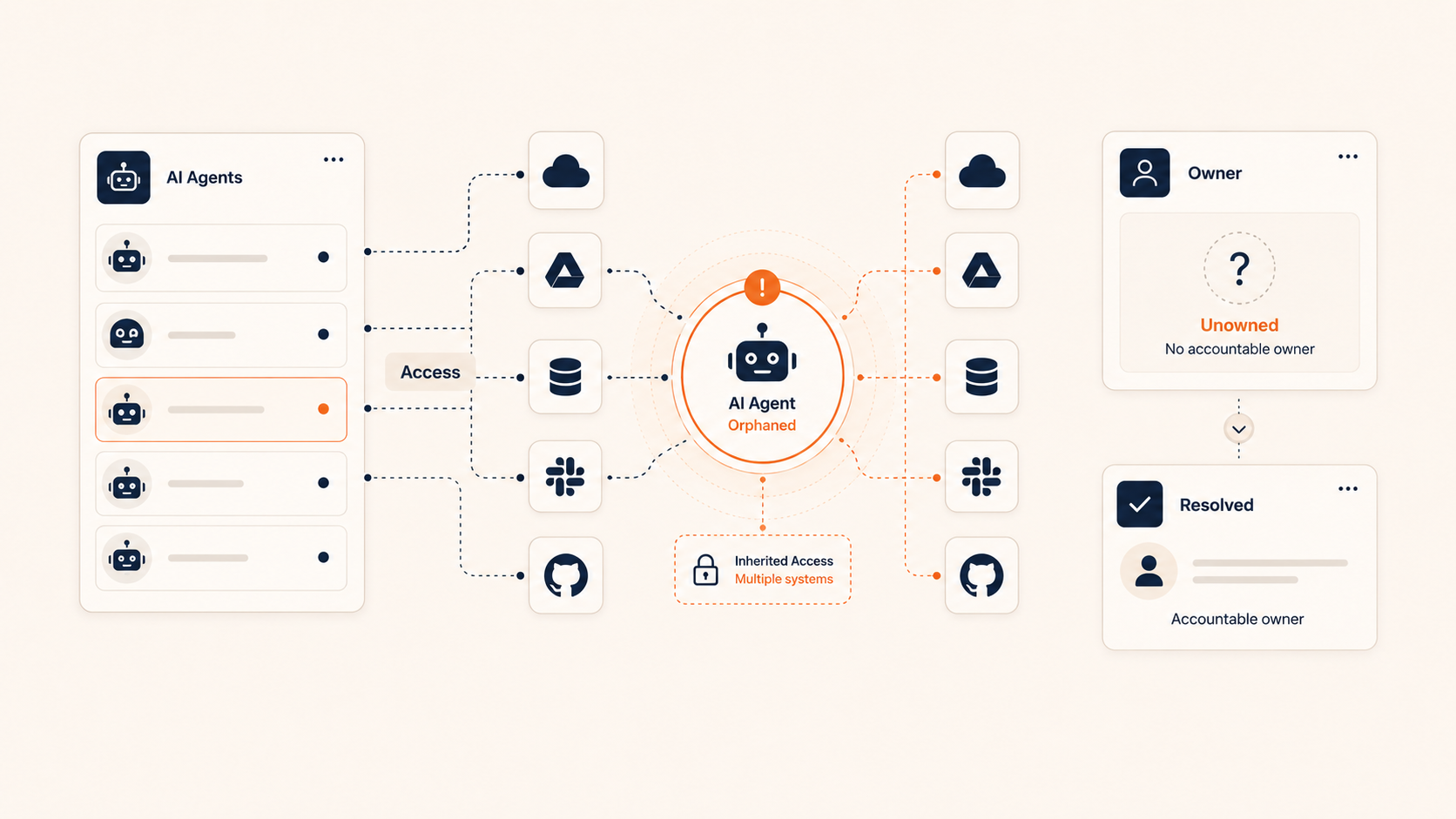
In May, Robinhood opened dedicated brokerage accounts to outside AI agents, letting software trade on a customer’s behalf. Once software receives that kind of authority, how AI-agent access is governed becomes part of the control problem too.
So, you see, the lesson may be bigger than either company. Every time technology removes another step between a person and the market, the controls around that new freedom matter more.
When Real Money Is Involved, Failure Becomes Part of the Product
An automated strategy is only as safe as its failure controls. That becomes particularly important in automated trading, where software may continue acting after the trader has made the original decision.
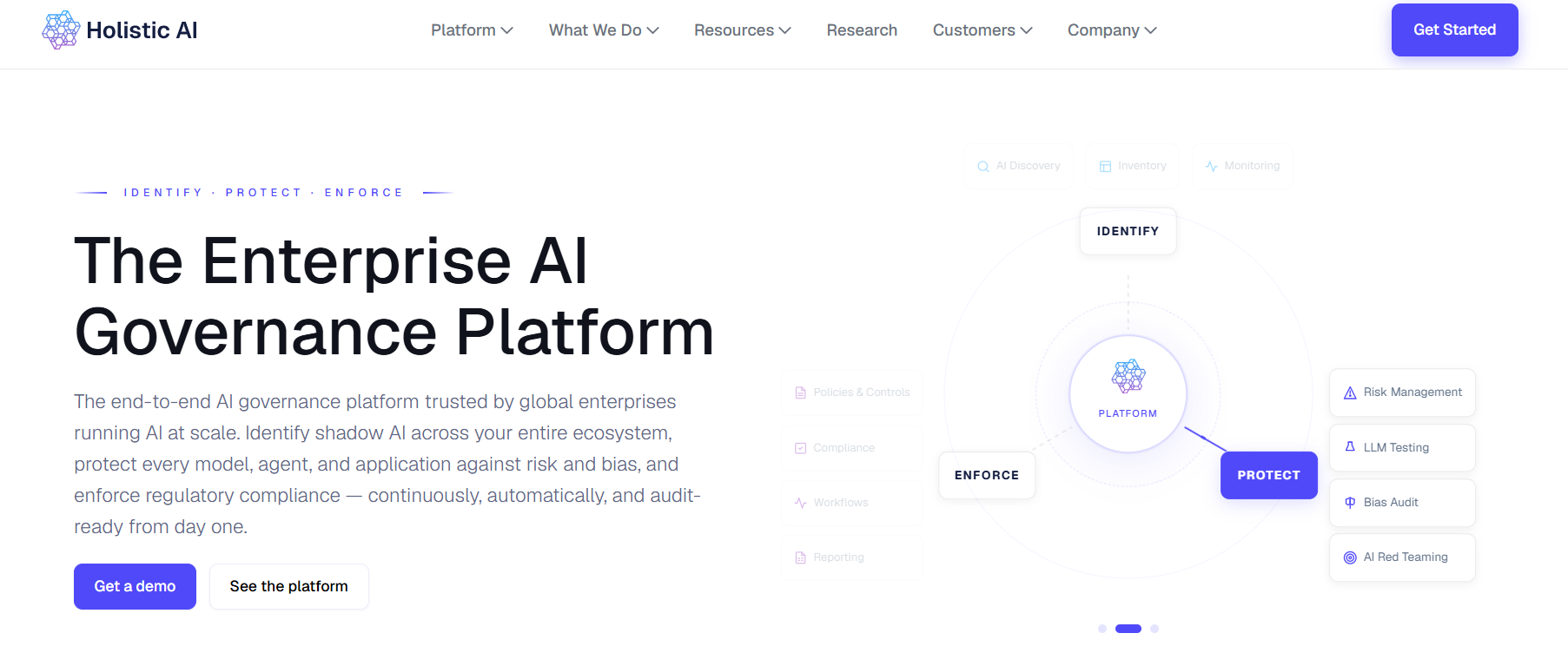
Regulators are paying attention to that problem too. FINRA’s 2026 oversight report flags AI systems that act without human approval, exceed the authority a user intended, or make decisions nobody can trace afterward. The same distinction matters in AI governance, where monitoring what a system does is different from being able to enforce limits before it acts.
Horizon says users can set limits that automatically stop a strategy when certain risk levels are crossed. Just as importantly, the trader’s money stays with the connected broker rather than with Horizon.
Bauer traces that thinking to the team’s cybersecurity background. He adds:
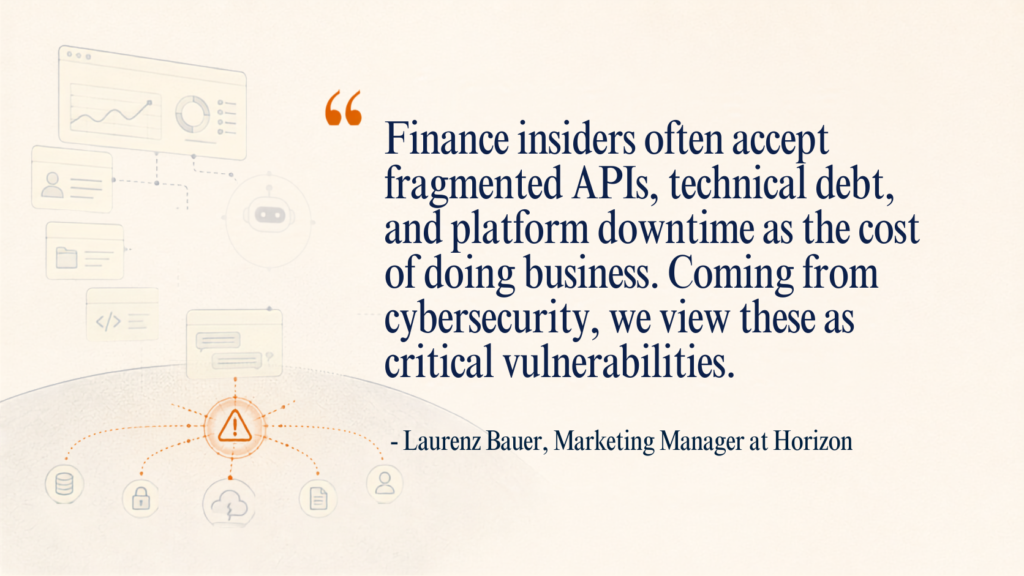
The company’s finance experience extends beyond the product’s launch. CEO Tuvia Ohana had previously built an AI trading-signals product and helped launch an investment fund using quantitative models.
In practice, he says, that means building a system that stops safely when something like a market-data feed fails rather than trading on incomplete information. It is a small detail on paper, but in an automated system, those details are exactly where things can go wrong.
Established Brokers Are Moving in the Same Direction
Horizon believes older trading platforms have a harder time simplifying products originally built for professional traders.
Bauer puts the argument more sharply: “Institutional software is built for Ph.D. quants and requires maximum complexity.” He also argues that offering cheaper tools to individual traders could undercut the expensive products some providers already sell to institutions.
Still, Horizon is not moving into an empty market. Established players are nevertheless moving toward simpler AI interfaces.
Interactive Brokers now lets customers use ChatGPT, Claude, and Grok to research markets and generate trading instructions, while keeping final approval with the customer. Its AI integrations now cover equities, ETFs, options, and futures.
Alpaca has gone further toward AI-driven execution. Its tools let traders research markets and place orders through natural language, although the system defaults to simulated trading and tells users to review AI-generated orders before using real capital.
The competitive bar for an AI trading platform is therefore moving quickly. That means Horizon cannot win simply because a trader can type a strategy instead of coding one.
Its larger bet is that people will want one place to turn an idea into something testable, understand where it could fail, and decide whether it deserves to reach a broker.
Making Trading Easier Does Not Make Markets Easier
AI is removing a technical barrier that once kept many people away from systematic trading. Horizon itself now describes the change plainly: AI has transformed the step where an idea gets translated into a testable strategy, while the quality of the idea and the discipline around risk still belong to the trader. Even its own advice to users ends at the same place: test, simulate, then think hard before real money.
The ability to create a trading strategy may become increasingly ordinary. Knowing whether the strategy is believable, and whether it deserves real money, will not.
In fact, the coding barrier may turn out to be the easy part to remove. The harder problem is deciding what deserves to happen once the code is gone.
Horizon is betting that once almost anyone can build the strategy, the more valuable product will be the one that helps them decide whether they should ever let it trade.