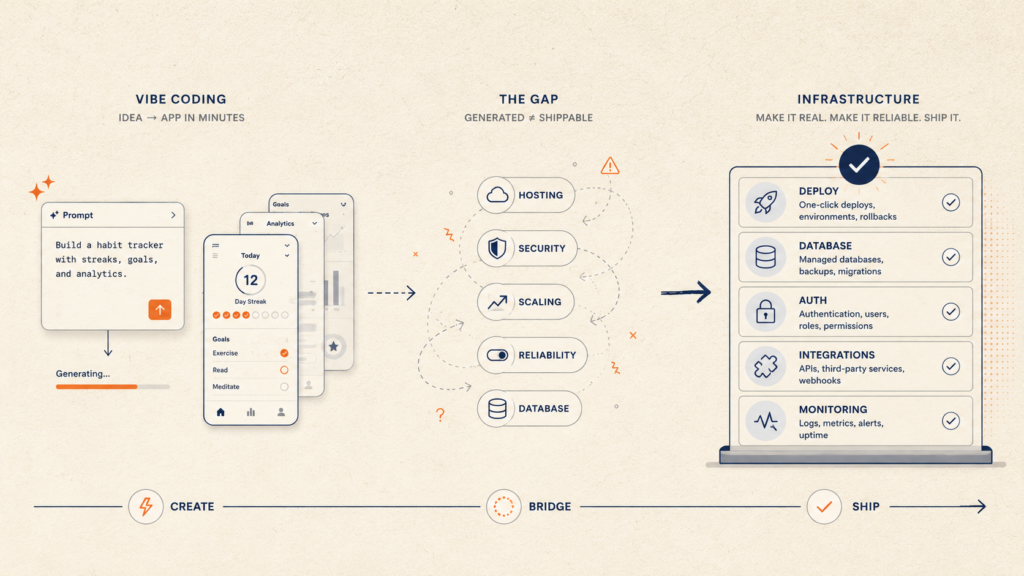
| TL;DR: Vibe coding made building software accessible to almost anyone, but the tools that generate code do not handle what comes next: hosting, databases, security, and the infrastructure that makes an app reliable enough to actually use. That gap between generating an app and shipping one has quietly become the biggest open problem in software right now. However, companies like Lovable, Replit, Supabase, Modelence, and Imagi are each building a different piece of that puzzle, and in 2026 alone they have raised over $1.3 billion doing it. |
Five years ago, building software used to mean hiring developers, spending months, and having a budget most teams couldn’t justify.
Then vibe coding came and changed the entire scene. Tools like ChatGPT and Claude made it possible for anyone to describe what they wanted and get working software live in minutes. Suddenly, the barrier that kept most people out of software creation was gone. Developers, founders, marketers, and students were all building apps they never could have built before.
But generating an app and actually running one are two very different things. The part that comes after the prompt, such as hosting, securing, scaling, and making it reliable enough for real users, is where most vibe-coded apps fall apart. The interesting part is that it is also where investors are placing their biggest bets right now.
Lovable’s $13.3B Valuation is About More Than the Prompt
Lovable raised $400 million at a $13.3 billion valuation recently, more than double what it was worth eight months ago. That is a huge jump. However, that kind of jump does not come from having a good AI underneath. Every major lab has that.
What Lovable has is everything around it. Users have created more than 60 million projects on the platform. Apps built on it receive over 900 million visits every month.
You see, 63% of vibe coding users are not developers; they are founders, marketers, and operators who had no path into software creation before vibe coding existed.
And Lovable did not stop at giving them that path. It gave them payments, integrations with Salesforce, Microsoft 365, Google Workspace, and Stripe, and security and governance features that even enterprise teams love and need. Adidas, Nvidia, and Deutsche Telekom are among the companies Lovable names as using it for internal software and workflows.
Lovable has increasingly built the hosting, security, integrations, and governance needed to move projects beyond the prototype stage. The prompt gets you the app. The infrastructure is what makes that app something you can actually depend on.
Lovable Is Not the Only One Making This Bet
Replit spotted the same gap and went after deployment. Raising $400 million at a $9 billion valuation in March, it built an environment where you write, run, and publish your app without ever touching a server.
On the other hand, Supabase went after the database problem. Every app that gets generated needs somewhere to store data, and most people building with AI have no idea how to set that up. Supabase made it simple enough that over 60% of new databases on the platform are now launched through some form of AI tool, which is why it just raised $500 million at a $10 billion pre-money valuation.
Modelence, a Y Combinator company that raised $3 million, is going after the connective tissue: the handoffs between authentication, databases, and hosting that can introduce additional failure points as vibe-coded apps move toward production. Those failure points are not always visible immediately. QA Cafe’s CDRouter stability testing shows how software can appear to work normally before memory or performance problems emerge after hours or days of operation.
Then there is Imagi, which is taking a different route altogether. It is going after the generation that has not started building yet. It raised $4.5 million to bring vibe coding into K-12 classrooms through a Lovable partnership, with OpenAI covering $1 million in credits so schools can access it for free.
Do you know the impact it created?
- A teacher used it to build an app that translated her curriculum into 15 languages.
- A student built a website for his lawn-mowing business with a live booking calendar.
Those examples may sound small, but they point to something bigger: people are already finding uses for this that traditional software development never made practical.
Put all five companies together, and the pattern becomes pretty clear. Investors are not just betting on people being able to generate software. They are betting on everything that happens once they do.
Vibe Coding Is Starting to Change Who Buys Software
For years, SaaS worked on a simple premise. Building software was hard, so companies paid for ready-made tools instead. CRM, HR software, project management, analytics – you name it. The per-seat model made sense because the alternative, hiring developers to build something custom, was expensive and slow.
Vibe coding is starting to challenge that logic for some software categories. The UK’s National Cyber Security Centre documented a real example in 2026: a startup’s engineering lead vibe-coded the core functionality of a SaaS product in a couple of hours after receiving an expensive renewal quote.
The NCSC also noted that larger companies are already seeing developers and admins use AI to create and maintain internal tools they would previously have bought from software vendors.
That is where things get interesting for SaaS. If a company can build a simple internal tool in hours instead of buying one, the old calculation starts to look a little different.
Markets have started pricing that shift in. In February 2026, AI disruption fears triggered a sharp software selloff. Bloomberg estimated that one day of selling erased $285 billion across software, financial services, and asset management stocks.
The NCSC is clear that broader change will take years, and that current AI-generated code still carries real security and maintainability risks. So this is not a case of SaaS disappearing overnight. But the direction of travel is becoming harder to ignore.
The Real Opportunity Is Not in the Prompt
Capital is no longer flowing only into the models that generate code. It is also flowing into the platforms, databases, deployment systems, and workflows that turn generated code into usable software. And that is really what these five companies have in common. They each cover a different part of what is becoming a new ecosystem. The financial record around that code is changing too, with CodeROI capturing development activity as it happens so R&D claims do not have to be reconstructed months later.
Of course, there is a catch. The security challenge running underneath all of this is real.
A CodeRabbit analysis of 470 pull requests found AI-generated code contained 1.7x more issues overall, with security issues appearing about 1.57x as often as in human-written code. Moreover, a 2025 security scan of 1,645 Lovable-built apps found 170, or 10.3%, exposed user data through missing or insufficient Row-Level Security policies.
Lovable disputed the CVE’s platform-level attribution and has since added automatic security checks before publishing, including database configuration and RLS scans. That is an important distinction. Making software easier to create does not automatically make it safer to run. Horizon is a near-perfect parallel; AI makes systematic trading easier to create, but real money makes testing and controls more important.
Additionally, the same generation-versus-validation gap appears in financial software, where dxFeed is putting testing and containment around AI-generated trading code before that logic can progress toward live markets.
In fact, the these problems can move in opposite directions. The easier it becomes for anyone to build an app, the easier it also becomes to build one without fully understanding what is happening underneath.
The Prompt Was Always the Easy Part. Building What Comes After It Isn’t.
Gartner forecasts that 75% of new enterprise production software will be built using vibe coding techniques by 2028. 84% of developers worldwide already use or plan to use AI coding tools, up from 76% in 2024. Microsoft CTO Kevin Scott predicted in 2025 that 95% of code could be AI-generated by 2030.
If those numbers hold, the question that matters for every software company is not whether AI can write code. We already know it can. The question is what sits around that code, who hosts it, who secures it, and, more importantly, who makes it composable and reliable enough for a company to depend on. And reliability eventually has to be proven, not assumed. For instance, Gremlin’s new Dynatrace app shows how enterprises are deliberately testing failure conditions before customers encounter them.
The companies that figured that out early are now commanding valuations of $9 billion, $10 billion, and $13.3 billion. They are not competing with ChatGPT or Claude. They don’t have to either. They are building what those tools cannot give you on their own. That’s something worth monitoring.