
| TL;DR: Most AI visibility tools look remarkably similar on the surface. However, the differences become clearer once you look at how they work, what they actually show you, and what you get at each price point. This guide compares 14 AI visibility tools, including Profound, GumShoe AI, Rankscale, GeoGym, Brandi AI, AirOps, and others. We look at what each tool is best suited for, which AI platforms it covers, the features it offers, and where pricing starts. |
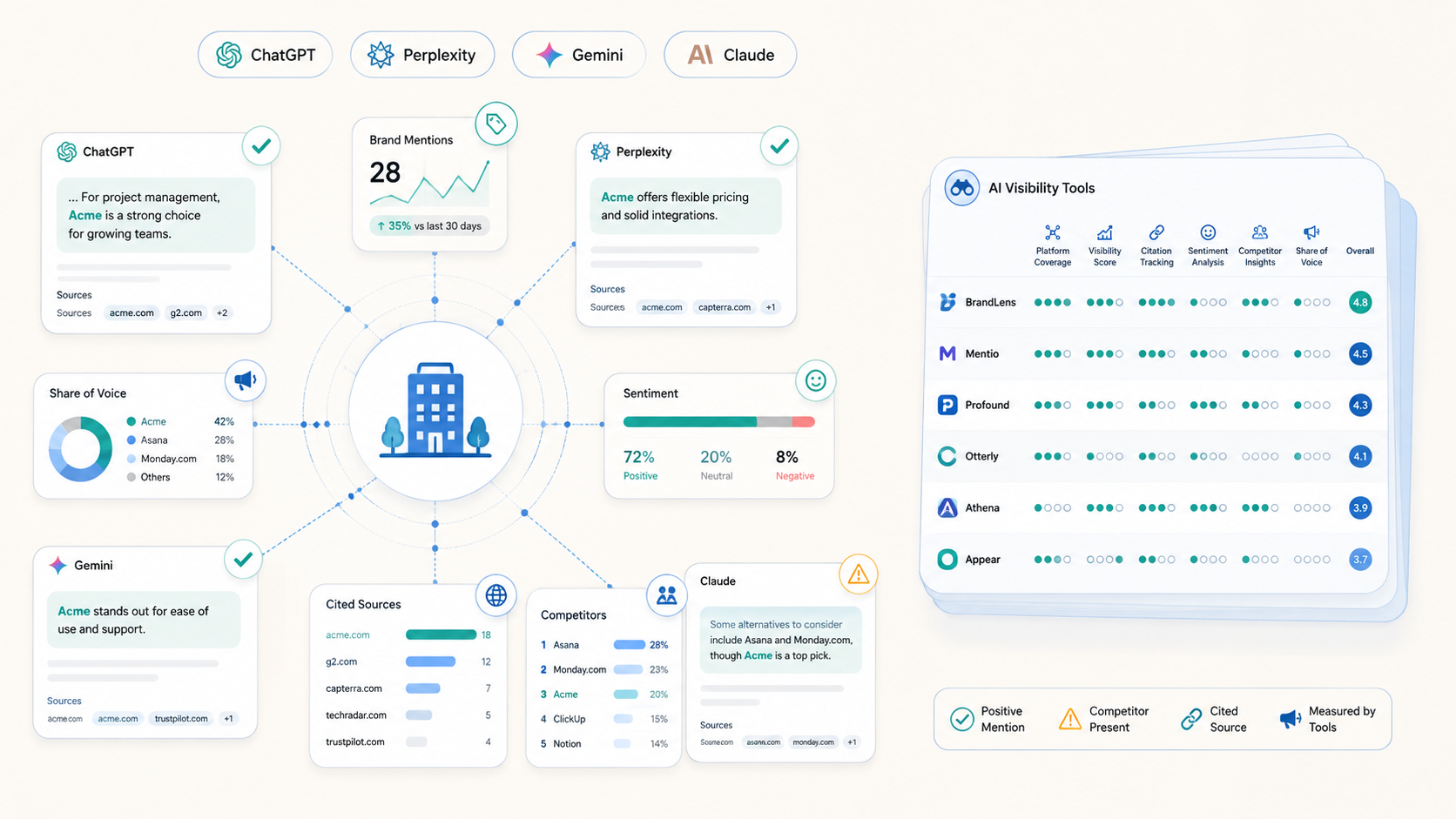
AI visibility has quickly become something every marketing team wants to understand. Brands want to know whether they appear when someone asks ChatGPT, Perplexity, Gemini, or another AI platform for the best companies, products, or tools in their category.
More importantly, they want to know who is showing up when they are not. That has also created a fair amount of FOMO.
Every few weeks, there seems to be another report ranking the brands getting the most visibility across AI platforms. At the same time, new AI visibility tools keep entering the market, each promising to show you where your brand appears, which competitors are ahead, what sources AI engines cite, and what you can do to improve.
The problem is that many of these tools look very similar from the outside. Almost all of them talk about prompt tracking, share of voice, citations, competitors, and multiple LLMs. Once you start using them, though, the differences become much easier to see.
With so many options, how do you figure out which AI visibility tool is actually worth your time and budget? That’s why we created this list of 14 tools, using hands-on research, product demos, documentation, and pricing information to understand what each one offers and where it stands out.
Before we get into the tools themselves, let’s look at five factors that can help you decide which one is right for your team.
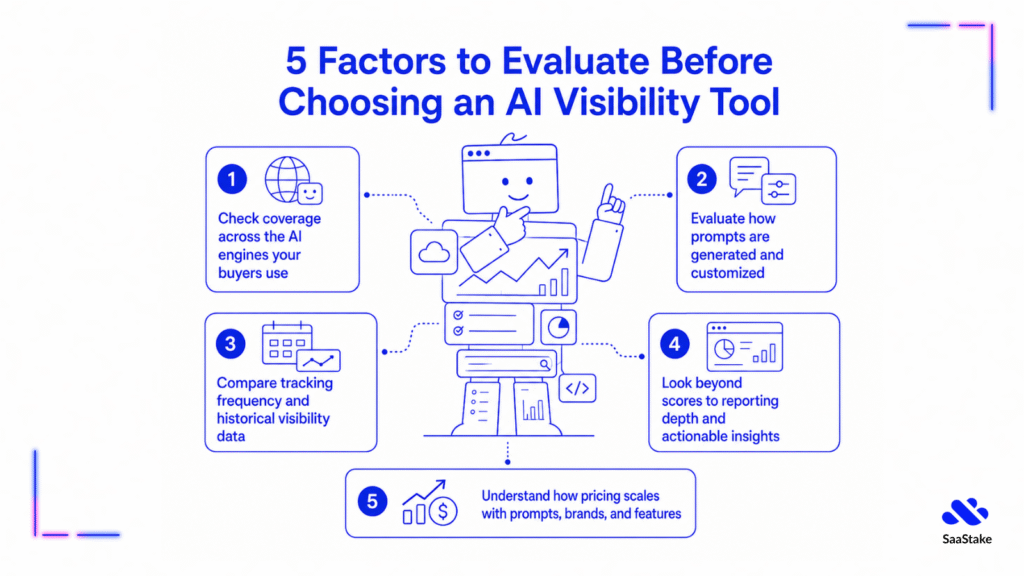
5 Factors to Evaluate Before Choosing an AI Visibility Tool
With so many AI visibility tools entering the market, comparing feature lists alone will not get you very far. Most cover some combination of prompts, citations, competitors, and AI platforms. The differences become clearer when you look at how that data is collected, what the tool actually lets you track, and whether the output is useful enough to act on.
Here are five factors worth looking at before you shortlist a tool.
1. LLM Coverage
Here’s an important caveat: not all AI engines are equally important for every category. A B2B SaaS brand selling to enterprise buyers may care most about ChatGPT, Perplexity, and Google AI Mode. At the same time, a consumer brand may care more about appearing across Google AI Overviews.
Tools in this space range from 3 engines at entry level to 17 or more at the high end. Broader coverage, though, does not automatically make a tool better. What matters is whether the engines your buyers actually use are covered on the plan you can afford.
| Question to ask: Which specific AI engines does this plan track, and are those the engines my buyers use most? |
2. Prompt Generation and Quality
AI visibility scores are ultimately based on the prompts a tool runs. That makes the quality of those prompts just as important as the number being tracked.
Some tools automatically generate prompts from your website or category. Others let you edit those suggestions, upload your own prompts, or build them around specific personas. During our testing, this was one area where the experience differed quite a bit from tool to tool.
It is important to look beyond how many prompts a plan gives you, and check whether those prompts resemble questions a potential buyer would realistically ask and how much control you have to change them. Otherwise, you may end up tracking a large set of queries that will tell you very little about your actual visibility.
| Question to ask: How are prompts generated, and can I customize or upload my own? |
3. Tracking Frequency
A visibility report is more useful when you can see how it changes over time. Your brand may gain or lose mentions as AI models change, new content gets published, or the sources being cited begin to shift.
This is where tracking frequency matters. Some tools automatically rerun prompts daily or weekly, while others are better suited to one-time or periodic audits. Historical data also varies. A tool may show your current score but give you very little context on whether that score has improved over the last few weeks or months.
If you want to measure whether your GEO or content efforts are working, check both how often prompts are rerun and how much historical visibility data you can access.
| Question to ask: How often does the tool re-run prompts, and how much historical data can I see? |
4. Reporting Depth
Most tools will give you some form of visibility score or share of voice. That alone is not enough to understand why your brand is appearing or what you should look at next.
The more useful reports let you dig into the individual prompts and AI responses behind the score. Depending on the tool, you may also get competitor comparisons, citations, sentiment, top cited domains, brand mentions, or recommendations for improving visibility.
This is also why trying the product or looking at a real sample report matters. Two tools can advertise almost the same features on their pricing pages and still give you very different levels of detail once the report is generated.
| Question to ask: What does the actual report show, and can I see a sample before I commit? |
5. Pricing Model and How It Scales
AI visibility tool pricing varies significantly. Some charge per domain, some use a credit system, while some price by the number of AI engines checked. Most tools, however, package these limits into fixed plans, so the starting price does not always tell you what the tool will actually cost for your use case.
It is important to look closely at what each tier includes and whether features such as recurring monitoring, exports, API access, or white-label reporting are included. A lower-priced plan can become less attractive if the limits you need are only available on the next tier.
Agency plans, multi-brand setups, and white-label options also vary widely. If you are evaluating this for an agency or for multiple brands, check which plan actually supports that setup rather than comparing entry-level prices alone.
| Question to ask: Which plan is best targeted to my use case and which features require moving to a higher tier? |
Now that we’ve looked at the factors that can help you evaluate an AI visibility tool, let’s look at the tools worth considering in 2026.
Top AI Visibility Tools to Consider in 2026
While there are plenty of AI visibility tools to choose from, not all of them are built the same way. Some are built specifically for AI visibility, while others add it to a broader SEO or content platform. We tested the 14 tools below to see how they work in practice and which use cases each one is better suited for.
- Profound
- Semrush AI Visibility Toolkit
- SE Visible by SE Ranking
- Rankscale
- GeoGym
- GumShoe AI
- AthenaHQ
- Writesonic AI Visibility Tracker
- Traqer
- Nightwatch
- Goodie AI
- Parsnipp
- Brandi AI
- AirOps
Let’s take a closer look at each one.
1. Profound – Best for Agencies Managing Multiple Client Brands
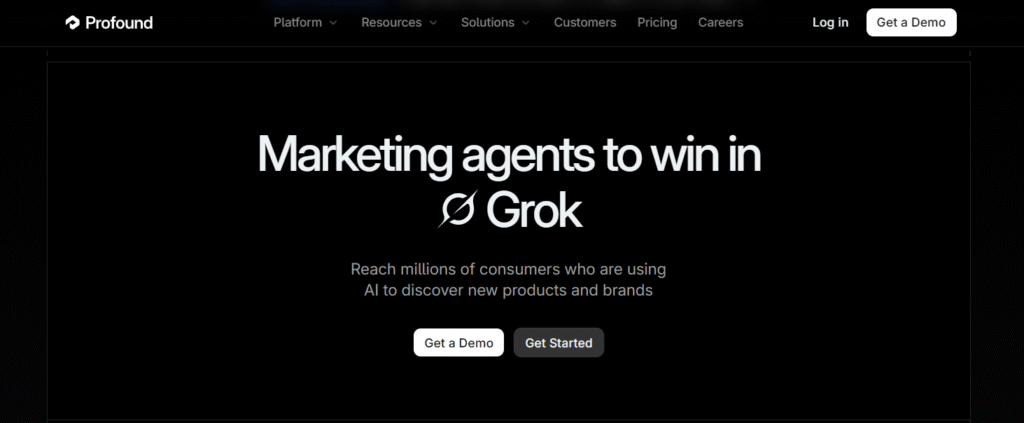
Profound is one of the most popular tools on our list, and it is built for both in-house marketing teams and agencies. However, its agency setup is particularly worth noting.
Instead of making agencies manage every client as a separate account, it provides centralized client management, dedicated agency support, and an Agency Mode designed around managing multiple brands from one place.
Source – Profound
It is a lot broader than a standalone AI visibility dashboard. Profound has been expanding into areas such as AI crawler analytics, content workflows, prompt research, and AI shopping visibility, so teams can use the platform for more than monitoring alone.
Notable Features
- Answer Engine Insights: Tracks how your brand and competitors appear across answer engines, including visibility, citations, sentiment, ranking, and competitive presence.
- Prompt Volumes: Helps teams research what people are actually asking AI platforms, along with prompt demand, trends, intent, and related topics.
- Agent Analytics: Shows which AI crawlers visit your site, which pages they access, and how AI search contributes to site traffic.
- Agents: Lets marketing teams build workflows for tasks such as content refreshes, FAQ generation, competitive research, and new content creation.
- Shopping: Tracks how products appear inside ChatGPT Shopping and surfaces opportunities to improve product placement.
What Sets It Apart
Profound stands out for combining broad answer-engine coverage with content execution. It supports up to nine answer engines and then uses its visibility and citation data to help marketing teams identify content gaps, create or refresh content, and track whether those changes improve AI citations. That closed-loop workflow goes further than simply showing teams where their visibility gaps are.
Rating
4.5/5 on G2, from more than 1,128 reviews.
Pricing
Profound offers tiered packages, starting with the Starter package at $99/month, billed yearly, which includes 50 prompts. From there, its Growth and Enterprise plans offer higher prompt volumes and broader LLM coverage.
It also has dedicated agency plans. You can check Profound’s website for more pricing information.
2. Semrush AI Visibility Toolkit – Best for Teams Already Using Semrush
Semrush AI Visibility Toolkit makes the most sense for teams already using Semrush for SEO. Instead of adding AI visibility as a completely separate workflow, it brings the data alongside the keyword tracking, competitor research, site audits, and content tools that teams may already use on the platform.
Source – Semrush
You can use the toolkit on its own or opt for Semrush One, which combines its SEO and AI visibility capabilities in one plan. This makes it particularly useful for brands that want to monitor how their visibility is changing across both traditional and AI search without managing separate platforms.
Notable Features
- Visibility Overview: Shows your brand’s overall AI visibility and lets you compare mentions, sources, and performance against competitors.
- Prompt Research: Helps discover relevant topics and prompts from Semrush’s prompt database, along with the brands and domains already appearing for them.
- Prompt Tracking: Tracks selected prompts daily and lets you compare AI visibility with traditional Google rankings.
- Brand Performance: Tracks share of voice, sentiment, narrative drivers, and how AI platforms describe your brand compared with competitors.
- AI Search Site Audit: Flags technical issues that may prevent AI bots from crawling and accessing your content.
What Sets It Apart
Semrush’s biggest advantage is how closely AI visibility connects with its existing SEO stack. Marketing teams can compare AI prompt performance with traditional rankings, check AI crawlability through Site Audit, research prompts, and work on content opportunities without moving between separate tools. Its large prompt database also gives teams another way to decide what is actually worth tracking rather than relying only on automatically generated prompts.
Rating
4.5/5, based on 4,026 reviews.
Pricing
The standalone AI Visibility Toolkit starts at $99/month per domain when billed annually. It includes 25 tracked prompts, one domain for Brand Performance, 300 AI Analysis reports per day, and more. Semrush One combines SEO and AI visibility. Its Starter plan costs $199/month, or $165.17/month when billed annually, and includes 50 prompts tracked daily. Higher tiers increase the number of websites, keywords, and prompts you can track.
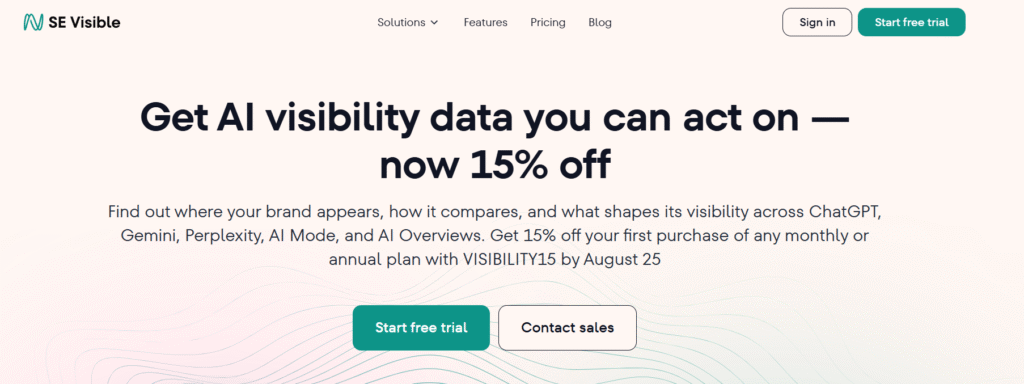
3. SE Visible by SE Ranking – Best for Teams That Want Deeper Sentiment and Source Analysis
SE Visible is a dedicated AI visibility platform from SE Ranking. While it covers the usual visibility and competitor tracking, it goes deeper into how AI engines talk about your brand and the sources shaping those answers. This makes it particularly useful for marketing teams that want to look beyond whether they appear and understand the context behind that visibility.
Source – SE Visible
It also supports tracking across different countries and languages, which can be useful for brands operating across multiple markets. Agencies can also manage multiple brands or clients from the same platform, invite unlimited users, and export visibility data for further analysis.
Notable Features
- AI Visibility Tracking: Tracks brand visibility, mentions, competitors, and trends across ChatGPT, Gemini, Perplexity, Google AI Mode, and AI Overviews.
- Sentiment Analysis: Shows how positively or negatively AI engines talk about your brand and lets you analyze sentiment at the prompt level.
- Source Analysis: Shows the domains and URLs most frequently cited in AI answers and groups sources into categories such as media, blogs, and forums.
- Competitor Analysis: Compares visibility, sentiment, prompts, and cited sources against competing brands.
- Multi-Country and Language Tracking: Supports localized tracking across multiple countries and languages.
What Sets It Apart
SE Visible stands out for the depth of its sentiment and source analysis. Along with tracking whether a brand appears, it shows how AI engines portray it and which domains, URLs, and types of sources are influencing those answers. That gives teams more context around why their visibility looks the way it does and where they may need to focus next.
Rating
4.7/5, based on 1,587 reviews.
Pricing
SE Visible offers three plans and a 10-day free trial. The Basic plan currently starts at $79/month and includes 200 prompts, around 12,000 AI answers analyzed per month, and 3 projects. Their Core plan starts at $151/month, while Plus starts at $284/month.
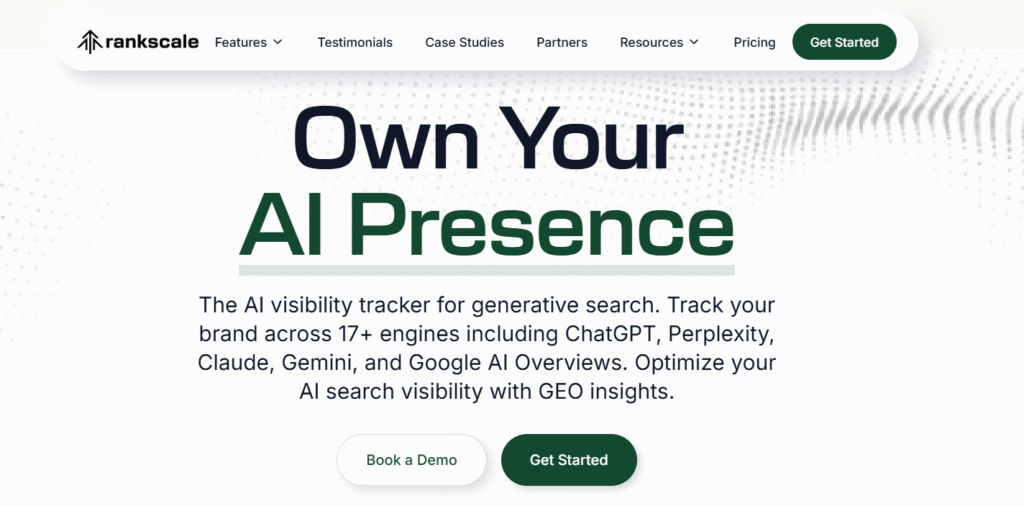
4. Rankscale – Best for Broad AI Engine Coverage and Technical Audits
Rankscale is one of the broader AI visibility tools in this list, with tracking across 17+ AI engines, including ChatGPT, Perplexity, Claude, Gemini, Google AI Overviews, DeepSeek, Grok, Copilot, Mistral, and AI Mode. Unlike some platforms that limit wider engine coverage to higher tiers, Rankscale includes access to all supported engines across its plans.
Source – Rankscale
It also puts more emphasis on the technical side of AI visibility. Alongside brand, competitor, citation, and sentiment tracking, Rankscale audits websites across 94+ technical checkpoints to identify structural and authority signals that may affect whether AI engines can understand and cite the content.
Notable Features
- AI Engine Tracking: Tracks visibility across 17+ AI engines and search experiences.
- Technical AI Audits: Checks websites across 94+ technical and content signals related to AI discoverability.
- Citation Analysis: Shows which sources AI engines rely on and how they contribute to brand visibility.
- Prompt and Competitor Tracking: Lets marketers monitor prompts and compare visibility against competing brands over time.
What Sets It Apart
Rankscale stands out for offering 17+ AI engines across all plans while also going deeper into technical AI readiness through its 94+ audit checkpoints. That combination makes it particularly relevant for marketers and SEO teams that want both visibility tracking and a more technical view of what may be affecting their ability to get cited.
Rating
5/5, based on 1 review.
Pricing
Their plans start at $99/month for the Pro plan, $385/month for the Growth plan, and $780/month for the Enterprise plan. They also offer a 7-day trial with the Pro plan.
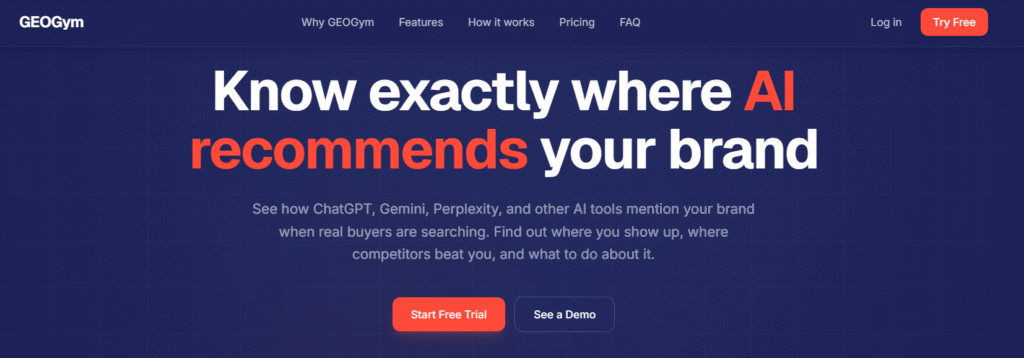
5. GEOGym – Best for B2B SaaS Teams That Want Focused AI Visibility Tracking
GEOGym is built with B2B SaaS teams in mind, helping them understand where their brand appears across ChatGPT, Gemini, Perplexity, Google AI Mode, and AI Overviews. Rather than overwhelming teams with unnecessary metrics, it focuses on the prompts, competitors, topics, and citations that can actually help them understand where they stand.
Source – GEOGym
During setup, teams can define their ICP, products, and key competitors, while GEOGym generates buyer-focused prompts across discovery, how-to, persona, keyword, and competitor comparison queries. This makes it easier to track visibility around the kinds of questions potential buyers are likely to ask.
Notable Features
- AI Visibility Tracking: Tracks brand mentions and citations across five AI platforms.
- Citation Context: Shows whether a brand is Recommended, Mentioned, Warned Against, or Not Mentioned.
- Prompt-Level Analysis: Helps marketing teams understand which buyer queries are driving brand visibility.
- Topic-Level Analysis: Shows where your brand is performing well and where competitors have stronger visibility.
- Historical Trends: Tracks how visibility changes over time.
- Unlimited Brands and Users: Lets teams manage multiple brands and users without separate per-seat or per-brand charges.
What Sets It Apart
GeoGym is particularly well suited to B2B and SaaS brands because it combines buyer-focused prompts with clear visibility, competitor, and citation-context reporting. It also offers unlimited brands and users across its plans, making it equally practical for agencies managing multiple SaaS clients.
Rating
Not yet listed on G2.
Pricing
Plans start at $29/month, with Growth at $99/month and Pro at $399/month. All plans include a 7-day free trial with no credit card required.
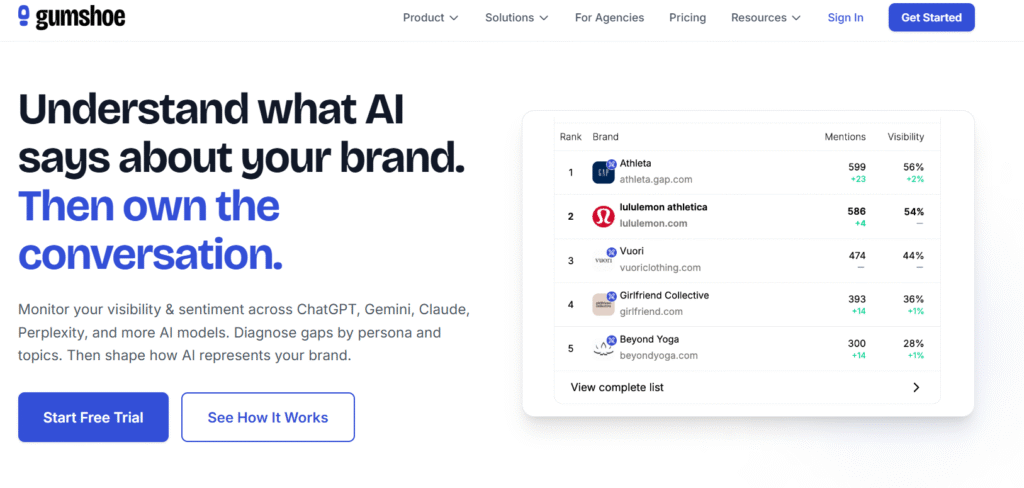
6. GumShoe AI – Best for Teams That Want Persona-Based AI Visibility Analysis
GumShoe AI takes a persona-based approach to AI visibility. Instead of looking at prompts without any buyer context, it creates AI-inferred personas based on your brand and industry and shows how recommendations change depending on who is asking the question. Users can also customize these personas or add their own.
Source – Gumshoe
The platform covers 11 AI models and is designed for both brands and agencies. Along with visibility tracking, it offers competitor analysis, citation insights, technical audits, and tools to help teams act on the gaps they uncover. Agencies can also use its visibility audits as part of their client work.
Notable Features
- Persona Reports: Shows how brand visibility changes across different buyer personas.
- Brand Leaderboard: Compares your visibility and recommendations against competitors across AI models.
- Citation Analysis: Shows which third-party sources AI models cite in your category.
- Content and Technical Audits: Highlights content and technical gaps that may be affecting AI visibility.
What Sets It Apart
GumShoe’s biggest differentiator is its persona-based methodology. It shows how AI recommendations change depending on the type of buyer asking the question rather than treating every prompt the same. Combined with coverage across 11 AI models, this gives both brands and agencies a more segmented view of their AI visibility.
Rating
4.8/5, based on 4 reviews.
Pricing
They have two packages: Starter at $99/month and Pro at $299/month. A free trial is also available with no credit card required.
7. AthenaHQ – Best for Teams That Want a Strong Free Starting Point
AthenaHQ is built for brands that want to monitor AI visibility and get recommendations on what to improve from the same platform. Its paid plans cover 8+ AI platforms, including ChatGPT, Perplexity, Gemini, Claude, Google AI Mode, AI Overviews, Copilot, and Grok.
Source – Athena
What makes Athena particularly accessible is its Essential plan. It is permanently free and still includes tracking across five AI platforms, competitor and source insights, content recommendations, unlimited members, and access to the Athena AI agent.
Notable Features
- AI Visibility Tracking: Tracks brand performance and competitors across major AI platforms.
- Ask Athena: An AI agent that uses your visibility, citation, competitor, and sentiment data to answer questions and recommend next steps.
- Content Recommendations: Identifies gaps affecting AI visibility and recommends on-page and off-page actions.
- Citation Analysis: Shows which websites and sources are influencing AI answers around your brand and category.
What Sets It Apart
AthenaHQ stands out for how much it includes in its free plan. Marketing teams can track five AI platforms, analyze competitors and sources, get content recommendations, and use its AI agent without moving immediately to a paid subscription. Paid plans then expand coverage to 8+ platforms and add more advanced optimization capabilities.
Rating
4.9/5, based on 34 reviews.
Pricing
Essential is free. The starter plan costs $295/month, while Enterprise comes with custom pricing.
8. Writesonic – Best for Marketers Who Want to Turn AI Visibility Insights Into Action
Writesonic goes beyond monitoring where your brand appears across AI search. Once it finds a visibility gap, its Action Center recommends what needs attention, whether that means creating new content, refreshing an existing page, earning citations from third-party sources, or fixing technical issues that could prevent AI crawlers from accessing your site.
Source – Writesonic
Some of these actions can also be handled within Writesonic. Its AI agents can assist with content updates, surface third-party sites where competitors are being cited, and flag technical issues affecting AI crawlers. The platform also tracks visibility after changes are made, so marketers can see whether performance has shifted.
Notable Features
- AI Visibility Monitoring: Tracks visibility, citations, sentiment, and competitors across AI search platforms.
- Action Center: Ranks the content, citation, and technical opportunities worth working on first.
- AI Agents: Helps create or refresh content, find external citation opportunities, and address technical issues.
- Performance Measurement: Tracks the impact of completed actions on citations, AI traffic, conversions, and pipeline.
What Sets It Apart
Writesonic brings more of the work that follows an AI visibility audit into the same platform. Along with identifying gaps, it can suggest and support content, citation, and technical actions, then track how visibility changes afterward.
Rating
4.7/5, based on 2,120 reviews.
Pricing
Plans start at $79/month when billed annually, with higher plans at $199 and $399/month. Enterprise pricing is custom. A 7-day free trial is available.
9. Traqer – Best for Topic-Based AI Visibility Tracking
Traqer.ai is built by the team at Grow & Convert and takes a topic-based approach to AI visibility. Instead of treating one prompt like a search keyword, it generates multiple natural-language variations around each topic and uses them together to give a broader view of how visible your brand is.
Source – Traqer
You can review and edit the suggested topics and prompts before tracking begins. Traqer then shows visibility across ChatGPT, Perplexity, Google AI Overviews, Google AI Mode, and Gemini, with Claude available as an add-on. It also allows unlimited brands and users across its plans.
Notable Features
- Topic-Based Tracking: Runs multiple prompt variations for each topic rather than relying on a single query.
- Competitive Benchmarking: Shows how your brand compares with competitors at the individual topic level.
- Citation Analysis: Surfaces the URLs most frequently cited by AI platforms for each topic.
- Prompt-Level Analysis: Shows which prompts generate brand mentions, their intent, and how frequently AI models mention companies in their responses.
What Sets It Apart
Traqer stands out for measuring visibility by topic rather than individual prompts. Since slightly different versions of the same question can produce very different AI answers, it uses multiple prompt variations to create a topic-level visibility score. That gives marketers a less fragmented view of where their brand is actually showing up.
Rating
Not listed on G2.
Pricing
Plans start at $25/month, with Plus at $100/month and Pro at $400/month. Claude tracking is available as a paid add-on.
10. Nightwatch – Best for SEO Teams That Want Search and AI Visibility in One Place
Nightwatch comes from a traditional rank-tracking background, so its AI visibility capabilities sit alongside the SEO data marketers may already be monitoring. You can track rankings across search engines while also seeing how your brand appears and gets cited across AI platforms.
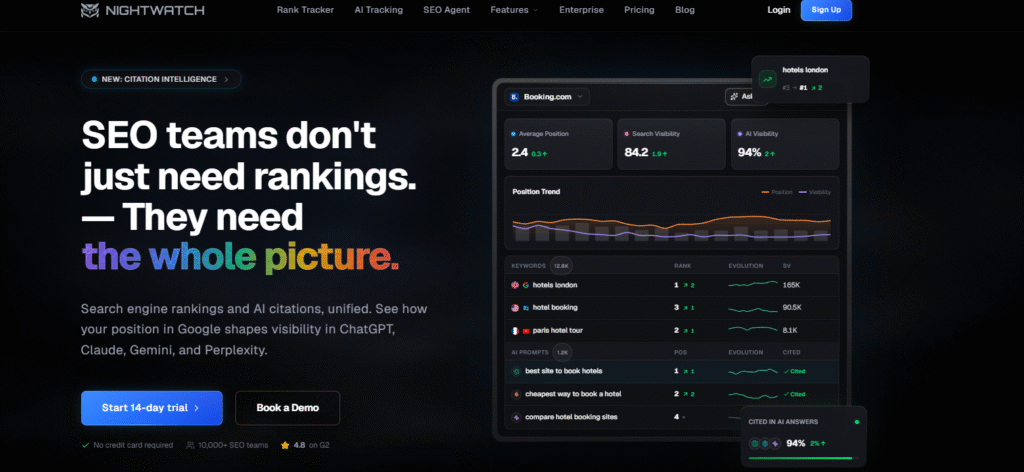
Source – Nightwatch
This makes Nightwatch particularly relevant for SEO teams that do not want to treat AI visibility as a completely separate channel. It also retains the deeper rank-tracking capabilities Nightwatch is known for, including local tracking across more than 107,000 locations and historical ranking data.
Notable Features
- AI & LLM Tracking: Monitors brand visibility, citations, share of voice, and sentiment across major AI platforms.
- Rank Tracking: Tracks traditional search rankings across Google, Bing, YouTube, DuckDuckGo, and Yahoo.
- Citation Intelligence: Connects AI mentions with the search activity that follows, giving marketers another way to understand how AI visibility affects search traffic.
- NightOwl Agent: Looks for competitor gaps, content opportunities, and SEO improvements within the same platform.
What Sets It Apart
Nightwatch stands out for connecting traditional search rankings with AI citations rather than treating them as two separate datasets. Its Citation Intelligence adds another layer by showing when an AI recommendation leads to subsequent search activity, which is particularly useful for SEO teams trying to understand the relationship between the two.
Rating
4.7/5, based on 64 reviews.
Pricing
The Starter plan costs €79 per month when billed yearly, while the Professional plan costs €159 per month and the Agency plan costs €399 per month, all billed yearly. The Enterprise plan has custom pricing. A 14-day free trial is also available, with no credit card required.
11. Goodie AI – Best for Enterprise Brands Tracking AI Search and Commerce Visibility
Goodie AI is built for brands that want to monitor AI visibility across a broad mix of search and discovery platforms. Along with ChatGPT, Claude, Gemini, Perplexity, Copilot, Grok, Meta AI, and Google AI experiences, it also extends into AI-powered shopping through platforms such as Amazon Rufus.
Source – Goodie
The platform is geared toward larger brands and supports use cases across SaaS, retail, fintech, travel, and other industries. Beyond monitoring visibility, Goodie includes tools for identifying optimization opportunities, creating content, understanding how AI crawlers interact with a site, and connecting AI search performance with traffic and revenue.
Notable Features
- Visibility Monitoring: Tracks brand mentions, sentiment, and competitive positioning across major AI platforms.
- Agentic Commerce Suite: Tracks how products appear across AI shopping experiences, including ChatGPT and Amazon Rufus.
- Optimization Actions: Prioritizes content, technical, and visibility opportunities based on the gaps the platform finds.
- Analytics & Attribution: Connects AI visibility with traffic, conversions, and revenue to help measure its business impact.
What Sets It Apart
Goodie stands out for combining broad AI-platform coverage with commerce-specific tracking. Its Agentic Commerce Suite extends visibility monitoring into AI shopping experiences, while its enterprise setup is designed to handle large numbers of pages, SKUs, and prompts.
Rating
Not listed on G2.
Pricing
Their Explorer plan starts at $479/month. Pro and Enterprise plans come with custom pricing. They also offer a free AI site audit.
12. Parsnipp – Best for Brands Combining AI Visibility, Advertising, and Commerce
Parsnipp approaches AI search as a broader marketing channel rather than only a visibility-tracking exercise. Along with monitoring how a brand appears across ChatGPT, Gemini, Claude, and Perplexity, it looks at the wider marketing footprint and provides recommendations around content, citations, website changes, and other areas that may affect AI visibility.
Source – Parsnipp
It also incorporates buyer personas and multi-turn conversations into its analysis, which gives brands another way to understand how AI responses can change depending on the customer and context behind the query.
Notable Features
- AI Visibility: Tracks brand performance, competitors, sentiment, prompts, and citations across major AI platforms.
- LLM Advertising: Uses visibility data to inform paid placements across AI search platforms.
- Agentic Commerce: Supports product-level visibility, product-feed optimization, and preparation for AI shopping experiences.
- AI Readiness Recommendations: Reviews a brand’s website and broader marketing presence and surfaces areas to improve.
What Sets It Apart
Parsnipp stands out for bringing organic AI visibility, LLM advertising, and agentic commerce into the same platform. That makes it particularly relevant for brands looking beyond mentions and citations to how AI search could also influence paid discovery and product purchases.
Rating
5/5, based on 1 review.
Pricing
A free plan is available. Their paid plans start at $39.99/month, with Advanced at $99.99/month.
13. Brandi AI – Best for Brand and PR Teams Focused on AI Perception
Brandi AI is built around a broader question than whether your brand appears in an AI answer. They ask how that answer is actually positioning you. Along with visibility and competitive benchmarking, it looks at the narratives, sentiment, citations, and third-party sources influencing how AI systems describe and compare a brand.
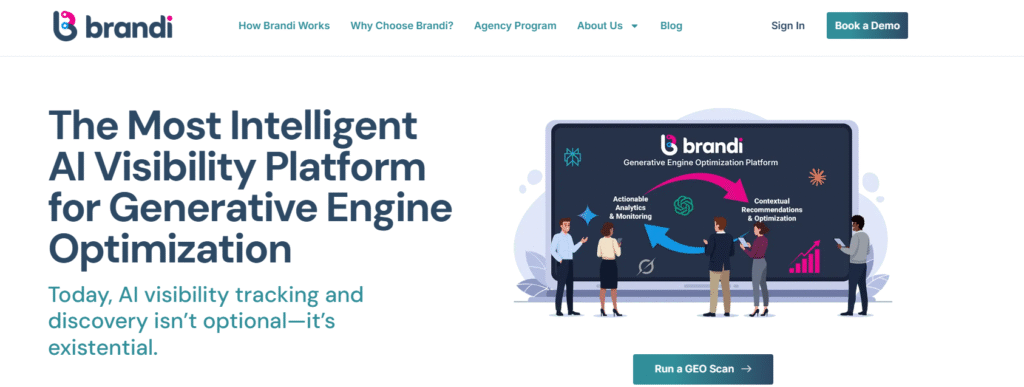
Source – Brandi
That makes it particularly relevant for marketing, PR, communications, and brand teams that care about reputation as much as visibility. Brandi also takes an optimization-first approach to content, using AI to identify gaps and improve existing human-authored assets rather than generating the brand narrative itself.
Notable Features
- Sentiment Hub™: Shows whether AI positions a brand as a category leader, credible option, inferior alternative, or risky choice, rather than stopping at positive or negative sentiment.
- Source Intelligence: Helps identify the publishers, reviews, articles, and other third-party sources that may be shaping AI-generated brand perception.
- Competitive Benchmarking: Compares share of voice, citations, sentiment, and positioning against competitors.
- Content Optimization: Identifies ways to improve existing human-authored content for clarity, structure, machine comprehension, and citation readiness.
What Sets It Apart
Brandi stands out for going deeper into the meaning behind AI visibility. Its Sentiment Hub looks at how a brand is positioned against competitors and across specific buyer attributes, while its source intelligence helps trace the public evidence influencing those narratives. It also deliberately focuses on optimizing human-authored content rather than generating more content from scratch.
Rating
4.9/5, based on 31 reviews.
Pricing
You can contact their team for more pricing information.
14. AirOps – Best for Content and SEO Teams Already Doing AI Search Optimization
AirOps is less of a standalone AI visibility tracker and more of a platform for actually working on the content behind that visibility. You can see where your brand is being cited, which competitors are appearing more often, and where there are gaps across AI search.
From there, AirOps can help identify which pages need refreshing, what new content may be worth creating, and which third-party sites are influencing visibility in your category.
Source – AirOps
That makes it a better fit for content and SEO marketers who want to use AI visibility data as part of their existing content program rather than simply monitor another dashboard. AirOps also includes Quill, its AI agent, which can work from your brand context and strategy to help run content-related tasks with human review built into the process.
Notable Features
- AI Search Insights: Shows citations, competitor visibility, share of voice, and areas where your brand is missing.
- Content Refresh: Identifies existing pages that may need updating based on content and AI search opportunities.
- Offsite Insights: Shows which third-party sources are influencing visibility and where competitors are earning mentions.
- Quill: Helps turn a content strategy into repeatable tasks and drafts while keeping people involved in review and approval.
What Sets It Apart
AirOps makes the most sense when AI visibility is only one part of the job. The same platform can help content marketers find visibility gaps, decide what content to work on, refresh existing pages, and look at offsite citation opportunities rather than moving those tasks into separate tools.
Rating
4.7/5, based on 134 reviews.
Pricing
AirOps uses task-based pricing. You can contact their team for more information.
Now that we’ve looked at each tool individually, let’s see how they compare side by side.
How the 14 AI Visibility Tools Compare
The table below brings together the main differences in positioning, AI platform coverage, trial availability, and starting price so you can narrow down the options more quickly.
| Platform | Best For | LLMs Tracked | Free Trial / Free Plan | Starting Price |
| Profound | Agencies managing multiple client brands | Up to 9 | No | $99/month, billed annually |
| Semrush AI Visibility Toolkit | Teams already using Semrush | Varies by feature and plan | 7-day Semrush One trial | $99/month per domain |
| SE Visible by SE Ranking | Deeper sentiment and source analysis | 5 | 10-day free trial | $99/month |
| Rankscale | Broad AI engine coverage and technical audits | 17+ | 7-day Pro trial | $17/month, billed annually |
| GeoGym | B2B SaaS brands tracking buyer-focused AI visibility | 5 | 7-day free trial | $29/month |
| GumShoe AI | Persona-based AI visibility analysis | 11 | Free trial | $99/month |
| AthenaHQ | Getting started without paying for a full subscription | 5 on free plan; 8+ on paid plans | Permanent free Essential plan | Free; Starter at $295/month |
| Writesonic | Turning visibility findings into content and technical actions | 10+ AI platforms | 7-day free trial | $79/month, billed annually |
| Traqer.ai | Topic-based AI visibility tracking | 5 included; Claude available as an add-on | Free trial | $25/month |
| Nightwatch | Connecting search rankings with AI citations | 5 | 14-day free trial | €79/month, billed annually |
| Goodie AI | Enterprise AI search and commerce visibility | 12 | Free AI site audit rather than a full trial | $479/month |
| Parsnipp | Combining AI visibility, advertising, and commerce | 4 | Permanent free plan | Free; Core at $39.99/month |
| Brandi AI | Brand and PR teams analyzing AI perception | Not publicly specified | Free AI visibility scorecard / Share of Voice snapshot | Contact for pricing |
| AirOps | Content and SEO teams already working on AI search optimization | 5+ | Free trial available | Task-based pricing |
That gets us to the end of a pretty wide spread here. Tools like Traqer, GeoGym, and Parsnipp give you relatively inexpensive ways to start tracking AI visibility, while platforms such as Profound, AthenaHQ, Goodie AI, and Brandi are aimed at broader or more specialized use cases.
The bigger difference, though, is what happens after the visibility data comes in. That’s why it is important to pick the tool that is best for your use case, rather than picking purely on the number of LLMs or the lowest starting price.
Final Takeaway
The right AI visibility tool is not the one with the most LLMs or the longest feature list. It is the one that tracks the engines your buyers actually use, runs prompts that reflect how your buyers actually search, and gives you output you can act on.
Before you commit to any tool, we would suggest running it on your actual brand with your actual competitors and asking to see a full sample report, not the landing page version.
That can help you make the right choice.
Disclaimer: This article is based on firsthand testing by our team and publicly available information, including product documentation, pricing pages, and product demos. Pricing and features were accurate at the time of research but may have changed. Always verify current pricing and feature details directly with vendors before making a purchasing decision. We have not received payment from any vendor listed in this article.