
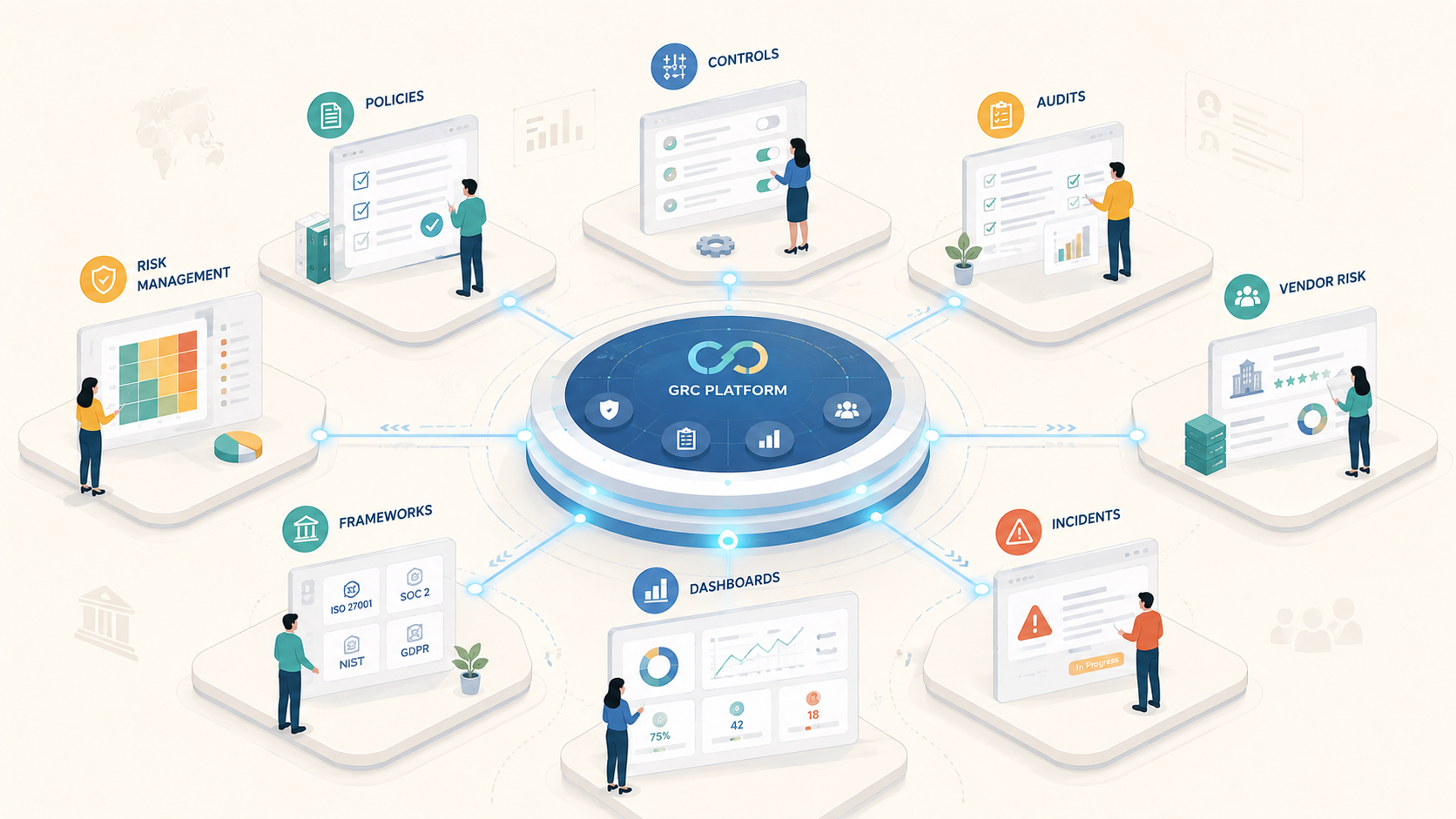
| TL;DR: GRC software has moved well beyond spreadsheets and manual audit prep, but most platforms make similar promises on the surface. To help you find the right fit, this guide covers 10 platforms including LogicGate Risk Cloud, Optro, and Vanta. It also walks you through five factors worth evaluating before you build your shortlist. |
GRC software is no longer something only large enterprises think about. Security and compliance leaders at companies of all sizes are actively evaluating platforms. The drivers are familiar: growing audit demands, expanding vendor ecosystems, and frameworks that keep multiplying. The market has grown accordingly, and so has the noise.
On the surface, most GRC platforms look alike. Every vendor leads with automated controls, framework coverage, and AI-powered risk insights. The real differences surface when programs scale. When a second framework gets added, when vendor reviews stack up, or when audit prep stretches into weeks despite having a tool in place.
This article covers the 10 GRC software solutions that appear most consistently across independent analyst and buyer sources. For each, we have summarized what it is built for, who it is best suited for, and where it has limitations, based on publicly available information.
5 Factors to Evaluate Before Selecting GRC Software
Every Governance, Risk, and Compliance platform looks capable in a demo. The real differences show up when your program grows, your audit scope expands, and the tool has to work across different teams and frameworks every single day.
These are the factors worth examining before making a decision.
1. Framework Coverage
GRC platforms vary widely in the compliance standards they support out of the box. Some are built around SOC 2 and ISO 27001. Others cover dozens of frameworks including HIPAA, PCI DSS, GDPR, NIST, and DORA.
As programs grow, organizations often need to add frameworks without rebuilding their control library. After all, compliance requirements rarely stay the same. A platform with strong cross-framework mapping lets the same evidence satisfy multiple standards, cutting duplicate work significantly.
| Question to ask: Does the platform support the frameworks you need today, and can it add new ones without starting over? |
2. Integration Depth
GRC software is only as useful as the systems it connects to. Platforms that rely on manual evidence uploads create the same bottlenecks organizations were trying to escape. Native integrations with cloud providers, identity systems, HR tools, and ticketing platforms make a real difference. They allow evidence to be collected automatically and controls to be monitored continuously, reducing manual effort along the way.
| Question to ask: Which integrations are native, and which ones require custom connectors or manual work? |
3. Ease of Use and Scalability
A platform that needs IT involvement for every workflow change will slow compliance teams down. The best GRC tools let practitioners configure forms, workflows, and dashboards without writing code. But ease of use should never come at the cost of depth. A tool that works well for one framework and one team may struggle when scope expands.
As your organization grows, it needs to support multiple business units, geographies, and risk programs without a costly re-implementation. The platform should grow with the program without becoming a bottleneck.
| Question to ask: Can business users configure workflows without technical support, and how does the platform perform as program complexity grows? |
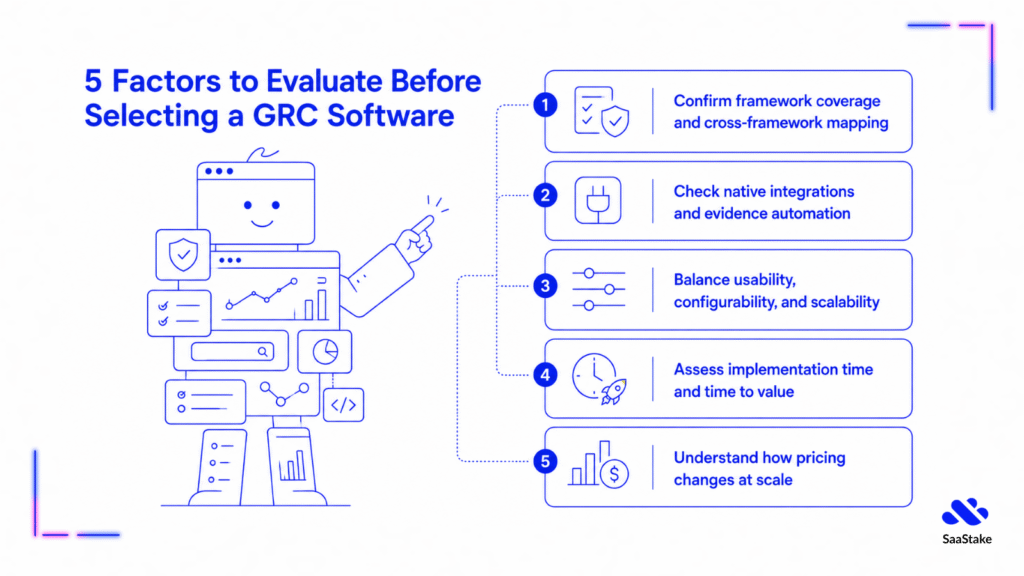
4. Implementation Timeline
Some GRC platforms take months to deploy before you see any value. Others are designed for fast onboarding with pre-built templates and guided setup. For most organizations, a long implementation means delayed certifications and missed audit deadlines. The right timeline depends on program maturity, but time to value matters.
| Question to ask: What does a typical implementation look like for a program at your stage, and when can we expect results? |
5. Pricing Model
GRC platform pricing varies significantly across vendors. Some charge per user, others per framework, and some use flat-rate models. Per-seat pricing that looks reasonable at 20 users can get expensive fast as headcount grows. That’s why understanding the full cost at scale, including add-on modules, matters just as much as the base price.
| Question to ask: Does pricing change based on team size and feature needs? |
Now that we have had a look at the factors, let’s look at the platforms.
10 Top GRC Software to Consider in 2026
The right GRC software depends on the workflows you need to support, the frameworks you are managing, and how mature your program is today. Below, we examine ten platforms, what each one is built for, along with its features and integrations.
- LogicGate Risk Cloud
- MetricStream
- Optro
- Hyperproof
- Archer
- ServiceNow GRC
- Drata
- Vanta
- IBM OpenPages
- OneTrust
Here is a closer look at each platform.
1. LogicGate Risk Cloud – Best for Enterprises Wanting Flexible, Configurable GRC Workflows
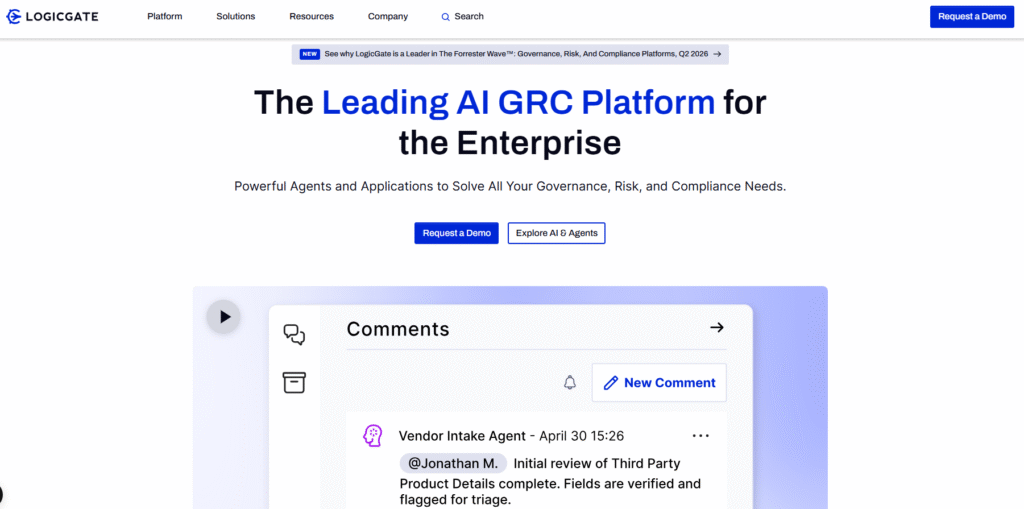
LogicGate Risk Cloud is a no-code GRC platform that brings together risk, compliance, audit, third-party risk, cyber risk, policy management, and other GRC programs in one place. It lets organizations connect risks, controls, issues, evidence, and compliance requirements across different workflows.
Source – LogicGate Risk Cloud
The software currently offers more than 30 purpose-built applications. You can use preconfigured applications or customize workflows, forms, rules, notifications, and reports without coding. This makes the platform suitable for organizations that need their GRC processes to evolve without rebuilding the underlying system.
Notable Features
- No-code workflow builder: Configure forms, workflows, rules, notifications, and automations without developer support.
- Spark AI: Uses AI to generate reporting insights, test evidence, map controls, and identify compliance gaps.
- Risk quantification: Uses Monte Carlo simulations to estimate financial risk exposure and communicate it in business terms.
- Workflow Agents: Automates selected GRC tasks across areas such as third-party risk, enterprise risk, business continuity, and AI governance.
Integrations
LogicGate integrates with Jira, Slack, Microsoft 365, Salesforce, ServiceNow, GitHub, Okta, Workday, and other enterprise systems. It also supports REST APIs and custom connectors.
Notable Customers
Equiniti, Texas Mutual Insurance Company, BCU, Dignity, Intradiem, and Horizon Media.
Analyst Recognition
LogicGate was named one of four Leaders in The Forrester Wave: Governance, Risk and Compliance Platforms, Q2 2026. It was also positioned as a Leader in the 2025 Gartner Magic Quadrant for Governance, Risk and Compliance Tools, Assurance Leaders. In Summer 2026, LogicGate reported that it had received G2 Leader recognition for the 28th consecutive quarter.
Rating
G2: 4.6/5, based on 191 reviews.
Pricing
LogicGate does not publish standard pricing. You can contact their team for a quote.
2. MetricStream – Best for Large Enterprises in Highly Regulated Industries
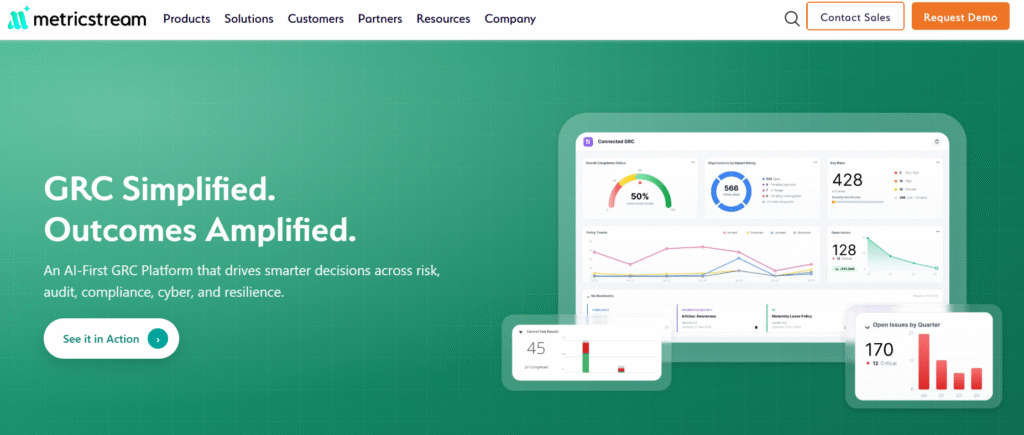
MetricStream is an AI-first GRC platform built for large enterprises operating in complex, highly regulated environments. It serves organizations across banking, insurance, healthcare, life sciences, energy, and technology.
Source – MetricStream
The Connected GRC platform brings enterprise and operational risk, compliance, audit, cyber risk, third-party risk, and resilience into one system. Since the data is connected, you can see how regulatory changes affect related policies, controls, risks, and business units without coordinating every update manually.
Notable Features
- Embedded AI across workflows: Helps users complete forms, refine control descriptions, summarize updates, and draft content within existing GRC workflows.
- Policy Assistant: Answers employee questions using approved policy documents and provides citations for its responses.
- Regulatory Change Management: Captures regulatory updates and maps their impact across policies, controls, risks, and business units.
- Risk quantification: Uses FAIR-aligned models and Monte Carlo simulations to express cyber risk exposure in monetary terms.
Integrations
MetricStream supports marketplace integrations with tools such as Jira, ServiceNow, and BMC. It also provides standards-compliant Business APIs for connecting other enterprise systems.
Notable Customers
Shell, London Stock Exchange Group, Nordea, Nationwide Building Society, and Siemens Energy.
Analyst Recognition
MetricStream was named a Leader in the IDC MarketScape: Worldwide Governance, Risk, and Compliance Software 2025 Vendor Assessment. It was also recognized as a Strong Performer in The Forrester Wave: Governance, Risk, and Compliance Platforms, Q2 2026. In 2026, Chartis Research ranked MetricStream first in Enterprise GRC and named it a Category Leader across all seven evaluated categories.
Rating
G2: 3.8/5, based on 14 reviews.
Pricing
MetricStream does not publish standard pricing. The cost depends on the products, users, deployment scope, and services required. You can contact their team for a quote.
3. Optro – Best for Enterprises Running Audit, Risk, and Compliance as a Connected Program
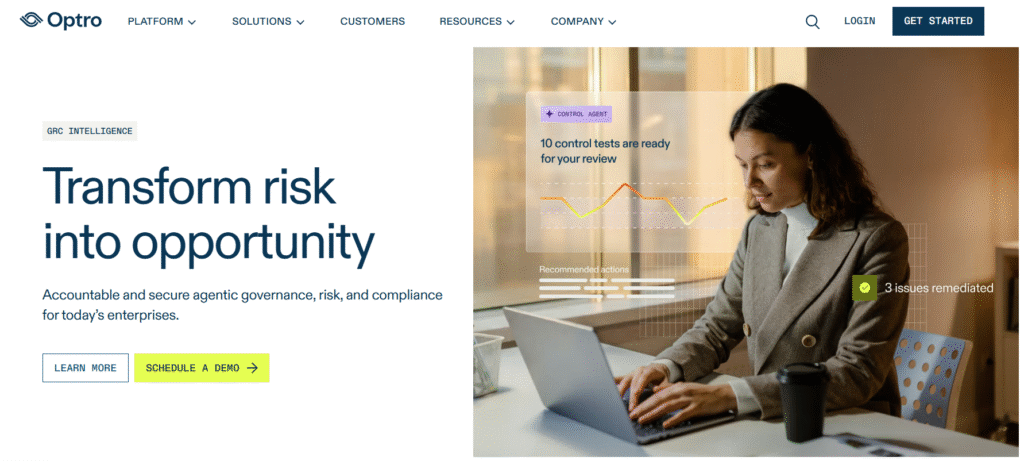
Optro is an AI-powered GRC platform that connects audit, risk, infosec, and compliance. AuditBoard rebranded as Optro in March 2026 to expand beyond audit management. More than half of Fortune 500 companies use the platform.
Source – Optro
The platform is built around a simple idea: audit, risk, infosec, and compliance teams should work from the same risks, controls, and evidence instead of maintaining separate systems. This helps you connect findings across functions, reduce duplicate work, and move from reactive reporting toward more proactive risk management.
Notable Features
- CrossComply: Reuses shared controls and evidence across frameworks, helping users test once and satisfy multiple requirements.
- Optro AI: Uses GRC-trained AI to automate evidence work, identify compliance gaps, surface insights, and support continuous testing.
- Framework and control library: Includes more than 30 preloaded frameworks and lets you add and map custom frameworks and controls.
- Microsoft Office integration: Lets users edit Word, Excel, and PowerPoint files within Optro while keeping changes synced to the platform.
Integrations
Optro integrates with Jira, ServiceNow, Azure DevOps, Microsoft Teams, Slack, Google Drive, Microsoft Office, Workday, NetSuite, Power BI, Tableau, and other enterprise systems. It also supports APIs and other connection options.
Notable Customers
PetSmart, Lennar, Marmon Holdings, Population Services International, and Edgewell.
Analyst Recognition
Optro was named a Leader in the 2026 Gartner Magic Quadrant for Third-Party Risk Management Tools for Assurance Leaders, positioned furthest on the Completeness of Vision axis. It was also named a Leader in The Forrester Wave: Governance, Risk, and Compliance Platforms, Q2 2026, and the 2025 Gartner Magic Quadrant for GRC Tools, Assurance Leaders. Optro also appeared on G2’s 2026 Best Software Awards lists for Best GRC Software and Best Software for Enterprise Businesses.
Rating
G2: 4.6/5, based on 1,620 reviews.
Pricing
Optro does not publish standard pricing. It offers flexible plans based on business needs. You can contact their team for a quote.
4. Hyperproof – Best for Mid-Market Teams Managing Multiple Compliance Frameworks
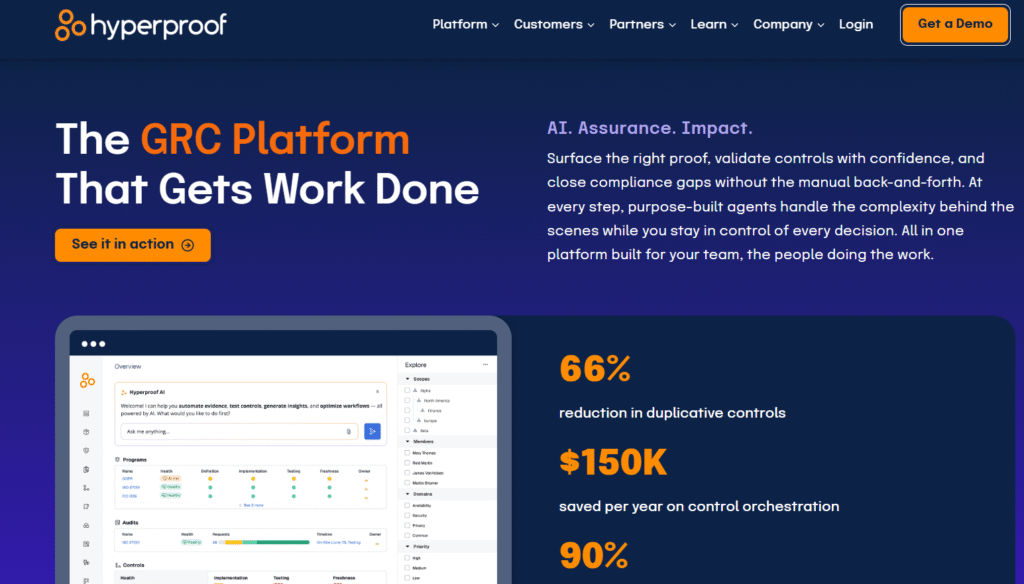
Hyperproof is an AI-powered GRC platform that helps IT, security, and compliance teams manage controls, risks, audits, and trust programs in one place. Organizations including Reddit, Fortinet, Appian, Outreach, and Thales use the platform.
Source – Hyperproof
The platform is designed for organizations managing multiple frameworks and recurring audits. Its common control approach lets you map controls once, reuse evidence, and identify where requirements overlap, rather than rebuilding your program for each framework.
Notable Features
- Cross-framework control mapping: Map controls once and reuse them across overlapping frameworks to reduce duplicate work.
- Hypersync integrations: Automatically collect evidence from connected systems on demand or at scheduled intervals.
- Hyperproof AI: Uses purpose-built agents to support evidence collection, testing, reporting, control mapping, and gap identification.
- Framework library: Includes more than 160 pre-built frameworks and supports custom frameworks for specific requirements.
Integrations
Hyperproof offers more than 200 Hypersync integrations with tools such as Jira, Slack, GitHub, Okta, AWS, Azure, SharePoint, and OneDrive. These connections help automate evidence collection and keep compliance work connected to everyday systems.
Notable Customers
Reddit, Fortinet, Appian, Outreach, Nutanix, and Artemis Health.
Analyst Recognition
Hyperproof was named a Category Leader in the 2026 Chartis RiskTech Quadrants for Enterprise GRC, Third-Party Risk Management, and IT Risk. It was also included in the 2026 Capterra Shortlists and Software Advice FrontRunners reports for Compliance and Risk Management.
Rating
G2: 4.5/5, based on 220 reviews.
Pricing
Hyperproof does not publish standard pricing. The cost varies based on the products, users, frameworks, and deployment requirements. You can contact their team for a quote.
5. Archer – Best for Large Enterprises With Deeply Customized Risk Programs
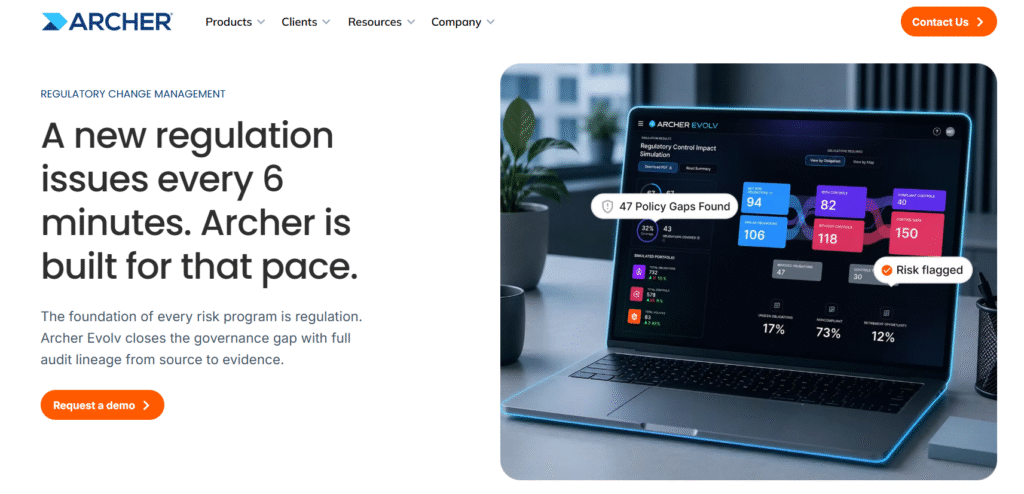
Archer is an enterprise GRC platform with more than 25 years of experience helping organizations manage risk and compliance. It serves over 1,200 clients across financial services, healthcare, technology, government, and other regulated industries.
Source – Archer
The platform brings enterprise risk, operational risk, IT risk, third-party risk, audit, and regulatory compliance into one environment. It is particularly suited to large organizations that need to shape the platform around complex processes and have the resources to manage a highly configurable implementation.
Notable Features
- Integrated risk management: Connects enterprise, operational, IT, third-party, and AI risks through a shared data model.
- Extensive configurability: Lets you build and manage custom applications through a flexible point-and-click interface.
- Regulatory intelligence: Monitors regulatory sources and connects changing obligations to related controls, policies, and evidence.
- Archer Exchange: Provides prebuilt applications, integrations, accelerators, and administrative tools for extending the platform.
Integrations
Archer Exchange provides integrations with tools such as ServiceNow, Tenable.io, AWS Security Hub, RiskRecon, and BlueVoyant. Organizations can also use prebuilt data connections and APIs to connect other enterprise systems.
Notable Customers
TIAA, First National Bank of Omaha, Turkcell, Evalueserve, Intuitive Surgical, and Banorte Bank.
Analyst Recognition
Archer was named a Leader in the 2025 Gartner Magic Quadrant for Governance, Risk and Compliance Tools, Assurance Leaders. It was also placed in the Leaders Quadrant in the Verdantix Green Quadrant: GRC Software 2025. In The Forrester Wave: Governance, Risk and Compliance Platforms, Q2 2026, Archer received the highest possible score for compliance management.
Rating
G2: 3.6/5, based on 20 reviews.
Pricing
Archer does not publish standard pricing. The cost depends on the products, users, deployment requirements, and implementation scope. You can contact their team for a quote.
6. ServiceNow GRC – Best for Enterprises Already Standardized on ServiceNow
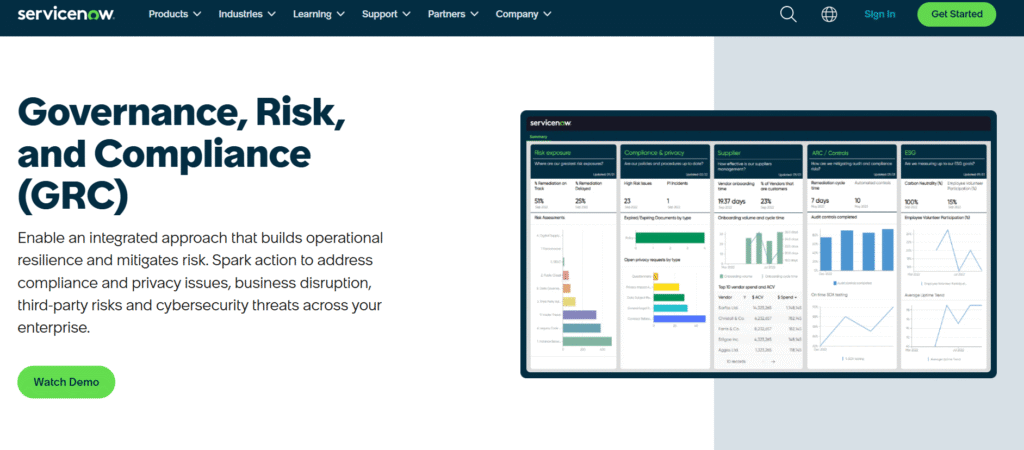
ServiceNow GRC is a suite of risk and compliance applications built on the ServiceNow AI Platform. It connects GRC with the operational workflows organizations already use for IT service management, security operations, business continuity, privacy, and third-party risk.
Source – ServiceNow GRC
Its main strength is consolidation. Policies, controls, risks, audits, evidence, incidents, and remediation work can all share the same data and workflows. This lets existing ServiceNow customers expand GRC without adopting another platform.
Notable Features
- Connected risk data: Links risk and compliance information with IT, cyber, business operations, and asset data.
- Continuous risk monitoring: Uses AI agents to assess controls, identify emerging risks, flag gaps, and route remediation work.
- Policy and compliance workflows: Automates policy management, control testing, issue investigation, and audit evidence collection.
- Role-based dashboards: Gives you and stakeholders real-time views of risks, controls, compliance status, and outstanding work.
Integrations
ServiceNow GRC works natively with ITSM, Security Operations, CMDB, HR, and other ServiceNow applications. It also supports third-party applications through integrations and APIs.
Notable Customers
CNA Insurance, Cognizant, Uber, KPMG, Deloitte, and National Grid.
Analyst Recognition
ServiceNow was named a Leader in the IDC MarketScape: Worldwide Governance, Risk, and Compliance Software Vendor Assessment, 2025. It was also named a Leader in The Forrester Wave: Governance, Risk, and Compliance Platforms, Q4 2023.
Rating
G2: 4.2/5, based on 113 ratings.
Pricing
ServiceNow does not publish standard GRC pricing. It provides custom quotes based on the applications, users, and organizational requirements. You can contact their team for more details.
7. Drata – Best for Tech-Forward Teams Wanting Continuous Compliance Automation
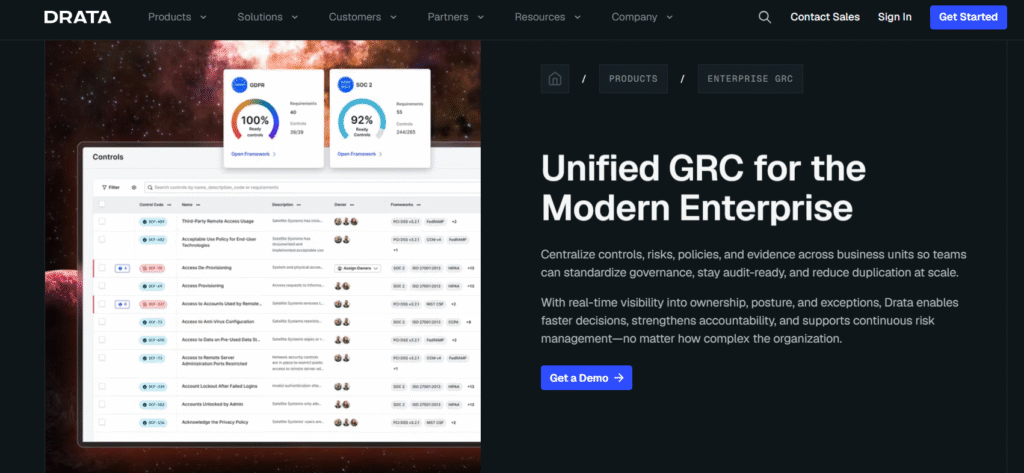
Drata is an AI-powered GRC platform that helps organizations automate compliance, manage risk, and prove their security posture. It serves more than 8,500 organizations worldwide and brings governance, risk, compliance, and assurance into one place.
Source – Drata
The platform focuses on continuous monitoring rather than periodic manual checks. It connects with cloud infrastructure, identity providers, HR systems, and development tools to collect evidence, test controls, and flag failures as they happen. This makes it a strong fit for technology companies and fast-growing organizations scaling their compliance programs.
Notable Features
- Continuous compliance monitoring: Automatically tests controls, collects evidence, and flags compliance gaps across connected systems.
- Agentic AI: Automates tasks such as control mapping, evidence collection, vendor assessments, and questionnaire responses.
- Trust Center: Gives prospects a self-service hub for reviewing security documents and requesting access to sensitive information.
- Multi-framework support: Offers more than 30 pre-built frameworks, including SOC 2, ISO 27001, HIPAA, GDPR, PCI DSS, and FedRAMP.
Integrations
Drata offers more than 200 integrations with tools such as AWS, Azure, Google Cloud, Okta, GitHub, Jira, and Slack. It also provides an open API for custom connections.
Notable Customers
Asana, Brex, Instacart, GitLab, Okta, Fortinet, and UiPath.
Analyst Recognition
Drata was named a Representative Vendor in the 2024 Gartner Market Guide for DevOps Continuous Compliance Automation Tools for the second consecutive year. It also appeared on G2’s 2026 Best Software lists for Best Software Products, Mid-Market Products, Governance, Risk and Compliance Products, and Security Products.
Rating
G2: 4.7/5, based on 1,334 reviews.
Pricing
Drata does not publish standard pricing. It offers Foundation, Advanced, and Enterprise plans. You can contact their team for a quote.
8. Vanta – Best for Cloud-Native Companies Pursuing Fast Audit Readiness
Vanta is an AI-powered trust management platform that helps organizations automate compliance, manage risk, and prepare for audits. By April 2026, it had crossed $300 million in ARR and served 16,000 customers worldwide.
Source – Vanta
Vanta is designed to make frameworks such as SOC 2 and ISO 27001 more accessible to cloud-native companies without the overhead of a traditional GRC platform. It continuously tests connected systems, collects evidence, and surfaces gaps before an audit. This makes it particularly useful for startups and growing technology companies building or scaling their compliance programs.
Notable Features
- Continuous compliance monitoring: Runs more than 1,400 automated tests to collect evidence and surface control failures.
- Broad integration ecosystem: Connects with more than 400 cloud, HR, identity, security, and development tools.
- Trust Center: Gives prospects and customers a self-service hub for reviewing security and compliance information.
- Vanta Agent for Risk: Connects risks with relevant assets, controls, and owners while recommending next steps.
Integrations
Vanta offers more than 400 integrations with tools such as AWS, Google Cloud, Azure, Google Workspace, Okta, GitHub, Jira, and Slack. It also provides an API for custom connections.
Notable Customers
Atlassian, Duolingo, ZoomInfo, Ramp, Clay, and Samsara.
Analyst Recognition
Vanta was named a Leader in The Forrester Wave: Governance, Risk, and Compliance Platforms, Q2 2026 on its first inclusion. It was also named a Leader in the IDC MarketScape: Worldwide Governance, Risk, and Compliance Software Vendor Assessment, 2025.
Rating
G2: 4.6/5, based on 2,688 reviews.
Pricing
Vanta does not publish standard pricing. It offers Essentials, Plus, Professional, and Enterprise plans. You can contact their team for a quote.
9. IBM OpenPages – Best for Global Enterprises With Mature Governance Operations
IBM OpenPages is a scalable, AI-powered GRC platform that brings risk, compliance, and audit processes into one system. It is available as SaaS, on IBM Cloud, or on premises, making it suitable for global enterprises with complex governance requirements.
Source – IBM OpenPages
The platform is built for organizations running mature GRC programs across multiple business units and jurisdictions. You can deploy modules for operational risk, model risk, compliance, internal audit, third-party risk, and other areas within the same environment.
Notable Features
- AI-assisted workflows: Automates issue classification and creation to reduce manual work across risk and compliance processes.
- GRC Canvas: Provides a visual workspace for connecting processes, risks, controls, and live GRC data.
- Modular architecture: Lets organizations deploy individual GRC modules or combine them within one integrated platform.
- Flexible AI integration: Connects watsonx.ai and third-party AI models through an API-based architecture.
Integrations
IBM OpenPages integrates with IBM Cognos Analytics, IBM App Connect, RiskRecon, SecurityScorecard, RapidRatings, and regulatory data providers. It also supports REST APIs and third-party AI models.
Notable Customers
Citi, Navigator Gas, CNP Vita Assicura, and IBM.
Analyst Recognition
IBM was named a Leader in the IDC MarketScape: Worldwide Governance, Risk, and Compliance Software 2025 Vendor Assessment. It was also named a Leader in the 2025 Gartner Magic Quadrant for Governance, Risk and Compliance Tools, Assurance Leaders.
Rating
G2: 4.2/5, based on 76 reviews.
Pricing
IBM publishes indicative starting prices from USD 3,300 for the SaaS Essentials edition. Standard, IBM Cloud, Enterprise, and on-premises options are priced separately.
10. OneTrust – Best for Enterprises Managing Privacy, AI Governance, and GRC Together
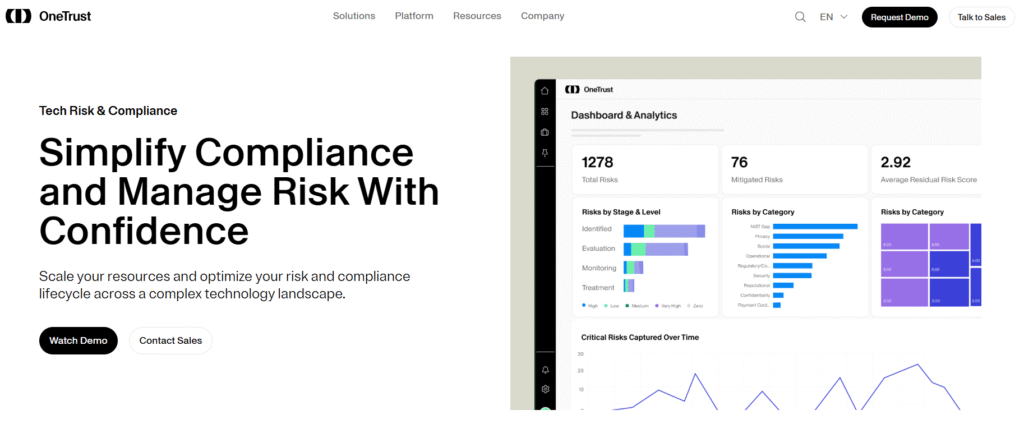
OneTrust is a governance platform that brings privacy, AI governance, technology risk, compliance, and third-party risk into one environment. It serves more than 14,000 customers globally and holds over 300 patents.
Source – OneTrust
The platform is designed for enterprises managing privacy, risk, and compliance obligations across multiple jurisdictions. Instead of running these programs in separate tools, you can connect privacy assessments, AI systems, third parties, controls, risks, and evidence within the same platform.
Notable Features
- Privacy Automation: Automates data mapping, privacy assessments, data subject requests, vendor reviews, and privacy incident workflows.
- AI Governance: Manages AI inventories, assessments, approvals, and controls for requirements such as the EU AI Act and ISO 42001.
- Third-Party Risk Management: Automates third-party onboarding, assessments, monitoring, risk mitigation, reporting, and offboarding.
- Tech Risk and Compliance: Centralizes controls, risks, policies, evidence, and compliance work across more than 55 frameworks.
Integrations
OneTrust provides access to more than 500 pre-built connectors, including integrations with Workday, ServiceNow, Salesforce, Microsoft 365, and Google Cloud. It also supports APIs, SDKs, data feeds, and custom connections.
Notable Customers
Samsung, Atlassian, Adobe, Chewy, Pfizer, and Yum! Brands.
Analyst Recognition
OneTrust was named a Leader in the IDC MarketScape: Worldwide Governance, Risk, and Compliance Software 2025 Vendor Assessment. It was also named a Leader in the 2026 Gartner Magic Quadrant for Third-Party Risk Management Tools for Assurance Leaders and a Visionary in the 2026 Gartner Magic Quadrant for AI Governance Platforms.
Rating
G2: 4.6/5, based on 108 reviews.
Pricing
OneTrust does not publish standard pricing. The pricing depends on the number of administrative users and the size of the asset inventory being managed. You can contact their team for a quote.
How the 10 GRC Software Compare
Every GRC platform on this list solves a real problem. The differences come down to who it was built for, how it handles scale, and where the trade-offs show up in practice.
The table below maps each platform across what it does best, what it connects to, and where buyers consistently run into friction, based on publicly available reviews and analyst sources.
| Software | Best For | Integrations | Strengths | Limitations |
| LogicGate Risk Cloud | Enterprises wanting flexible, configurable GRC workflows | Jira, Microsoft 365, Salesforce, ServiceNow, API-based connections | • Highly customizable workflows without coding • Strong customer support throughout setup • Unified view of risk, compliance, and audit in one dashboard | • Advanced reporting and complex configurations may require additional setup. • Reporting features need updates; advanced configurations require extra work |
| MetricStream | Large enterprises in highly regulated industries | ERP, HRIS, ITSM, cloud providers, third-party risk data sources | • Centralized platform for risk, compliance, audit, and policy • Broad regulatory coverage across banking, insurance, healthcare, and energy | • Steep learning curve; UX needs improvement • Enterprise implementations can require significant configuration and training. |
| Optro | Enterprises running audit, risk, and compliance as a connected program | Jira, Microsoft 365, Salesforce, Workday, API connections | • Purpose-built for audit teams with excellent SOX 404 workflow • Trusted by more than 50% of the Fortune 500 | • Initial setup and configuration can require training, particularly for complex audit and compliance programs. |
| Hyperproof | Mid-market teams managing multiple compliance frameworks | Jira, SharePoint, GitHub, Azure DevOps, Microsoft Teams, OneDrive, 100-plus others | • Easy to use with strong control linking across frameworks • Some customers report saving up to 350 hours a year on audit preparation. | • Native reporting and advanced configurations may require additional setup. |
| Archer | Large enterprises with deeply customized risk programs | Vulnerability scanners, threat intelligence feeds, GRC Community library | • Comprehensive risk view by pulling data from multiple sources across teams • Connects operational, IT, enterprise, and third-party risk. | • Dated interface with a steep learning curve • Heavily customized instances become expensive to maintain over time |
| ServiceNow GRC | Enterprises already standardized on ServiceNow | Native ServiceNow ecosystem, HR, security, IT operations, third-party risk tools | • Consolidates policies, controls, audits, and incidents into one platform with real-time visibility • Strong operational integration with existing ITSM workflows | • Complex to implement; often requires specialized expertise • Licensing can be expensive; interface is unintuitive for users unfamiliar with ServiceNow |
| Drata | Tech-forward organizations wanting continuous compliance automation | 200+ integrations across cloud, identity, HR, security, and development tools. | • Strong automation, responsive support, and time-saving evidence collection • Always-on continuous monitoring with automated evidence packaging | • Enterprise capabilities like regulatory change management still growing • Documentation assumes GRC knowledge; onboarding can be harder for newer organizations |
| Vanta | Cloud-native companies pursuing fast audit readiness | 400-plus integrations across cloud, HR, identity, and developer tools | • Large customer base with an extensive integration ecosystem. • 1,400-plus automated tests running continuously | • Less suited for broad enterprise risk programs or deep customization needs • Costs can rise as requirements expand, and more flexibility is wanted in certain workflows. |
| IBM OpenPages | Global enterprises with mature governance operations | Cognos, IBM watsonx, ERP, HRIS, and security systems via API | • Modular architecture with strong customization and reporting capabilities • Supports operational risk, model risk, compliance, audit, and third-party risk in one environment. | • GUI is not modern; harder to onboard end users • Complex customization and a substantial learning curve. |
| OneTrust | Enterprises managing privacy, AI governance, and GRC together | Workday, ServiceNow, Salesforce, HR, security, cloud, and ITSM tools | • One of the few platforms unifying privacy, AI governance, and GRC in one place • Strong coverage for GDPR, DORA, EU AI Act, and 55 frameworks | • Too many layers; settings are buried, and navigation is unintuitive • Moving between modules feels disconnected; initial configuration is time-intensive |
Final Takeaway
Picking the right GRC platform comes down to matching the tool to where your program actually is, and where it realistically needs to go. The platforms that work well at one stage often create friction at the next. A tool that fits a lean compliance team today may not hold up when frameworks multiply, vendor lists grow, and audit demands increase.
Before settling on a platform, you should test it against a real workflow. Pull in your actual frameworks, your existing integrations, and the audit workflows your organization handles regularly. That is where the differences between platforms stop being theoretical and start mattering.
Disclaimer: This article is based on publicly available information including product documentation, analyst reports, third-party reviews, and pricing data sourced from G2, Gartner, Forrester, and Capterra. We have not independently tested any of the platforms listed. Pricing information was accurate at the time of research but may have changed. Always verify pricing and feature details directly with vendors before making a purchasing decision.