
| TL;DR: An outdated or incomplete ChatGPT answer can lead a buyer to rule out software before speaking to the vendor. Businesses in ChatGPT can let eligible vendors claim a profile and submit current product details that ChatGPT may use in its answers. Vendors can also see which topics come up when the platform cites their website. Those with a Business Agent can answer follow-up questions in a separate chat while buyers are still comparing options. |
By the time a software company speaks to a potential customer, ChatGPT may have already influenced whether its product makes the buyer’s shortlist.
For instance, an operations team choosing a workspace app might ask ChatGPT whether they can edit Notion pages offline. Notion added offline editing in August 2025, but users must download pages before working on them offline. A simple yes from ChatGPT could leave out that requirement.
In G2’s 2026 survey, eight in ten software buyers said they’d used AI chatbots for recommendations in the previous two years. Yet a software company can update its product page and still find ChatGPT describing the old version.
OpenAI’s Businesses in ChatGPT beta gives eligible vendors a more direct route. In Business Hub, they can claim the profile ChatGPT shows for their business and submit updated information, which ChatGPT may use. But will those updates reach buyers before they’ve decided a product isn’t worth considering?
A Product Release Can Change Which Shortlists Include a Vendor
When Notion released offline mode, CEO Ivan Zhao explained why it had taken so long. Unlike a personal notes app, Notion had to make offline work possible in a product where thousands of people collaborate across workspaces. Its engineering team also had to solve problems around syncing and resolving conflicting edits.
An operations team that needs to edit pages offline now has a reason to consider Notion. However, a review written before the update may still describe offline editing as a missing feature. If ChatGPT draws on that review, the buyer could drop Notion for a limitation the company has already addressed.
The problem is, the vendor may not get an opportunity to correct that impression before the buyer moves on. In 6sense’s 2026 B2B Buyer Experience Report, 91.4% of buying groups had already ranked their shortlist before first contacting a vendor. When buying groups changed their preferred vendor after reaching an initial consensus, the most common reason was that their view of how well the product met their needs had changed.
A release like Notion’s can make a product worth a second look for buyers who previously ruled it out. It also gives the company a reason to check whether its website and supporting documentation reflect the update, particularly if older reviews still describe offline editing as a missing feature. Updating the vendor site alone may not solve the problem, because ChatGPT can also rely on third-party sources when recommending SaaS products.
What Happens When You Claim Your Business in ChatGPT
ChatGPT can mention a business even if it hasn’t claimed a profile. Once OpenAI approves a company’s claim, it can access its profile in Business Hub. It must complete identity verification through Persona before it can publish changes to its business information or view insights. Once Persona approves the verification, the profile receives a blue check.
That said, the platform may draw on those updates alongside other sources, and it still makes its own recommendations. So claiming doesn’t guarantee a business will show up higher in its answers.
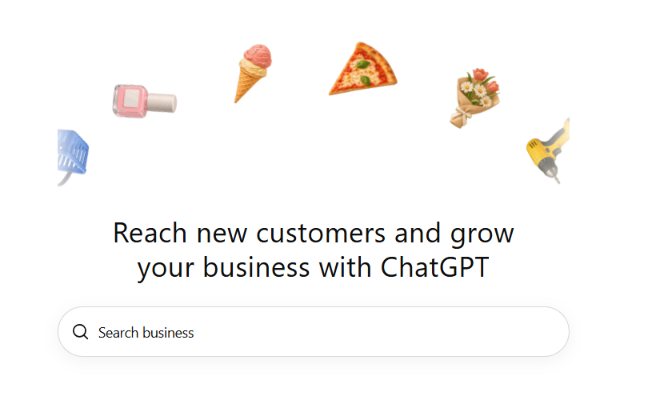
Source – ChatGPT Business Hub
Beyond profile updates, retailers can go a step further with product feeds that list prices and availability. Shopify merchants can connect their store so those details sync automatically. Businesses that sell products can also submit product feeds through Business Hub, including CSV feeds, to share pricing and availability.
Consider what this means for a buyer. A shopper needs to know whether an item is in stock and what it costs. A software buyer’s version of that question might be whether a product connects to the accounting platform their finance team already uses.
The bigger question about Businesses in ChatGPT for SaaS companies is whether buyers will find accurate product information when researching software. After all, details such as supported integrations, plan limits, and feature availability should match across the company’s profile, website, and third-party reviews.
What ChatGPT Business Hub Discovery Topics Can Tell a Vendor
Once a company completes its claim and Persona verification, Business Hub shows aggregate mentions and website clicks from the past 28 days. It also lists discovery topics, which highlight common themes in ChatGPT answers that mention or cite the business.
For an online business, a mention counts only when the platform references the company’s website. That means a recommendation that names the company and cites only a third-party review falls outside that count. Individual conversations stay private, and OpenAI only reports combined totals once enough activity meets its thresholds.
If buyers ask about an accounting integration and ChatGPT cites the vendor’s website in its answers, invoice syncing could appear as a discovery topic in Business Hub. When it does, the vendor can see that this subject comes up in the platform’s answers mentioning or citing its business. The company can use that signal to check whether its integration documentation clearly explains which plans include the feature and which data it syncs. That documentation matters beyond the vendor’s own website too, because help articles can become sources for AI-generated answers.
Where ChatGPT Business Agents Enter the Buying Process
For some vendors, there’s now a way to answer that kind of question inside ChatGPT. Once an eligible business publishes a ChatGPT Business Agent, buyers can open its profile and start a separate, labeled conversation. The agent uses information and guidelines supplied by the company and can link to its website.
At launch, ChatGPT Business Agents are available to eligible U.S. ecommerce and online service businesses with a website. OpenAI also checks industry as part of eligibility, so a SaaS vendor may be able to claim a profile without getting an agent.
Sponsored Business Agents are also rolling out to eligible advertisers, who can use them as destinations for ChatGPT ads. The ad and agent conversation are clearly labeled, distinguishing them from ChatGPT’s independent answers.
For example, a buyer evaluating software that connects to their accounting platform might want to know whether the integration imports invoices and customer records before booking a demo. If the vendor has published a Business Agent and supplied those details, the agent can explain what syncs and link to the setup guide.
By the time a buyer books a demo, they may already have formed a view about whether the software fits. Businesses in ChatGPT gives eligible vendors another way to submit current business information that the platform may use in its answers. Ultimately, those details are most useful when buyers see them while they’re still deciding which products to try.