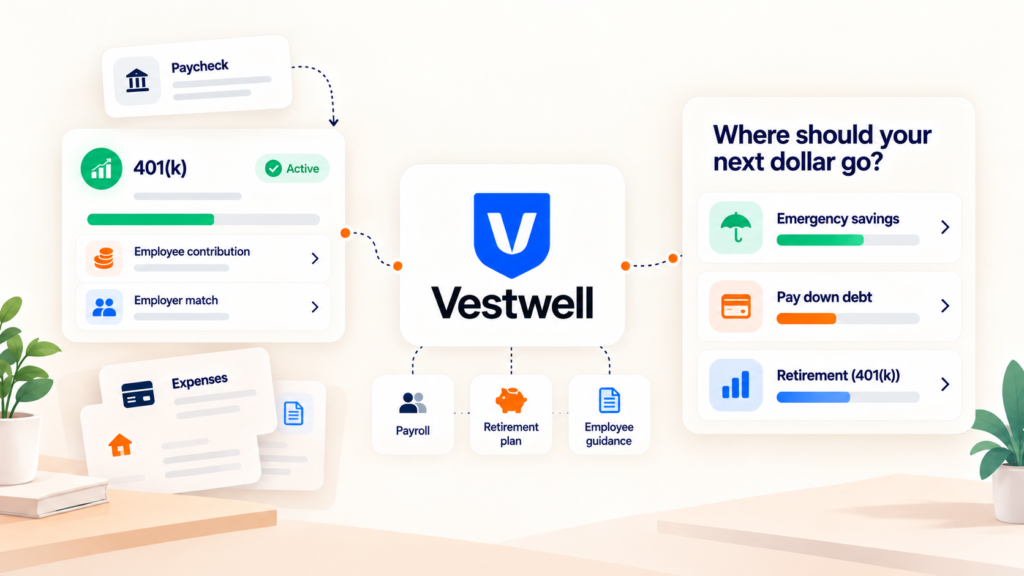
| TL;DR: Joining a 401(k) has become easier, but workers still have to choose between retirement, debt, and immediate expenses. Vestwell’s survey found that everyday costs hold back retirement contributions, while few workers seek guidance through their employer’s benefits platform. Vestwell is putting emergency savings and other goals alongside retirement accounts and embedding its technology in payroll software. Its longer ambition is to help workers understand which goal deserves attention with each paycheck. |
A worker can be enrolled in a 401(k) and still have no clear answer to a simple question. Where should the next dollar of their paycheck go? Retirement is one answer. Paying down a credit card is another.
Vestwell’s 2026 Saver Survey puts numbers around that problem. Among 1,007 employed US adults, 90% said a workplace retirement plan was essential or very important when taking a job. Yet 63% said everyday expenses kept them from saving more. Only 12% turned to their employer’s benefits or HR platform for financial guidance.
That gap helps explain where workplace savings is heading. Vestwell, which provides the technology and administration behind retirement plans, is adding ways to save for emergencies and other goals. It bets that a platform close to payroll can help workers make the calls a retirement account alone cannot.
Joining a 401(k) Got Easier. Finding Money to Save is Still Hard.
Retirement plans have come a long way. Automatic enrollment and employer matches have pulled far more people in. Across nearly five million workers in its plans, Vanguard found that participation among eligible employees reached 86%.
However, getting people into a plan does not suddenly give them more money to save. About 6% of eligible Vanguard participants took a hardship withdrawal in 2025, up from about 5% the year before. Simpler withdrawal rules played a part, but the rise still shows how short-term needs can reach into long-term savings.
Higher pay does not settle the problem either. In Vestwell’s survey, more than half of workers earning $125,000 to $200,000 still named everyday expenses as a barrier. Among those earning $200,000 or more, 64% were only somewhat confident about where an extra dollar should go.
Aaron Schumm, Vestwell’s founder, chairman, and CEO, puts it this way:
Vestwell is Bringing More Savings Goals Into Payroll
Vestwell’s answer has been to add more savings options to its platform. Alongside retirement plans, it runs emergency savings and education accounts. Student loan repayment benefits sit on the same platform too.
The logic comes back to payroll. Employers already move money from each paycheck into retirement accounts. Adding another savings destination puts a new benefit into a routine workers already follow.
“People’s financial priorities are interconnected, so their savings experience should be, too,” Schumm said. Vestwell is putting those priorities on the same platform.
The company is also reaching employers through the payroll software they already use. Payroll platforms are already moving into adjacent financial tools. Gusto, for example, combines payroll with budgeting and automatic savings features. Vestwell is taking that idea further by putting multiple savings goals next to the paycheck.
In June, Paylocity introduced a retirement offering powered by Vestwell inside its HR and payroll system. QuickBooks 401(k) runs on Vestwell’s technology for small and midsize businesses. For workers, that means retirement can show up in the same place they already go to see their pay.
The company has also grown quickly. Vestwell raised $385 million in February after passing $200 million in yearly recurring revenue. Its platform now serves more than 2.55 million active savers and over 750,000 businesses.
An Emergency Savings Account Puts the Strategy to Work
Vestwell’s emergency savings account shows what this looks like in practice. Eligible workers can open it beside their retirement account and set a savings goal. Some employers allow after-tax payroll deductions into it, and workers can also fund it from a linked bank account. The money comes out without the penalties tied to retirement plan withdrawals.
In June, they reported that registrations had grown eightfold from its beta group. It also showed some employers an emergency savings banner when they chose a plan. Of 477 prospective plans that saw the banner, 4.2% signed on, compared with 2.7% of the 222 that did not. The numbers suggest that emergency savings could influence which benefits employers choose to offer.
Other research suggests emergency savings may also help workers save for retirement. Commonwealth’s 2026 report found that 20% of emergency savers at participating employers began contributing to a 401(k) after opening their emergency account. In other words, building a cash cushion does not necessarily have to compete with retirement savings. The two can grow side by side.
Workers Ask Chatbots Before Their Benefits Platform
Putting accounts side by side is only part of the job. Workers also need to know those accounts exist and how to use them. In Vestwell’s survey, 16% of respondents said they had delayed or ignored a financial benefit because they did not know it was available. Another 10% said they did not understand how it worked.
The numbers also show where workers turn when they need financial advice. Friends and family led at 44%. AI tools such as ChatGPT reached 18%, ahead of the 12% who used their employer’s benefits platform.
Schumm sees that 12% as a challenge for the whole workplace savings industry. “People will use the source that gives them the clearest answer in the moment, whether that’s an AI tool or something else,” he said.
Employers have their own hurdles here. The Employee Benefit Research Institute found that employers struggle to connect separate financial benefits, citing cost and data privacy. Putting those benefits on one platform could also reduce the number of systems employers have to manage.
The same shift is happening across workforce software. Helios brings payroll, benefits administration, and other HR functions into one platform, another example of employers trying to cut down on the number of systems they have to juggle.
A Paycheck Guide Has to Show Its Work
The survey also tested demand for something bigger. Vestwell asked workers to imagine a tool that automatically sent each paycheck dollar to the goal with the biggest impact. Building emergency savings before paying off high-interest debt was one example given. Sixty-eight percent called the idea extremely valuable, rising to 94% among workers who did not know where to start.
However, there is one big hurdle: people have to trust the recommendation. Asked what such a tool would need before savers trusted it, Schumm kept his answer short:
The need to understand how an AI system reaches an answer is not unique to financial guidance. It is showing up elsewhere in payroll AI too. Symmetry is taking a controlled approach by letting AI agents reach its tax engine for calculations without permitting them to rewrite payroll records.
Vestwell has said it is building toward personalized guidance on its platform. Its accounts are already connected to payroll, giving Vestwell a place to deliver that guidance.
Where Workplace Savings is Headed
For years, workplace savings measured progress by how many people got into a plan. Vestwell is betting the next question is what happens after they join. It is working toward a platform that sits beside the paycheck and helps workers figure out where each dollar should go.
If that works, the 401(k) becomes one part of a broader approach to workplace savings. The employer, in turn, could become another place workers turn to when they need a clear answer about their money.