| TL;DR: Payroll AI is moving from answering employee questions to auditing runs and checking tax calculations, where mistakes can affect paychecks and create tax problems. Symmetry’s new MCP server takes a controlled approach: AI agents can access its tax engine and calculate across thousands of US jurisdictions, but they cannot rewrite payroll records. |
For years, AI stayed at the edge of payroll. It answered employee questions and explained deductions. Then the boundary began to move. ADP built an agent that can audit payroll runs and recommend corrections. Workday built one that checks a run against tax rules before paychecks go out. Software was no longer only explaining what happened to a paycheck. It was entering the process that created it.
That changes the stakes. A confident mistake inside a chatbot is an unreliable answer. The same mistake inside payroll can alter someone’s income or create a tax liability.
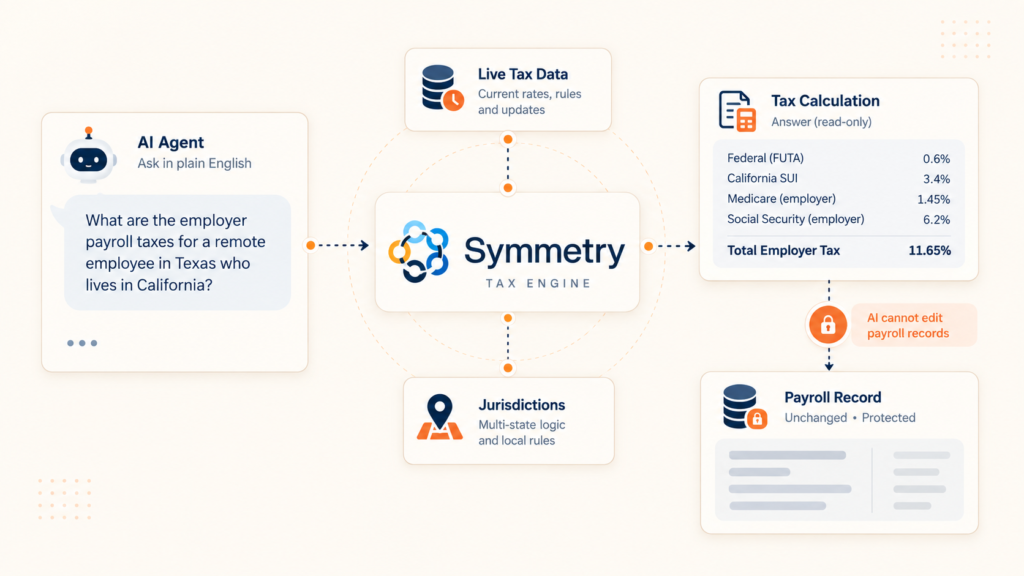
Symmetry entered this shift in July with a boundary built into its new MCP server. Its MCP server for payroll taxes lets an agent reach the tax engine and return a calculation, but it cannot change the payroll record.
That restriction puts an important industry question into focus: how much access should AI agents have to live payroll systems, and what should they be allowed to change?
Payroll AI Adoption is Outrunning Trust
Payroll teams have adopted AI quickly. Trusting its answers is another matter altogether.
In a Symmetry-commissioned survey of 300 people working in payroll and HR software, 78% said their organizations were using or testing AI. Only 45% had connected those tools to a live source of tax data. The rest were running on manual updates or on whatever the model already knew, and 39% named inaccurate tax calculations as a leading concern.
That leaves a fairly basic problem: more than half are relying on processes that may not give AI continuous access to current tax information.
AI Can Sound Right and Still Calculate Payroll Wrong
The concern over accuracy comes from a basic mismatch between how language models work and what payroll demands.
A model produces an answer by predicting what should come next from patterns in its training data. That makes it good at interpreting a question and explaining a complicated subject. Payroll works differently. The same salary produces a different result depending on where someone lives and where they work. Year-to-date earnings and supplemental pay shift it again.
The rules also change from time to time. According to the IRS Employer’s Tax Guide, the Social Security wage base rose to $184,500 in 2026. A model working from last year’s figure will calculate withholding confidently and get it wrong.
The US National Institute of Standards and Technology treats confidently generated false information as a distinct risk of generative AI. Its risk-management guidance recommends verifying outputs and the sources behind them. In payroll, that verification can’t be an afterthought. It has to be built in rather than bolted on.
Symmetry is Separating the Conversation from the Calculation
Symmetry’s MCP server is built around exactly that split.
For instance, a payroll analyst may need the tax on an employee who lives in one state and works in another. She asks in plain English. The AI works out what she is asking and what it needs to know, then passes it to the Symmetry Tax Engine. The engine runs the numbers against its own tax tables and sends back the answer.
The company says it has processed more than a billion payroll tax calculations and tracks over 7,400 US tax jurisdictions. Its technology contributes to calculations covering 64 million employees a year.
That scale is the point. Symmetry is not asking the AI to be good at tax. It is handing the AI a phone line to something that already is, built over four decades.
It Gives Agents Access without Giving them Control
The clearest signal in the launch is where the server stops. A support rep can rerun the exact calculation a customer is disputing. Nobody can use it to change a payroll run or edit a tax rule.
Tax compliance vendors have been connecting agents to their systems since late 2025, and each one has had to answer the same question about how much authority to hand over. The approaches differ. For instance, Avalara runs a family of servers covering everything from rate lookups to returns filing. TaxBandits lets an agent transmit 1099s to the IRS and W-2s to the Social Security Administration. The protocol supports all of it. Symmetry drew its line before the agent can write anything back.
That read-versus-write boundary is appearing in other MCP deployments too. CookieYes lets AI assistants retrieve consent information while reserving changes for explicit approval.
Kayla Santo, who works in product marketing at Symmetry, said:
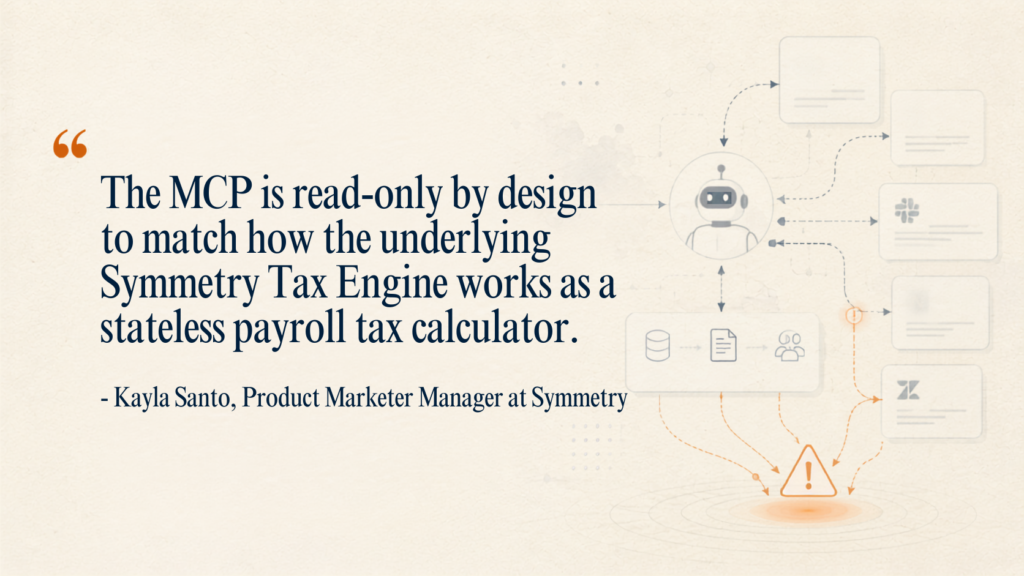
She adds, “Additionally, we know that many payroll platforms are still hesitant to let AI and agents handle real product payroll scenarios, so starting in a less risky way gives us a better opportunity to showcase the value of the MCP.”
That caution shows up in the way the engine works. The engine does not store anything between requests. It takes the numbers you hand it and gives one back, so there is nothing sitting inside for an agent to overwrite. Both the design and the caution lead to the same conclusion: agents are being trusted to calculate and investigate, but not yet to rewrite payroll.
Limiting what an agent can change is one way to reduce the risk. When agents receive broader access elsewhere, Salt Security is looking at the API activity that follows, including whether legitimate access is being used in ways the task did not require.
Tax Infrastructure Could Become Payroll AI’s Defining Layer
Symmetry competes from a different place than the platforms building their own agents. ADP, UKG and Workday own the screen where customers already run payroll. Symmetry sits a layer below, supplying tax logic that payroll platforms can build on top of.
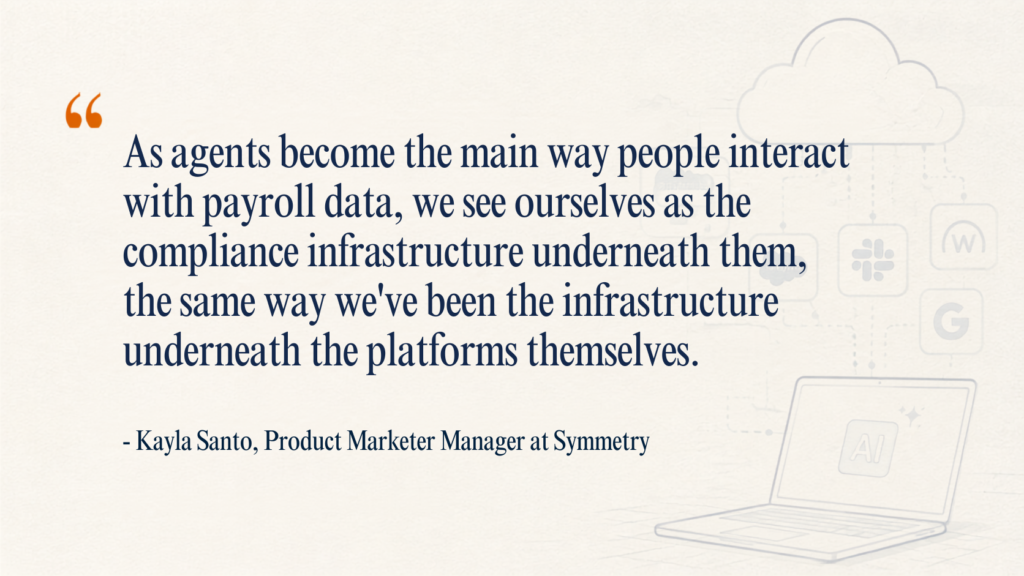
The question now is whether that layer stays separate, and Santo answers it by pointing back to forty years of the same arrangement.
According to Santo:
Buyers are still deciding. Large providers can build more compliance logic in-house, and customers can reach the same calculations through existing APIs. Symmetry’s own survey splits almost down the middle: 41% of respondents expect to maintain AI compliance logic internally, while 40% would rather work with a specialist.
The contest is shifting beyond the payroll assistant itself. It is about something deeper: who supplies the rules and the evidence behind the answers.
AI Changes the Process, Not the Employer’s Liability
A reliable connection to a trusted engine does not move legal responsibility. The IRS holds employers liable for taxes and penalties even when a third party handles deposits, and its failure-to-deposit rules apply when a deposit is late or wrong. The liability still sits with the employer.
So the record matters as much as the number. A business needs to know which rules applied on a given date, and it needs to reproduce that calculation a year later when an auditor asks.
How the agent gets access matters too. Official MCP authorization guidance calls for stronger controls when a server reaches user-specific information. Read-only design reduces a major operational risk because an agent cannot rewrite payroll data. However, that doesn’t settle everything. Organizations must still decide who can request a calculation and how that activity will be logged.
Those questions sit inside a broader agent identity problem too: companies still need to know who owns an AI agent and what that agent can actually access.
In Agentic Payroll, Trust Sits Beneath the Interface
If payroll teams start asking agents instead of clicking through menus, the engine underneath those conversations matters more, not less. Every question still needs a source that can read thousands of shifting rules and return the same answer twice.
Symmetry’s read-only server is a way into that future that does not ask payroll providers to accept full autonomy on day one. More authority may follow later, but only once the layer underneath can prove what it produced.
We believe that AI agents in payroll will enter the workplace one controlled task at a time. People will talk to the agent, but the tax engine behind it decides whether the number is right. When an answer becomes a paycheck, sounding right stops being enough.