| TL;DR: Creating AI content is getting easier. Knowing whether that content is safe to use commercially is not. We spoke with CopySight CEO Artem Petrov about what companies are finding when they check their AI-generated work, and why CopySight is bringing that check closer to the point of creation. |
A reporter at TheWrap recently asked Gemini to create a “space knight holding a laser sword on the backdrop of a desert planet.” He did not mention Star Wars, The Mandalorian, or a lightsaber.
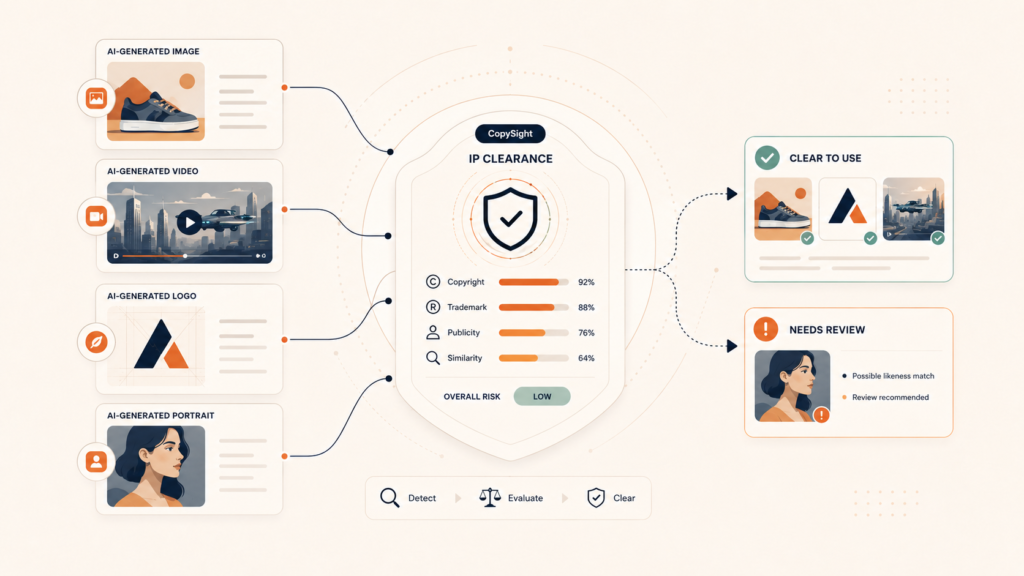
When he ran the image through CopySight, the character scored an 88% similarity to The Mandalorian. The weapon registered an 85% match to a lightsaber. Neither score establishes copyright infringement. But for a studio putting an AI-generated character into a film or a brand preparing an AI-generated ad, that resemblance may need to be caught before the work is released.
CopySight is building that check into the production process. Its core product, CopyScore, checks AI-generated images and videos for similarities to protected characters, trademarks, real people, and other intellectual property, then gives the asset a risk score. In July, the company raised $3 million in seed funding led by Mucker Capital and launched CopyScore V2, expanding those checks further into video.
Demand for those checks is growing quickly. CopySight says it has processed more than 87,000 checks since January 2026, with usage increasing 25-fold over that period.
We asked CopySight Co-founder and CEO Artem Petrov what was behind that jump. Petrov, a former creative director at Snap and tech creative director at Meta, told SaaStake the answer had less to do with regulation than we expected.
What Companies Find When They Start Looking
“Mostly nerves, and they’re earned,” he said.
Petrov points to what customers are finding once they start checking their own AI-generated content.
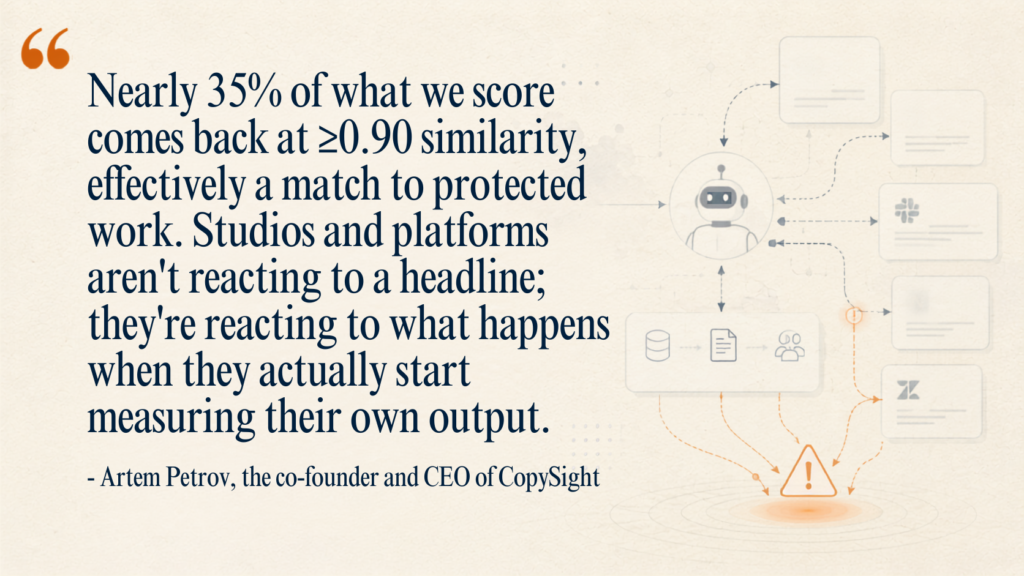
The ≥0.90 figure in Petrov’s quote is a similarity score, not a legal finding of infringement. What it gives a studio or platform is a way to see which outputs are close enough to protected material to deserve another look.
But where that second look happens matters too. OpenArt, an AI platform for generating images and videos, has built a CopySight-powered IP check into its platform. The check, in other words, does not have to wait until the finished asset reaches a separate legal review.
That gives CopySight’s 25x growth a more useful explanation than concern alone. Its usage can rise with the volume of AI-generated content moving through its customers’ products.
The AI Copyright Problem Looks More Familiar Than You Might Think
Once companies start checking at that volume, another question arises: what are they actually finding? Much of the public debate around generative AI and copyright has centered on artists, from whose work the models were trained to how closely AI can reproduce a particular style.
The AI-generated content being checked through CopySight points to a more familiar set of problems.
When we asked Petrov what kind of IP was causing enterprise teams the most trouble, he pointed first to trademarks. They account for roughly 35% of the IP detected across the platform, he said. Together, trademarks and characters make up about 60% of all detections.
But volume and consequence are not quite the same thing. For studios, Petrov pointed to a different category.
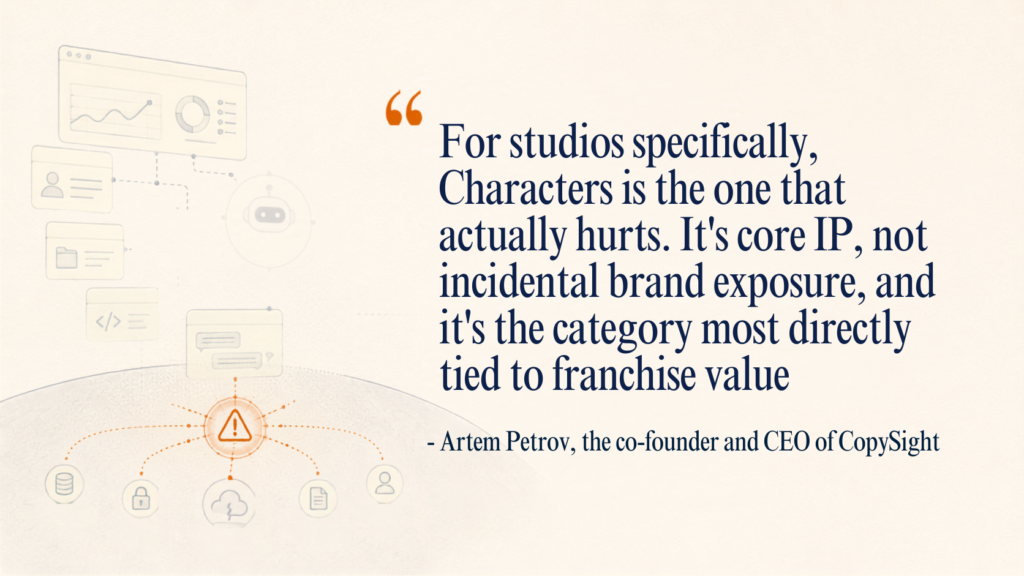
That makes sense when the asset in question sits at the center of a film, game, series, or licensing business. A character is not simply another visual element. It can be the franchise.
The complication is how it got there. In a conventional production process, putting a recognizable character into an asset is usually a deliberate creative decision. With generated content, the team reviewing the finished work may be looking for elements nobody explicitly chose.
Enterprise teams already know that characters and trademarks carry rights. What they did not previously have to account for was a model introducing those elements without anyone on the creative team deliberately putting them there.
By the Time Legal Finds It, the Work May Already Be Done
CopySight’s earliest use cases tended to begin after someone had a reason to worry. Petrov says a piece of content might be flagged internally, or a lawsuit elsewhere in the industry might prompt a legal team to take a closer look.
Now, those conversations are starting earlier.
The practical difference is what happens next. If a potential issue surfaces after an ad, scene, or character has been approved, the team may be revisiting finished work. If it surfaces while that work is still being made, the response can be much simpler: regenerate the asset, change it, or send that particular result for review.
CopySight says 38% of the content it scores is flagged at some level of risk. At that frequency, the timing of the check starts to matter. Finding something while it can still be changed is one problem. Finding it after the work has been approved is a much more expensive one.
CopySight’s API allows those checks to happen inside other products and workflows.
That lets legal teams focus on the outputs that need their attention while the creative team still has room to revise the work. For CopySight, it also moves the check from the end of the process into production itself.
But clearance raises another question too. It is one thing to check whether an AI-assisted asset conflicts with somebody else’s work. It is another to show what you can claim as your own.
One example is CopySight’s work with Raksha World where the company’s Proof of Creation framework supported an AI-assisted project that was accepted for registration by the U.S. Copyright Office. Petrov was careful about what he thinks matters here.
“The significance isn’t the single registration,” he told SaaSTake. “It’s what it proves: that AI-assisted work can clear a real registration process when the provenance and IP-clearance trail is documented properly.”
In practical terms, that means keeping a record of how the AI-assisted work was made and where humans contributed to it. For CopySight, the job is beginning to extend beyond identifying potential conflicts before something ships.
What Happens If the Score Travels With the Work?
Petrov’s longer-term ambition for CopyScore goes beyond the moment an asset is scanned.
He has described CopyScore as an attempt to create a standardized measure of IP risk that can follow AI-generated work through commercial production. In his conversation with TheWrap, Petrov compared the idea to a credit score. Different parties can look at the same signal and still make their own decision about what to do with it.
That becomes useful when an AI-generated asset passes through more than one set of hands. A creator may make it, a platform may host it, a studio may license it, and a legal team may clear it for release. A shared risk score gives each of them a reference point without requiring the assessment to begin from zero every time.
Petrov’s ambition extends beyond creators and studios. Sharing his ambition for CopyScore, he said he wants it to become something insurers could eventually recognize when assessing AI-related risk, and something that could provide evidence if a dispute reaches court.
The real test of that ambition will be whether CopyScore becomes something a studio, platform, or insurer asks for without CopySight having to explain why it matters.