| TL;DR: Law firms have spent years storing contracts, precedents, clauses, and other work from past cases and transactions. But having something on file does not necessarily make it useful knowledge. As AI makes more of that history easier to find and reuse, we looked at why Epona is building its new knowledge management system around a selective idea: deciding what deserves to be carried forward. |
Earlier this year, a UK Upper Tribunal examined inaccurate citations in a legal filing. The legal representative denied using ChatGPT. According to evidence before the tribunal, a trainee had relied on an outdated precedent on the firm’s system, along with practitioner blogs and personal notes, without checking the references against official sources.
The outdated precedent was available. That did not make it current or appropriate to reuse.
Law firms have dealt with versions of this problem for years. Legal work leaves behind contracts, clauses, precedents, emails, and multiple versions of documents. A document management system, or DMS, helps organize that work. But two documents that look equally relevant in a search can have very different histories.
One clause may represent the firm’s preferred wording. Another may have been a compromise accepted for one negotiation. A precedent may still be useful, or circumstances may have changed since it was approved.
That distinction sits at the center of Epona’s approach to legal AI knowledge management. Its new knowledge management system, or KMS, is designed to create a curated collection of material selected for value beyond the work in which it was originally created.
What sets Epona apart is that its KMS starts with a decision that comes before the search: which parts of a firm’s history deserve to become reusable knowledge?
Not Everything a Law Firm Saves Should Become Reusable Knowledge
A document management system and a knowledge management system have different jobs in Epona’s model.
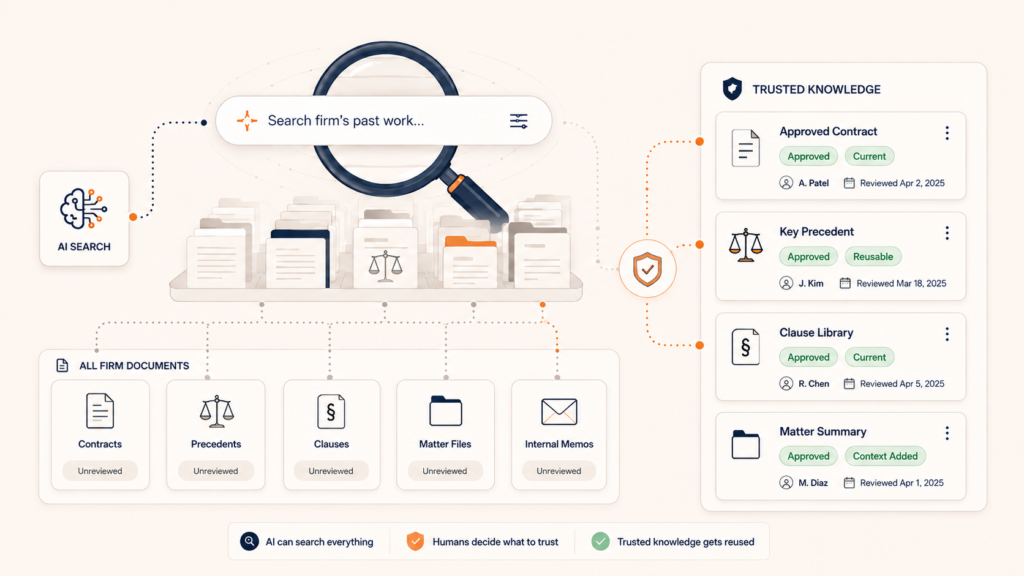
The DMS contains the full history of legal work. The KMS is meant to contain selected material with broader, longer-term value.
In other words, the goal is not to move everything the firm has saved into another repository.
Instead, a lawyer or knowledge management team can identify a useful clause, precedent, piece of guidance, or other material from existing work. A designated reviewer can check it, add the context someone would need to understand it, and approve it for wider use.
The difference is easy to miss. Epona is not trying to build a better archive. It is trying to give selected material enough context that someone can understand why it is worth using again.
That leads to a harder question: when should that decision be made?
Epona Wants Firms to Identify Useful Knowledge While Its Context Is Still Clear
Useful legal knowledge often begins as ordinary legal work.
A clause may emerge during a negotiation after several versions have been exchanged. A particular approach may prove useful enough to apply again. Someone then has to recognize that the work could help another lawyer later and preserve the context around it.
That has traditionally been difficult because knowledge management can sit outside everyday legal work. Marcel Lang, Epona’s co-founder and chief commercial officer, says legal professionals have often been expected to contribute, describe, or classify documents separately. When that process adds extra steps, client work naturally takes priority.
Epona is trying to bring the two activities closer together.
Its KMS is built on Microsoft SharePoint and designed to work alongside an existing DMS. Legal professionals or knowledge management teams can nominate useful material from their work, after which it can be reviewed and given the context needed for wider use.
The timing matters. If useful work is identified while the people involved still understand why a particular clause, argument, or approach mattered, a future lawyer does not have to reconstruct all of that history after finding the document.
Epona is moving part of that judgment from after retrieval to before material enters the firm’s reusable knowledge collection.
Once AI enters that process, the distinction becomes more important.
AI Can Help Organize Legal Knowledge, but People Still Decide What Gets Trusted
Lang describes AI as exposing existing knowledge-management weaknesses faster.
Someone manually reviewing search results may notice that a document looks old or that several versions exist. AI can process the same underlying material much more quickly, but the quality, status, and context of that material do not automatically improve with the speed of the search.
Legal teams are already using AI for this kind of work. Thomson Reuters found that 47% of legal respondents actively using generative AI cited knowledge management as a use case in 2025.
The same push is happening across enterprise software, where AI tools are increasingly being built to work across large collections of unstructured company data.
Epona gives AI a supporting role in its own process. Its KMS can suggest metadata, or information used to categorize documents, and identify similar material. However, the organization retains the final decision over what becomes trusted knowledge.
That division of labor is important. AI can reduce some of the work involved in organizing a firm’s information. But it does not have to be the system that decides which legal position the organization is prepared to reuse.
For legal teams, that control starts with being clearer about which information has been approved for wider use.
A Firm’s Own Legal Experience Becomes More Valuable as AI Gets Easier to Access
External legal information remains important. Lawyers still need legislation, case law, and research platforms to understand the law.
But those sources are available to many firms.
What competitors cannot simply buy is the experience created through the firm’s own work: how its lawyers structured transactions, approached recurring risks, negotiated particular positions, or reasoned through earlier decisions.
Corporate legal teams accumulate their own version through approved clauses, internal guidance, and previous business decisions.
That makes a firm’s internal knowledge fundamentally different from the legal information available to everyone else.
A similar pattern is emerging outside legal technology. In SaaStake’s analysis of Atlassian’s AI strategy, we saw that the advantage was not simply access to an AI model. It was the years of organizational data, workflows, and context already accumulated inside the platform.
Epona’s argument points in the same direction for legal work. AI may make information easier to use, but it cannot manufacture a firm’s history of negotiations, decisions, and preferred approaches.
The challenge is turning enough of that history into something the next person can actually use.
And selecting it once is not enough.
Knowledge That Is Approved Today Still Needs Someone Responsible for It Tomorrow
A clause can become outdated. Internal guidance can change. A position approved today may need to be reconsidered after the law, company policy, or surrounding circumstances move on.
Epona addresses that by allowing important knowledge to be assigned an owner and a review date.
The owner’s role is to help keep the material useful after it has entered the knowledge collection. That creates an important distinction between storing knowledge and maintaining it. A repository can continue holding a document indefinitely. While a maintained knowledge collection needs someone to decide whether that document still deserves the status it was originally given.
For Epona, responsibility sits with the knowledge itself. Someone still has to preserve the context around it and revisit it when circumstances change.
Epona introduced its new KMS during ILTACON 2026, ahead of a planned September release. The product arrives as law firms are gaining more ways to search, summarize, and reuse the work they have accumulated over years. But better access also raises the cost of treating every stored document as equally reliable.
That may be where knowledge management becomes more important, rather than less, in an AI-enabled firm. The value is not simply in helping AI find more of what the firm knows. It is in giving lawyers a clearer signal about what has been reviewed, why it matters, and whether it is still appropriate to use.
If AI can search almost everything a law firm has ever saved, the harder question is no longer whether the information can be found. It is deciding which parts of that history deserve to be trusted when they are found.