| TL;DR: Law firms are putting more money into AI than ever before, but buying the technology is only one part of the equation. We spoke with three Harbor leaders about what happens after firms deploy AI, and why the problems showing up now may have started much earlier. |
A 180-person law firm did what many firms are being told to do with AI. It tested a legal-specific tool for a month, trained employees on it, and then rolled it out across the firm.
And yet, average adoption reached just 40%.
The problem wasn’t that people refused to use AI. Employees struggled to see where the tool fit into parts of their everyday work. Some weren’t checking its outputs carefully enough, and the firm discovered only later that the software wasn’t compatible with its case-management system. The case was presented at the Law Society’s AI in Legal Practice Summit as an example of how much can still go wrong after an AI tool has been chosen, tested, and introduced.
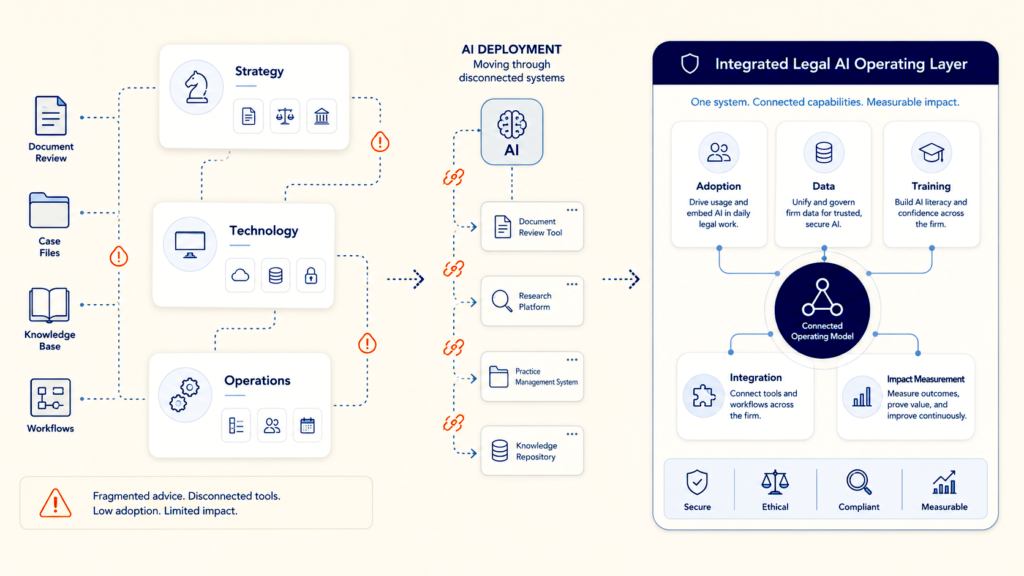
That is the part of AI adoption Harbor has been building around. The legal consulting and services company works with law firms and legal departments across strategy, technology, data, operations, and implementation, including the work required after a new system goes live.
For SaaSTake, we asked three Harbor leaders what firms are missing between buying AI and making it useful. Their answers took us beyond the rollout itself, and toward a problem Harbor had been bringing under one roof before the current AI boom.
What Happens After Everyone Gets the Login?
The 40% figure suggests that access itself isn’t the problem.
Justin Hectus, Managing Director at Harbor, thinks firms can run into trouble when they treat implementation as something that ends once the tool goes live.
“A project has a launch date, a budget, and a team that moves on once it ships,” Hectus told SaaSTake. “A capability has an owner, an ongoing measurement discipline, and accountability that continues well past go-live.”
Put simply, launching AI is an event. Making it useful is an ongoing job.
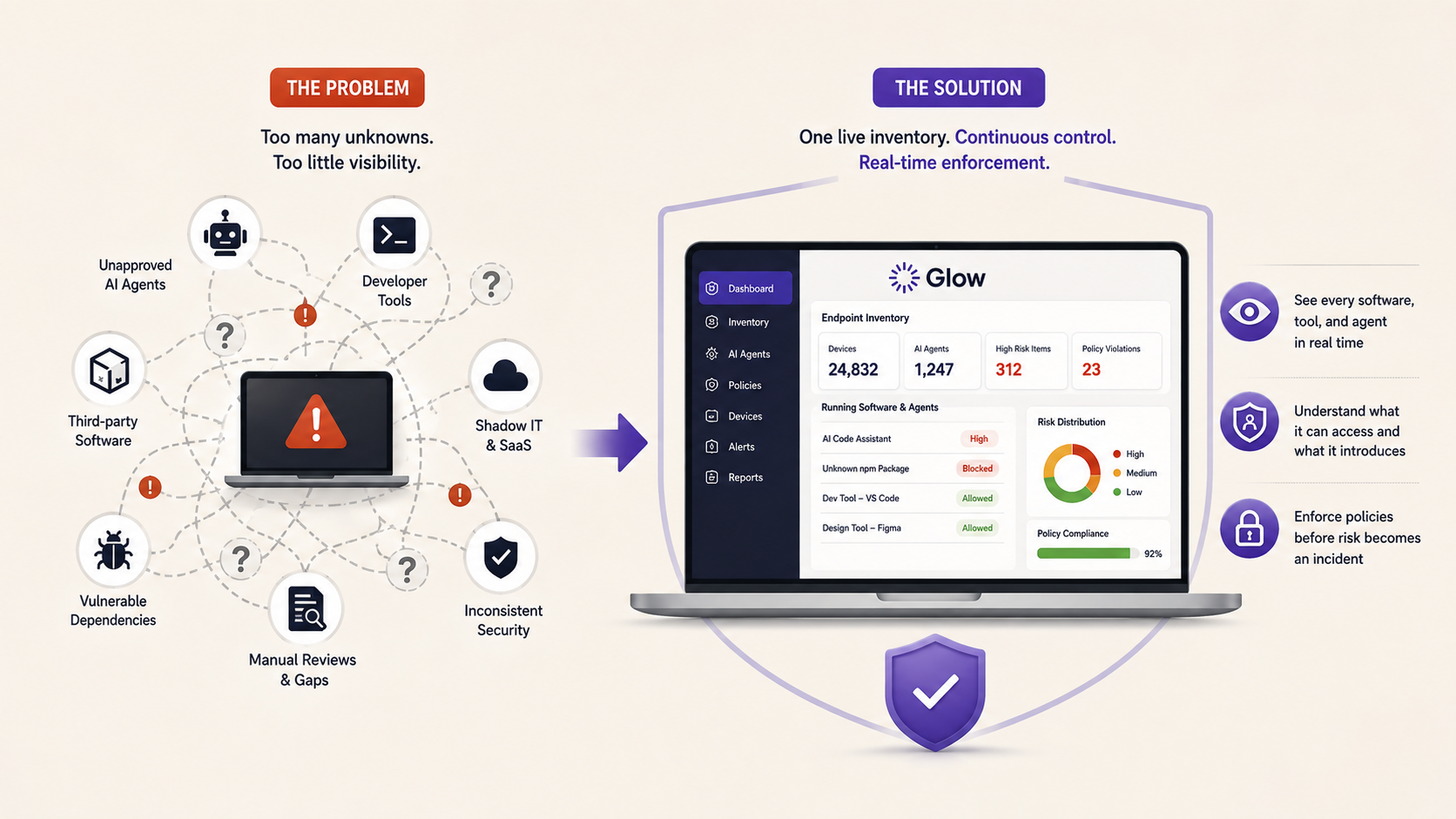
Harbor’s own research suggests many firms still cannot tell whether that investment is paying off. In its 2026 Legal Lab study on how law firms are adopting and measuring AI, firms could point to things such as licenses, training attendance, and usage. But none of the participating organizations had a mature framework for measuring whether AI was actually creating business or client value.
That is striking because firms are not holding back on the technology. Harbor found that average annual software spending rose 41% between 2021 and 2025.
Firms can increasingly answer “Did we deploy it?” The harder question is “What got better because we did?”
Hectus, however, thinks the better test comes later.
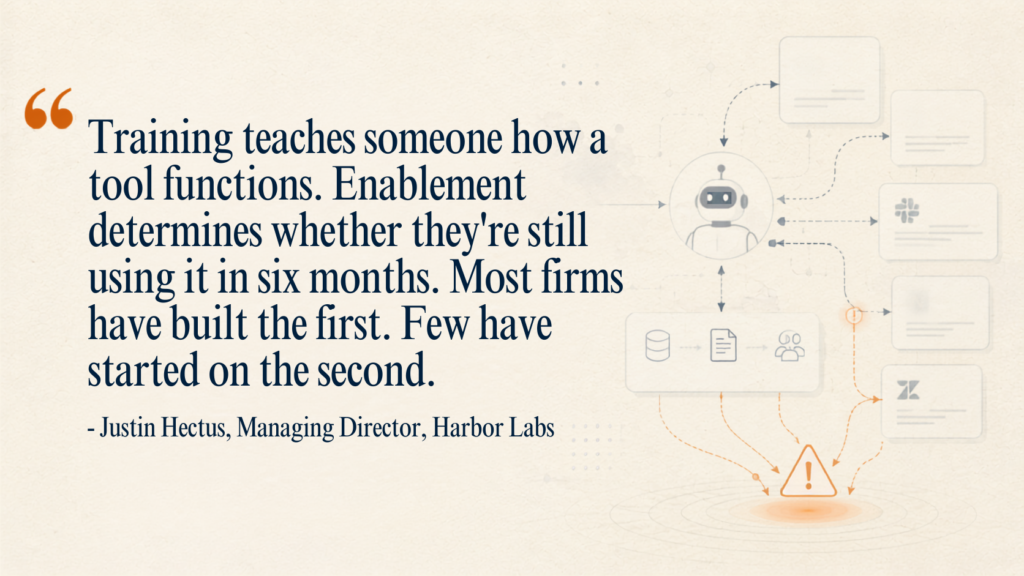
Six months is a harder test than launch day. By then, the training session is over, and the tool has had to compete with real workloads, existing systems, and the way people were already doing the job.
Which raises an earlier question: what if some adoption problems begin with decisions made before anyone gets a login?
Does the Advice Change When the Adviser Has to Make It Work?
Those questions are often answered by different people.
A consulting team may recommend the strategy. A technology provider supplies the system. Another team implements it. And once everything is live, somebody inside the firm has to make it work.
Justin Farmer, Practice Group Leader at Harbor, thinks that separation can affect more than the handoff.
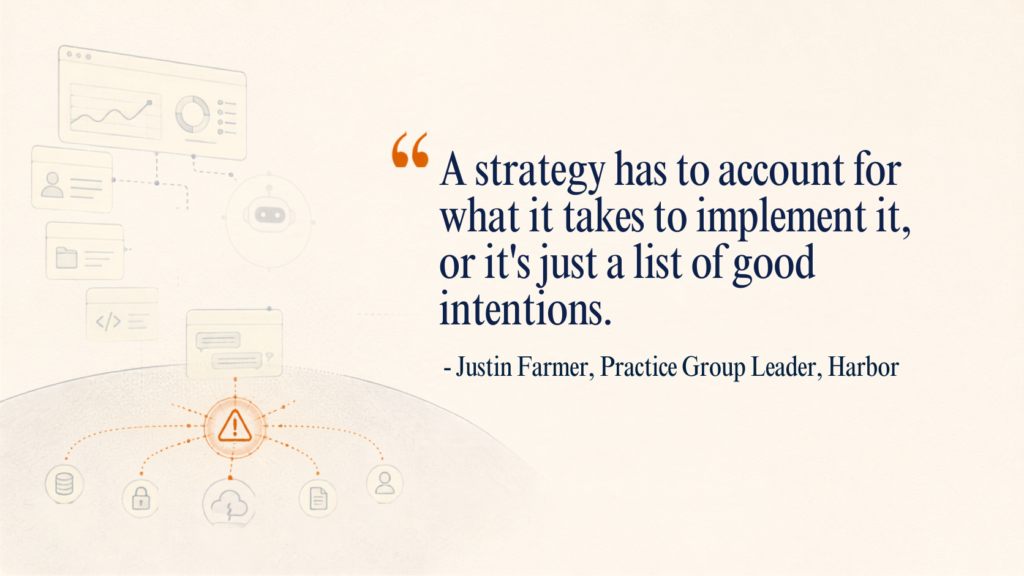
“Most firms get strategic advice from one place, the technology from another, and the operational support from a third, often stitched together after the fact,” Farmer told SaaSTake. “That fragmentation shows up in the advice itself.”
Farmer isn’t simply saying it is easier to work with one provider. His point is that knowing you will eventually have to build and run what you recommend can change the advice you give in the first place.
That idea is built into Harbor’s own history. When the Harbor brand launched in 2023, it brought together HBR Consulting, LAC Group, and Wilson Allen, businesses working across verticals such as legal strategy and operations, research and intelligence, technology, and data.
In other words, Harbor was bringing those pieces together before the current AI boom made the gaps between them much harder for firms to ignore.
Harbor has continued adding to that model. In July, it acquired legal technology training specialist iTrain, bringing training and AI enablement further into the same structure.
Which raises another broader question: is AI creating a new implementation problem, or exposing one that was already there?
What Do an AI Rollout and a Law Firm Merger Have in Common?
AI isn’t the only place where a project can look finished before the difficult part is actually over.
Harbor had eleven sessions at ILTACON this year. On the agenda, they looked remarkably different. There were conversations about AI and data, but also mergers, change management, taxonomies, and marketing technology.
We asked Brooke Daniels, Harbor’s Senior Vice President of Marketing, what connected them.
“Stand back from all eleven sessions, and they look like they’re about different things,” Daniels told SaaSTake. “Look closer, and they’re the same argument told from different seats.”
Take a merger, for instance. The deal can close on a particular date. That doesn’t mean two firms suddenly have compatible systems, connected data, or people working in the same way the next morning.
An AI rollout can reach the same kind of milestone. The milestone is real. It just isn’t the whole job.
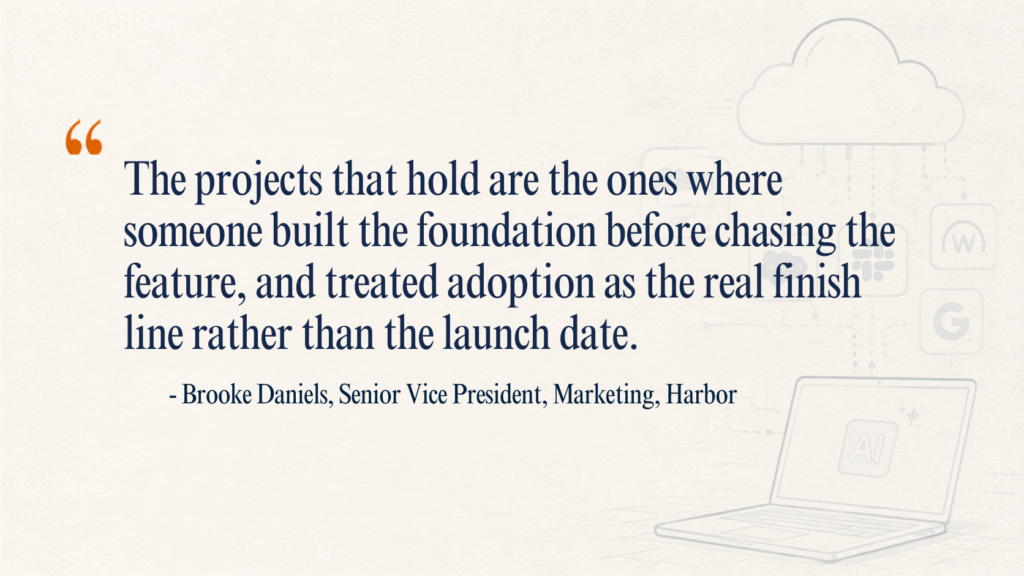
Data makes the problem tangible. A firm can have years of useful information, but not in a form its AI can reliably find or use. Harbor Connect is designed to connect and govern that existing information rather than requiring firms to start again.
There is an important detail in Daniels’ answer, though. She isn’t arguing that firms should stop everything and rebuild a perfect technology foundation before touching AI.
“That also means meeting a firm exactly where it is today, with whatever data and systems it’s already running, rather than insisting on an idealized rebuild before anything else can move,” she told SaaSTake.
That gives “AI-ready” a much more practical meaning: start with the firm that actually exists.
Seen that way, AI hasn’t invented an entirely new challenge for law firms. It has made an old one much easier to see.
Why Are AI Companies Moving Beyond the Model?
Harbor is not the only one paying more attention to what happens after a company gets access to AI.
TechCrunch reported this summer that forward-deployed engineers, specialists who work directly with customers to fit AI into their systems and workflows, have become some of the industry’s most sought-after hires.
OpenAI has been moving in a similar direction. In February, it partnered with consulting firms to help companies turn AI experiments into working deployments.
The interesting part is the direction of travel. AI companies started with the model and are moving closer to the organization. Harbor started inside the organization and is moving closer to the model.
Harbor Deploy, launched this month, is where those two directions meet. Harbor embeds teams with law firms and legal departments to move AI from pilot into everyday use without tying that work to a particular model or platform.
What Happens If AI Keeps Changing?
Harbor Deploy is built for a market where today’s AI choice may not be tomorrow’s. Because it is not tied to one model or platform, Harbor can stay with the firm as the technology changes.
That could make each new AI decision less disruptive. Instead of rebuilding the strategy, data, workflows, and support around every new tool, firms can build on what they already have.
If AI keeps changing as quickly as it is now, that gives Harbor a clear advantage: Being the tool ready for whatever comes next.